
For close to two decades, the third-generation Pontiac Firebird sat in an awkward spot in the collector world. Too modern for the muscle car crowd chasing 1969 Trans Ams, too common to feel scarce, and too tied up with digital dashboards and the "Screaming Chicken" hood decal to be taken seriously by anyone who hadn't grown up watching Knight Rider reruns. That has changed. The gen3 firebird collectible market has firmed up noticeably over the past several years, and the reasons are documented in production records, not just nostalgia.
Car Features
7 min read
Gen3's Rising Collector Status
The third-generation Firebird spent years as an overlooked commuter classic, but production records and the 1989 Turbo Trans Am are reshaping how collectors value it today.
A generation built in volume, not scarcity
Pontiac built the third-generation Firebird from 1982 through 1992, and it sold in real numbers. Total production across the run came to roughly 819,000 units, with the Trans Am and Formula trims carrying the performance mandate while base coupes handled fleet and commuter duty. That volume is exactly why collectors avoided the car for so long. When something was parked in every mall lot in 1985, it does not feel rare in 1995, or even 2005.
What has shifted is attrition. Third-gen Firebirds were driven hard, modified freely, and treated as disposable performance cars well into the 2000s. Rust claimed the ones that lived through Midwest winters. Teenagers wrecked a large share of the turbocharged and 5.0-liter cars. The survivors that remain unmodified, with factory drivetrains and intact interiors, are a much smaller pool than the original build sheet suggests. Factory records from Pontiac's Pontiac, Michigan assembly operations show build codes that let researchers verify original engine and options packages, and that documentation is now doing real work in the market.
The Turbo Trans Am changed the conversation
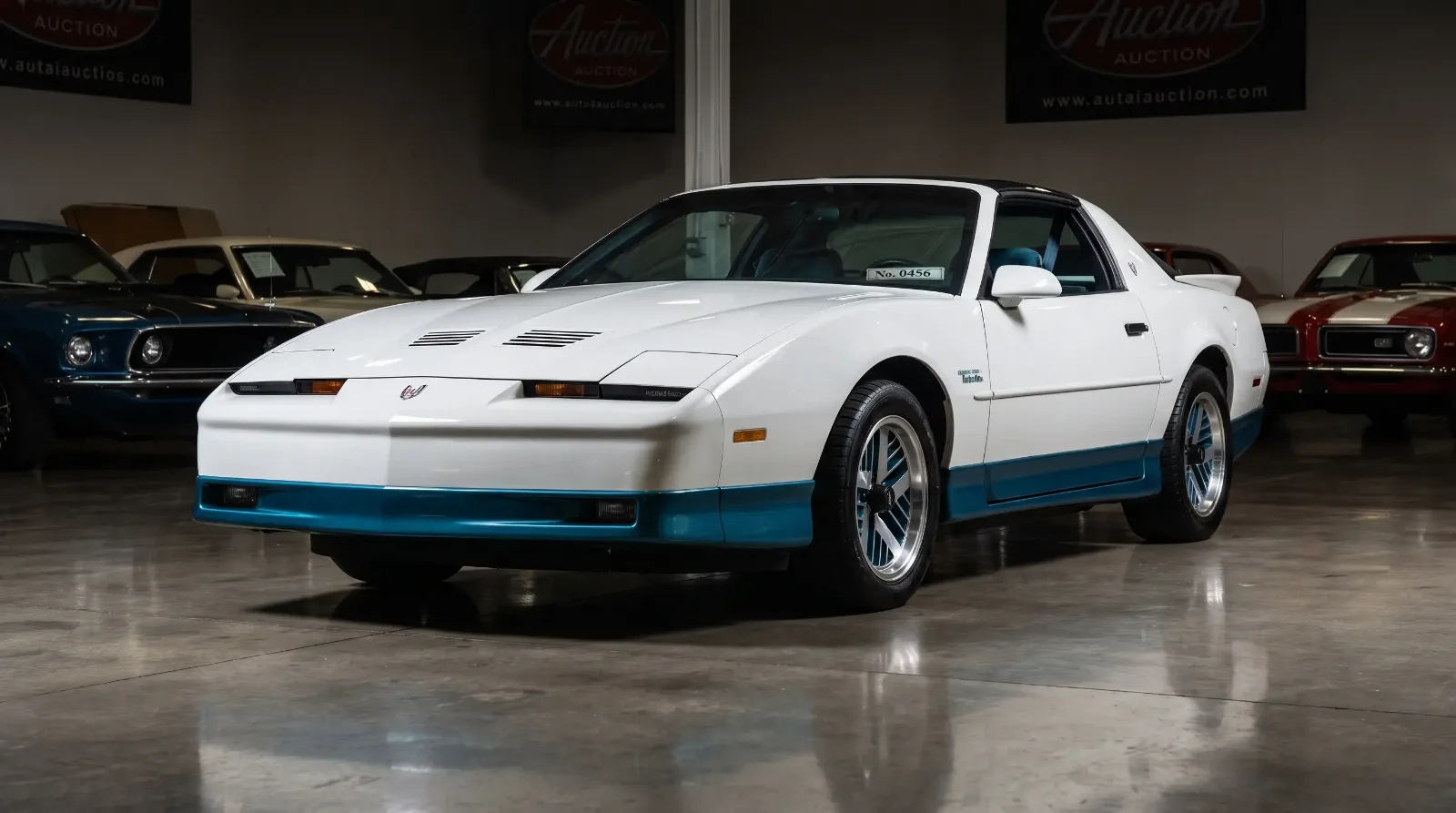
No single third-gen model did more to legitimize the era than the 1989 20th Anniversary Turbo Trans Am. Pontiac built it to celebrate two decades of the Trans Am nameplate, fitting a turbocharged and intercooled 3.8-liter V6 borrowed from Buick's Grand National program in place of the expected V8. Output was rated at 250 horsepower and 340 lb-ft of torque, a genuinely quick figure for 1989, and Pontiac limited production to 1,555 cars finished in Circle Track white over dark aqua with a numbered dash plaque.
That car did two things for the third generation. First, it proved a Pontiac-badged F-body from this era could be quick enough to matter to collectors who cross-shop Buick Grand Nationals and turbocharged Mustangs. Second, its low production numbers gave researchers and appraisers a template for documenting rarity within a generation that otherwise reads as common. Once buyers understood that a 1989 Turbo Trans Am is a different animal from a base 1985 coupe, they started asking the same production-code questions about GTAs, Formula 350s, and the WS6 handling package cars.
"People assume every third-gen looks the same from the parts counter, but the build sheet tells a completely different story depending on the month it rolled off the line. Learn to read a Pontiac Service Parts Identification label and the car in front of you stops being generic."
Tom Ramirez
GTA, WS6, and the options that separate cars
Pontiac introduced the GTA trim for 1987, pairing the 5.7-liter TPI V8 with a sport-tuned suspension and unique wheels, and it ran through the end of production in 1992. The GTA is where a lot of gen3 firebird collectible interest concentrates today, because it combines the strongest available naturally aspirated drivetrain with trim-level scarcity that base Trans Ams do not have. The WS6 Performance Package, meanwhile, added specific springs, larger anti-roll bars, and 16-inch wheels, and it is documented on the build sheet rather than advertised with a badge, which means plenty of cars on the market get misidentified in either direction.
For anyone researching a specific car, the production data is not folklore. It exists in Pontiac's own documentation and in registries that cross-reference VINs against known build numbers.
| Trim / Package | Years Offered | What Sets It Apart |
|---|---|---|
| Trans Am GTA | 1987-1992 | 5.7L TPI V8, unique suspension tuning, GTA-specific wheels |
| 20th Anniversary Turbo TA | 1989 only | Turbocharged 3.8L V6, limited build run, numbered plaque |
| WS6 Performance Package | 1982-1992 (intermittent) | Upgraded springs, bars, and wheel/tire package |
| Formula | 1982-1992 | V8 performance without the Trans Am body addenda |
What the auction floor is showing
Public auction results over the last several years back up what dealers and club members have been saying anecdotally. Clean, unmodified 1989 Turbo Trans Ams and well-documented GTAs with verifiable history have generally commanded stronger prices than rough or undocumented examples of the same cars, and the spread between a rough driver-quality third-gen and a documented, low-mile example has widened considerably. That widening spread is itself a sign of a market maturing rather than simply inflating across the board. Buyers are no longer treating every third-gen the same way, and sellers who can produce a Pontiac Historical Services report or an original build sheet are being rewarded for it at the gavel.
Regional car clubs dedicated to the third generation have also grown steadily, and that community infrastructure, judging classes, technical registries, model-specific parts networks, tends to follow rising collector interest rather than create it. Clubs formed around the second-generation Trans Am decades ago for the same reason, once that generation's values started climbing enough to justify the organizational effort.
What documentation buys a buyer today
The practical lesson for anyone shopping this generation now is that paperwork moves prices more than it used to. A GTA or Turbo Trans Am with its original window sticker, dealer invoice, or a matching Pontiac Historical Services report commands a real premium over an otherwise identical car with no history. Cars that already appear in this market and carry that kind of documentation are exactly the ones worth chasing, and readers who want more context on how this generation fits into the Firebird's overall arc should look at the third-gen Firebird for the fuller model history, or take another angle on how the 1982 redesign itself came together.
None of this means every third-gen coupe sitting in a driveway is suddenly a blue-chip investment. Base V6 cars and automatic-equipped coupes without options are still affordable, everyday-usable classics, and that is a feature of this market, not a flaw. It simply means the ceiling on the genuinely rare, well-documented cars at the top of the range, the GTAs, the WS6-equipped Trans Ams, and above all the 1989 Turbo Trans Am, has moved upward in a way that reflects real scarcity rather than hype.
Values still have room to move before this generation catches up to the second-gen Trans Ams that dominated collector attention through the 1990s and 2000s, but the gap is closing. Buyers who understand build codes, options packages, and the difference between a numbers-matching GTA and a re-badged base car are the ones positioned well as that gap continues to close.
Sources and notes
- Pontiac Firebird (third generation) - Wikipedia
- Classic Classified: 1989 Pontiac Trans Am 20th Anniversary - Hagerty Media
- 1989 Pontiac Firebird Trans Am GTA - Hagerty Valuation Tools
- TurboTransAm.com - 1989 Pontiac Turbo Trans Am 20th Anniversary Registry
- 1987 Pontiac Firebird Trans Am GTA - HowStuffWorks
- One Fast Bird: Looking Back At Pontiac's '89 Turbo Trans Am - Street Muscle
Related Reading

Have a
Pontiac Firebird
for Sale?
Reach thousands of serious classic car collectors across the US.
Sell It Here →
Are You a Classic Car Dealer?
List your full inventory and connect with targeted classic car buyers.
Join as a Dealer →

About the author
Tom Ramirez
Corvette researcher and historian based in Bowling Green, Kentucky. Two decades documenting Corvette production history from original factory records.
Related Listings - Pontiac Firebird
Comments
Be the first to comment on this article.