
The Firebird's base engine in 1967 was not the ordinary inline six that Pontiac buyers might have expected. It was a 230 cubic inch overhead cam six, an unusual and expensive piece of engineering for what was supposed to be the economical end of the lineup, and in Sprint form with a four barrel carburetor it became one of the more interesting engines Pontiac ever put into production. Understanding why Pontiac built it at all says as much about the division's engineering culture in the mid-1960s as anything in the Firebird's styling.
Car Features
6 min read
The Overhead-Cam Sprint Six
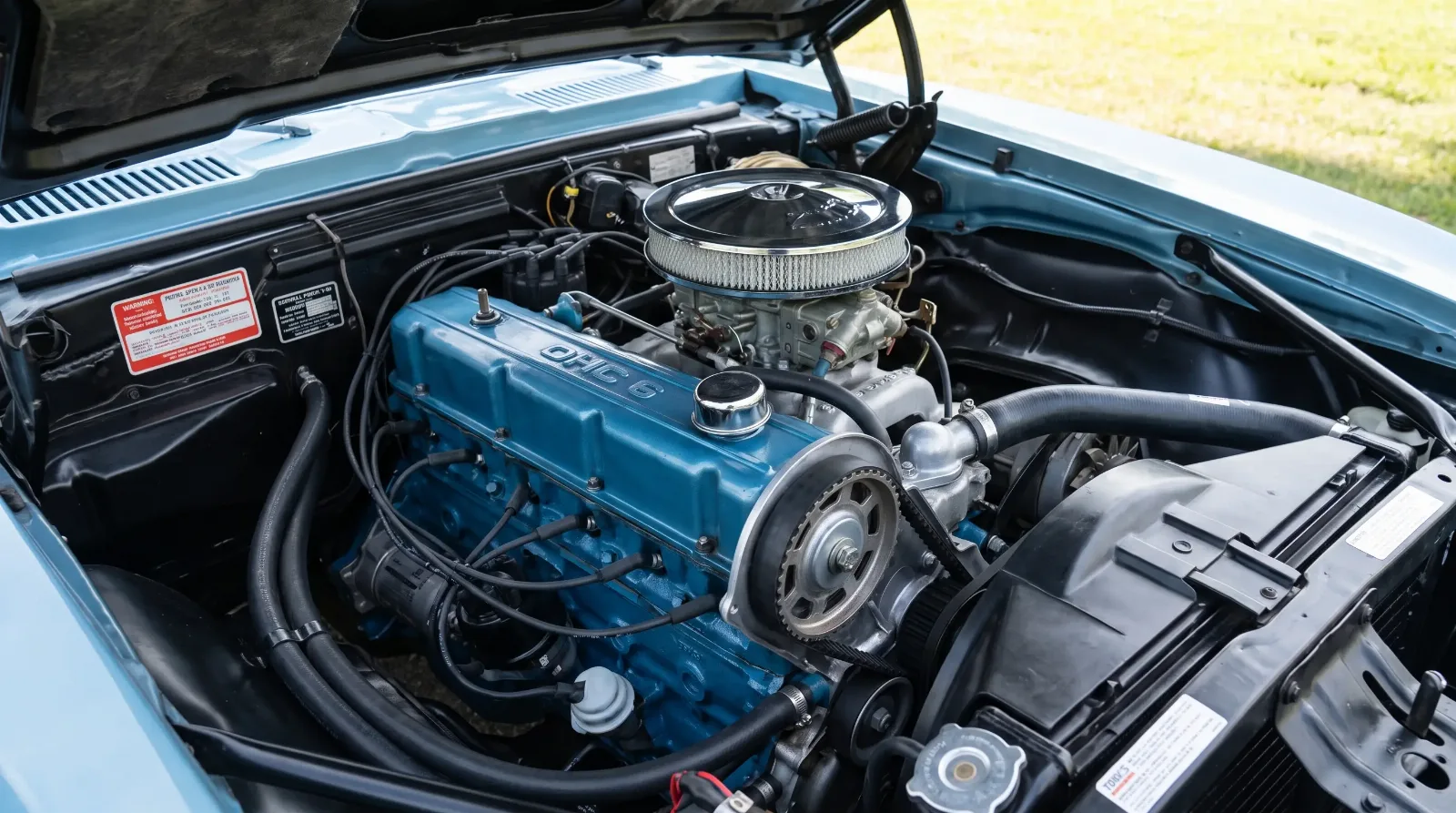
The Firebird OHC Sprint Six paired a belt-driven overhead cam head with Pontiac's existing six cylinder block, chasing European-style refinement in a market that still equated performance with V8 badges.
Why Pontiac bothered with an overhead cam six
Almost every American six cylinder engine on sale in 1967 used a pushrod valvetrain, the same basic layout Detroit had relied on for decades because it was cheap to build and easy to service. Pontiac's chief engineer, John DeLorean, and his engineering staff wanted something that could compete on refinement with European sixes, particularly the smooth, higher revving units found in cars like Mercedes-Benz sedans, without abandoning the cost structure of a mass production Detroit six. The answer was to keep the existing 230 cubic inch six's basic bottom end and cylinder block, largely shared with other Pontiac sixes, and top it with a new overhead cam cylinder head. For the wider context of how this engine choice fit into the car's launch, how the Firebird began lays out the full debut story.
A belt driven cam in an era of chains and gears
The detail that made Pontiac's engineers proudest, and made some dealers nervous, was the camshaft drive. Rather than a timing chain or gear set, the OHC six used a one-inch-wide fiberglass-reinforced, neoprene-impregnated nylon fabric belt, developed with Uniroyal engineer Richard Case, to turn the overhead camshaft, a genuinely novel choice for a mass production American engine in this period. Critics worried publicly that a rubber belt could not survive normal service life, and Pontiac's engineers spent considerable effort proving otherwise, with test engines reportedly running 100,000 miles or more without a belt change. The belt drive kept valvetrain noise down and allowed higher engine speeds than a comparable pushrod six, which mattered because the whole point of the design was refinement at revs a standard six could not reach cleanly.
Standard six versus the Sprint upgrade
| Version | Carburetion | Horsepower | Notes |
|---|---|---|---|
| Base OHC six | One barrel | 165 hp | Standard equipment, entry level Firebird |
| Sprint OHC six | Four barrel | 215 hp | Optional, higher lift cam, dual exhaust available |
The Sprint package added a four barrel carburetor, a revised camshaft profile with more lift and duration, and in most applications dual exhaust, pushing output from 165 horsepower in base form to 215 horsepower. Compression climbed with it, from 9.0:1 on the base engine to 10.5:1 on the Sprint head. That put the Sprint six within reach of the smaller 326 cubic inch V8 in a straight line while offering a noticeably different character behind the wheel: smoother at higher rpm, quieter at idle, and lighter over the front wheels than either V8 option, which showed up in the car's handling balance.
Why buyers were skeptical anyway
Tom Ramirez has spent time with Pontiac's own service bulletins from this period, and the picture they paint is one of an engine that performed as promised but fought an uphill battle against buyer expectations shaped by decades of V8 marketing. A six cylinder engine, however sophisticated, carried a stigma in a market where displacement and cylinder count sold cars at the dealership. Belt drive skepticism did not help, even after the engineering proved sound in service.
"The OHC six did everything Pontiac's engineers claimed it would do, and it still could not out-market a V8 badge on the fender. That tells you more about 1967 buyers than about the engine."
Tom Ramirez
Buyers who wanted the muscle car experience gravitated toward the V8 lineup instead, a path covered directly in keep reading the series, which picks up with the 400 cubic inch option that most 1967 performance buyers actually chose.
Dealer technicians in 1967 had decades of experience with pushrod sixes and V8s, and the OHC six's belt driven overhead cam asked them to learn a genuinely new maintenance routine. Belt tension checks and eventual belt replacement were unfamiliar procedures for most shop floors, and Pontiac had to train service departments on a component that simply did not exist on any other American production engine at the time. Period service literature gave no fixed mileage figure for replacement, calling instead for periodic inspection and replacement as a wear item, which left individual dealers to judge belt condition largely on their own. That training gap mattered more than Pontiac's engineers probably expected, since a service advisor who was uncertain about a repair procedure was unlikely to talk a nervous customer into the Sprint six over a familiar V8.
The engine's aluminum die cast timing cover and composite cambelt tensioner were also more expensive to manufacture than a comparable pushrod valvetrain, narrowing the cost advantage the OHC six was originally meant to offer over a small V8. Pontiac's own engineering staff considered the design a technical success on its own terms, and much of what they learned building the belt drive system fed into later Pontiac engine programs, even after the OHC six itself was retired.
Why it did not last
Pontiac kept the OHC six in production through 1969 with a larger 250 cubic inch version added along the way, but rising emissions requirements, the added manufacturing cost of the overhead cam head and belt drive relative to a conventional pushrod six, and persistently soft demand relative to V8 models led the division to phase it out. By the early 1970s Pontiac had returned to a more conventional pushrod six for its base engine needs. The OHC design remains, decades later, one of the more genuinely inventive American sixes of its era, and a useful reminder that the Firebird's lineup was never just about the V8s. For the complete picture of that lineup and everything that followed it, the complete Firebird guide covers all four generations, and buyers curious about the car in person can browse first-gen Firebirds for sale to see how many OHC six cars survive against their V8 siblings today.
Sources and notes
- Ate Up With Motor: Cammer, The Pontiac OHC Six (belt development)
- Ate Up With Motor: Cammer, The Pontiac OHC Six (specifications)
- Wikipedia: Pontiac straight-6 engine
- Curbside Classic: 1967 Firebird with the OHC inline-six
- OnAllCylinders: Pontiac's Innovative OHC Sprint Inline 6
- Midwest Firebirds: The Sprint 6, The Little Engine that Could
Related Reading
Have a
Pontiac Firebird
for Sale?
Reach thousands of serious classic car collectors across the US.
Sell It Here →
Are You a Classic Car Dealer?
List your full inventory and connect with targeted classic car buyers.
Join as a Dealer →

About the author
Tom Ramirez
Corvette researcher and historian based in Bowling Green, Kentucky. Two decades documenting Corvette production history from original factory records.
Related Listings - Pontiac Firebird




Comments
Be the first to comment on this article.