
The Impala emblem history starts in the same 1958 design offices that gave the car its name, and the two decisions were never really separate from each other. Once Chevrolet's planners settled on an African antelope as the inspiration for the new trim level, the styling department had to figure out how to render that animal as a piece of chrome small enough to sit on a grille, a hood, or a rear quarter panel without looking cartoonish. What they landed on, a stylized leaping antelope caught mid-bound, became one of the most recognizable badges Chevrolet ever produced, and it went through more revisions over the following decades than most owners realize.
Car Features
6 min read
The Impala Emblem and Its Origins
The Impala emblem history begins with the 1958 debut year, when Chevrolet's stylists rendered the car's antelope namesake as chrome badging that evolved over decades but never lost its leaping silhouette.
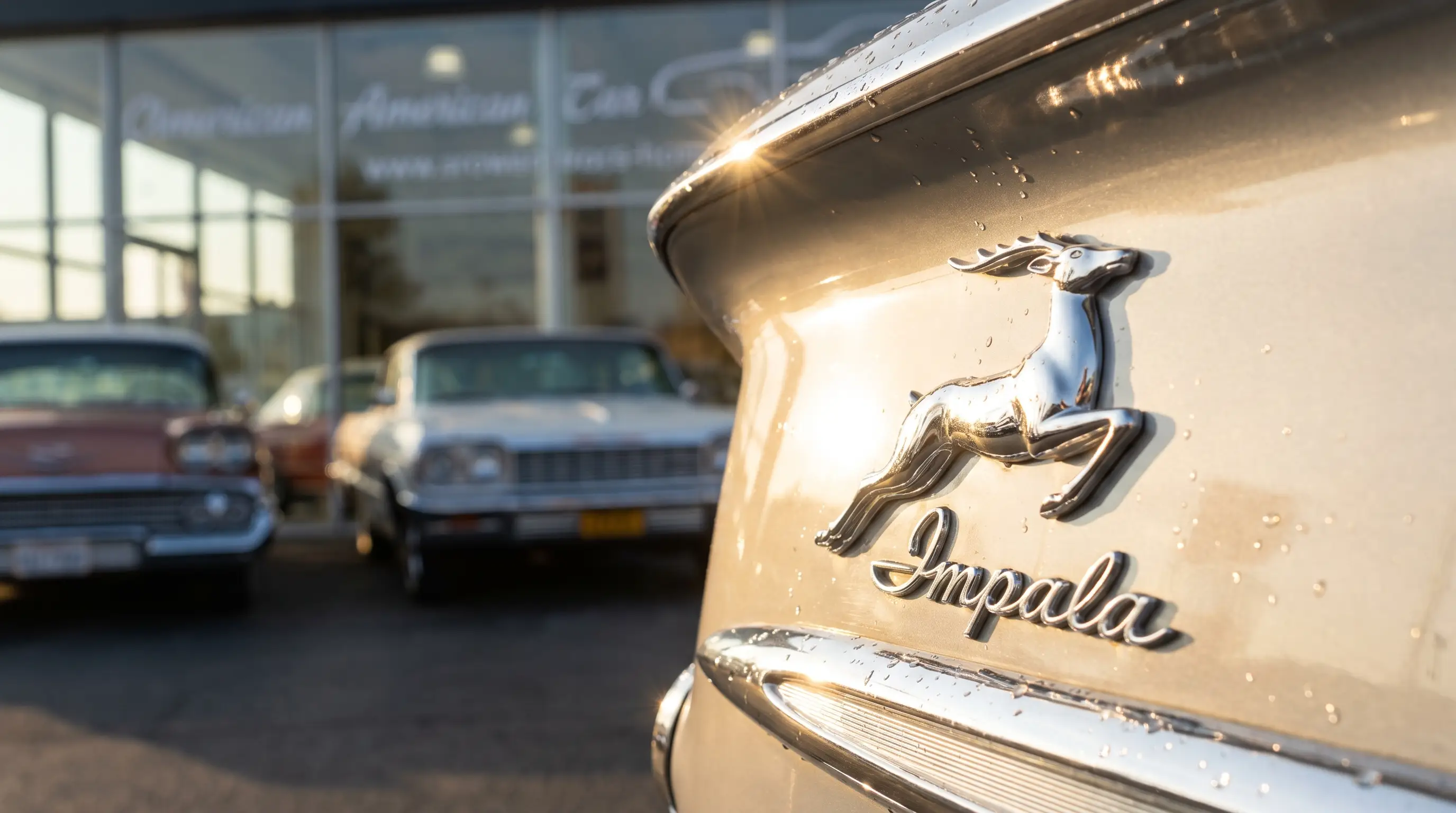
Understanding the emblem's development matters for a practical reason beyond simple trivia. Collectors and restorers regularly need to identify which emblem variant belongs on which model year, and getting it wrong is one of the more common mistakes made on cars that have had trim swapped in over the years from a different model or even a different make entirely.
The first emblem and what made it distinct
The 1958 debut year emblem depicted the antelope in a running or leaping pose rendered in chrome, mounted prominently enough to serve as an identifying mark on a car that, that year, was still officially a Bel Air sub-series rather than a standalone model. Chevrolet's stylists wanted the badge to do real work in a crowded showroom, differentiating the new Impala trim from standard Bel Airs at a glance even before a buyer noticed the triple taillights or the upgraded interior. The emblem appeared on the grille, on badging inside the cabin, and in some configurations on the rear deck as well, giving the new trim level visual signatures in multiple places rather than a single badge alone.
Chevrolet's commitment to the imagery went beyond the emblem itself. Dealership signage, print advertising, and even some dashboard trim incorporated variations of the leaping animal motif, reinforcing a single consistent piece of iconography across nearly every customer touchpoint rather than treating the badge as an isolated design detail.
How the emblem changed as the car evolved
When Chevrolet redesigned its full-size lineup for 1959 and promoted Impala into its own standalone model line, the emblem evolved along with the rest of the car's identity. Later model years refined the antelope's pose and proportions, and by the mid-1960s, when Impala had become the best selling car in America, the badge had been simplified in some applications while retaining the same leaping silhouette that buyers had come to associate with the name since 1958. Those year-to-year variations are subtle enough that casual observers rarely notice them, but they are exactly the kind of detail concours judges and serious restorers check closely.
The emblem's persistence across so many redesigns says something about how much value Chevrolet placed in the imagery itself, independent of whatever body style or trim level it happened to be attached to in a given year. Few automotive badges survived multiple full platform redesigns with their core visual identity so clearly intact.
"The emblem changed shape a dozen times over the decades, but Chevrolet never once considered dropping the antelope. That tells you how much the badge itself had become the brand, separate from any single model year."
- Tom Ramirez
Why emblem accuracy matters to collectors
Because the emblem varied by model year, and because reproduction parts of varying quality have circulated for decades, verifying that a car wears its correct original badge is a meaningful part of assessing authenticity on any classic Impala. A 1958 emblem does not belong on a later car, and vice versa, yet mismatched badges show up often enough on cars that have passed through several owners and partial restorations that buyers should check emblem details carefully rather than assume the badge on a car matches its stated model year. Anyone researching 1958 impala history in depth will find the emblem is one of the more reliable, checkable details available for confirming a car's stated year and trim.
Readers interested in the broader marketing story behind the badge, including how Chevrolet built entire ad campaigns around the leaping figure, can find a related story covering that side of the history in more depth. For buyers currently comparing what is on the market, checking emblem condition and correctness is worth doing before finalizing any purchase, and a look at Impalas for sale now shows how much emphasis serious sellers place on documenting original trim.
Where the emblem shows up beyond the badge itself
The antelope figure was never confined to a single mounting point on the car. Depending on the model year, Impala buyers could find the motif worked into steering wheel horn buttons, door sill plates, floor mats, and even key fobs supplied by the dealer at delivery. That level of saturation across the whole ownership experience, rather than just the exterior, reflects how thoroughly Chevrolet wanted the imagery associated with the car in every context a buyer might encounter it. Few nameplates from the same era received that kind of comprehensive treatment across interior trim, and it is part of why so many small emblem-bearing parts, not just the grille badge, have become collectible in their own right.
That saturation cuts both ways for today's restorers. On one hand, a well preserved original car often has more surviving points of reference to confirm correct emblem detailing than a single badge alone would provide. On the other hand, it means there are simply more small parts that can go missing, get swapped, or get replaced with incorrect reproductions over sixty-plus years of ownership, which is exactly why thorough documentation matters so much when assessing originality on a car carrying this level of small-part detail.
A small detail that carries real weight
The Impala emblem is easy to treat as a minor design flourish next to bigger topics like engine options or body styles, but its consistent presence across more than two decades of production says something meaningful about how Chevrolet managed the nameplate's identity over time. A badge that started as a way to distinguish a new Bel Air trim in 1958 ended up outlasting nearly everything else about that debut year car, and it remains one of the clearest, most checkable signals of authenticity for anyone evaluating a classic Impala today. Whatever else changes on a well restored example, from paint to upholstery to drivetrain, the emblem is one of the few details that should look exactly the way Chevrolet built it, and buyers who take the time to check it closely rarely regret the effort, and sellers who can document original emblem provenance are usually the first to point it out.
Sources and notes
Related Reading
Have a
Chevrolet Impala
for Sale?
Reach thousands of serious classic car collectors across the US.
Sell It Here →
Are You a Classic Car Dealer?
List your full inventory and connect with targeted classic car buyers.
Join as a Dealer →
#1958 impala
#Chevrolet Impala history
#Impala emblem
#classic Chevrolet badges
#restoration authenticity

About the author
Tom Ramirez
Corvette researcher and historian based in Bowling Green, Kentucky. Two decades documenting Corvette production history from original factory records.
Related Listings - Chevrolet Impala
Comments
Be the first to comment on this article.