
1958 Impala advertising had a specific job that most car marketing of the era did not, convincing buyers that a brand new sub-series within the familiar Bel Air lineup was worth paying a premium for, without the benefit of years of established reputation to lean on. Chevrolet's marketing department approached that challenge by leaning hard into the car's newness itself, its lower stance, its quad headlights, and its distinctive triple taillights, treating the Impala as the clearest physical evidence of everything the company claimed had changed for the new model year. It was, in effect, advertising built to sell a concept as much as a car.
Car Features
6 min read
Selling the 1958 Impala
1958 Impala advertising sold status and styling ahead of specifications, using the convertible's image and dealer-level reinforcement to justify a premium over ordinary Bel Air trims.
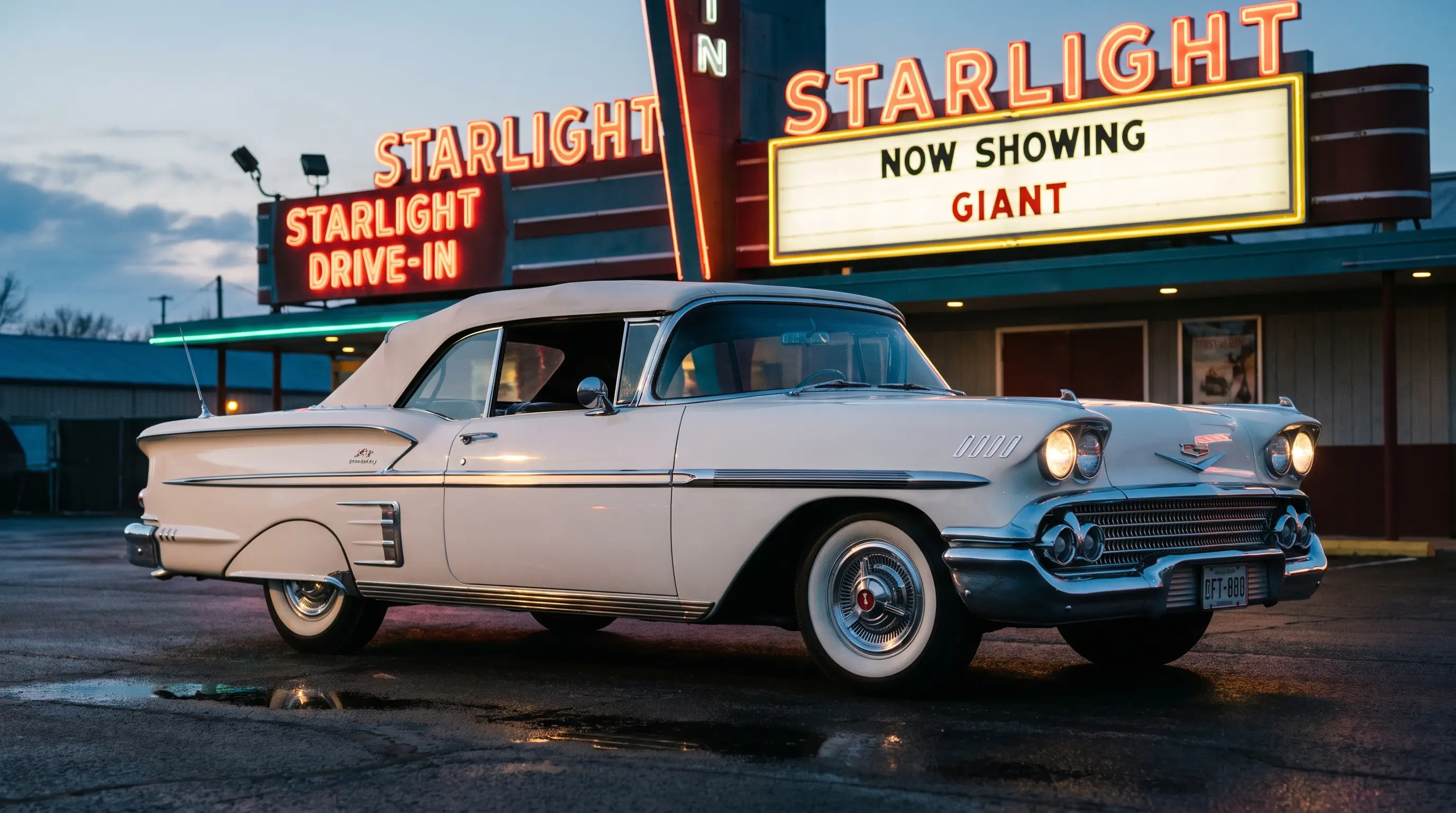
Reading period print campaigns for the 1958 Impala today reveals a marketing strategy built around visual novelty first and specific feature claims second, a sensible approach given that the car's actual mechanical advantages, a new frame and a new range of engines, were harder to photograph and explain than a longer, lower silhouette against a dramatic backdrop.
Selling a trim level as a destination in itself
Because Impala was technically a Bel Air sub-series in 1958 rather than its own standalone model, Chevrolet's advertising had to work harder than it would for an entirely new nameplate to convince buyers the Impala badge represented something meaningfully different rather than simply an expensive Bel Air option box to check. Print ads and dealer materials from the year leaned on language emphasizing exclusivity and distinction, pairing images of the Sport Coupe and Convertible with copy that positioned Impala buyers as choosing something set apart from ordinary Chevrolet ownership. That distinction mattered because Chevrolet needed the campaign to justify a real price premium over a comparably equipped Bel Air, not just a badge difference.
The convertible carried an outsized share of that advertising weight, appearing in national print campaigns far more often than the Sport Coupe despite selling in smaller numbers. That imbalance between advertising emphasis and actual sales volume was a deliberate choice, using the more dramatic open-top body style to sell the aspirational idea of Impala ownership even to buyers who would ultimately choose the cheaper, more practical hardtop.
What the campaigns emphasized, and what they left out
1958 Impala advertising rarely dwelled on hard mechanical specifics like horsepower figures or frame construction details, preferring instead to describe the car in terms of feeling, presence, and status. That approach reflected broader trends across the industry in the late 1950s, when styling and image increasingly drove new car marketing more than raw specification sheets did, but it also suited Chevrolet's specific challenge of selling a car whose most significant engineering change, the new X-frame chassis, was invisible to a showroom customer and difficult to dramatize in a magazine spread.
What the campaigns did emphasize consistently was the car's lower, wider stance compared to the 1957 models it replaced, along with its distinctive rear treatment and available big-block power for buyers who wanted a performance angle alongside the styling pitch. That combination, style first with performance as a secondary hook, became something of a template for how Chevrolet marketed the Impala nameplate in the years that followed, even as the car itself grew into its own standalone model line.
"Chevrolet's 1958 campaigns weren't selling a frame or a horsepower number, they were selling the feeling of stepping up. The engineering story came later, once buyers already wanted the badge."
- Sarah Whitfield
Why the advertising history still matters
For anyone researching the 1958 model year in depth, period advertising remains one of the most useful primary sources available, offering direct insight into how Chevrolet itself wanted the car understood at the time rather than relying solely on retrospective analysis written decades later. Readers exploring the whole picture of the debut year will find that the advertising strategy explains as much about the car's initial reception as its engineering specifications do, since buyer expectations in 1958 were shaped as much by what they saw in magazines and showrooms as by what was actually under the hood.
That period marketing material also carries direct collector value today. Original print advertisements, dealer brochures, and showroom materials from 1958 are actively collected alongside the cars themselves, and documented advertising ephemera can add meaningful context, and occasionally value, to a well restored example. Buyers comparing current listings can find a classic Impala and see how often period-correct documentation, including original sales literature, factors into how sellers present their cars.
How dealers carried the message beyond print
National magazine campaigns told only part of the story. Individual dealerships played an outsized role in 1958 Impala advertising through window displays, showroom standees, and local newspaper inserts that echoed the national message while adapting it to local markets. Salespeople were trained to lead with the Impala's status positioning first, then walk interested buyers toward whichever body style and drivetrain combination actually fit their budget, a technique that let dealers use the halo car to sell against Bel Air and Biscayne inventory that otherwise carried thinner margins. That dealership-level reinforcement mattered as much as the national print campaigns in convincing skeptical buyers that the Impala badge represented a genuine step up rather than a marketing gimmick layered onto a familiar car.
Regional dealer associations sometimes ran their own supplementary campaigns as well, particularly in markets where Pontiac and Oldsmobile competition was strongest, tailoring the national message with local pricing and financing terms that a single nationwide campaign could not address. That layered approach, corporate advertising setting the tone and dealers filling in the specifics, is a pattern researchers see across the industry in this period, but it is especially well documented for the 1958 Impala precisely because so much dealer material survives in collector archives today.
A campaign that outlived its model year
Though the specific 1958 print campaigns were retired once Chevrolet redesigned the Impala for 1959, the marketing template they established, style and status first, engineering as a supporting argument, carried forward through the nameplate's rise to becoming America's best selling car by the middle of the following decade. The 1958 advertising push is easy to overlook next to the bigger sales numbers that came later, but it set the tone for how Chevrolet would sell every Impala that followed for years afterward. Look closely at Impala campaigns from the mid-1960s and the same basic pitch is still there, aspiration and status ahead of a spec sheet, only refined by a decade of practice and backed by sales figures the 1958 marketing team could only have hoped for. The origin point for all of it sits in that first, uncertain campaign built to sell a car most of the buying public had never heard of a year before.
Sources and notes
Related Reading
Have a
Chevrolet Impala
for Sale?
Reach thousands of serious classic car collectors across the US.
Sell It Here →
Are You a Classic Car Dealer?
List your full inventory and connect with targeted classic car buyers.
Join as a Dealer →
#1958 impala
#Chevrolet Impala history
#Bel Air
#classic car advertising
#automotive marketing history

About the author
Sarah Whitfield
Third-generation classic car collector specializing in pre-war American and European coachbuilt automobiles. Researcher and concours enthusiast.
Related Listings - Chevrolet Impala
Comments
Be the first to comment on this article.