
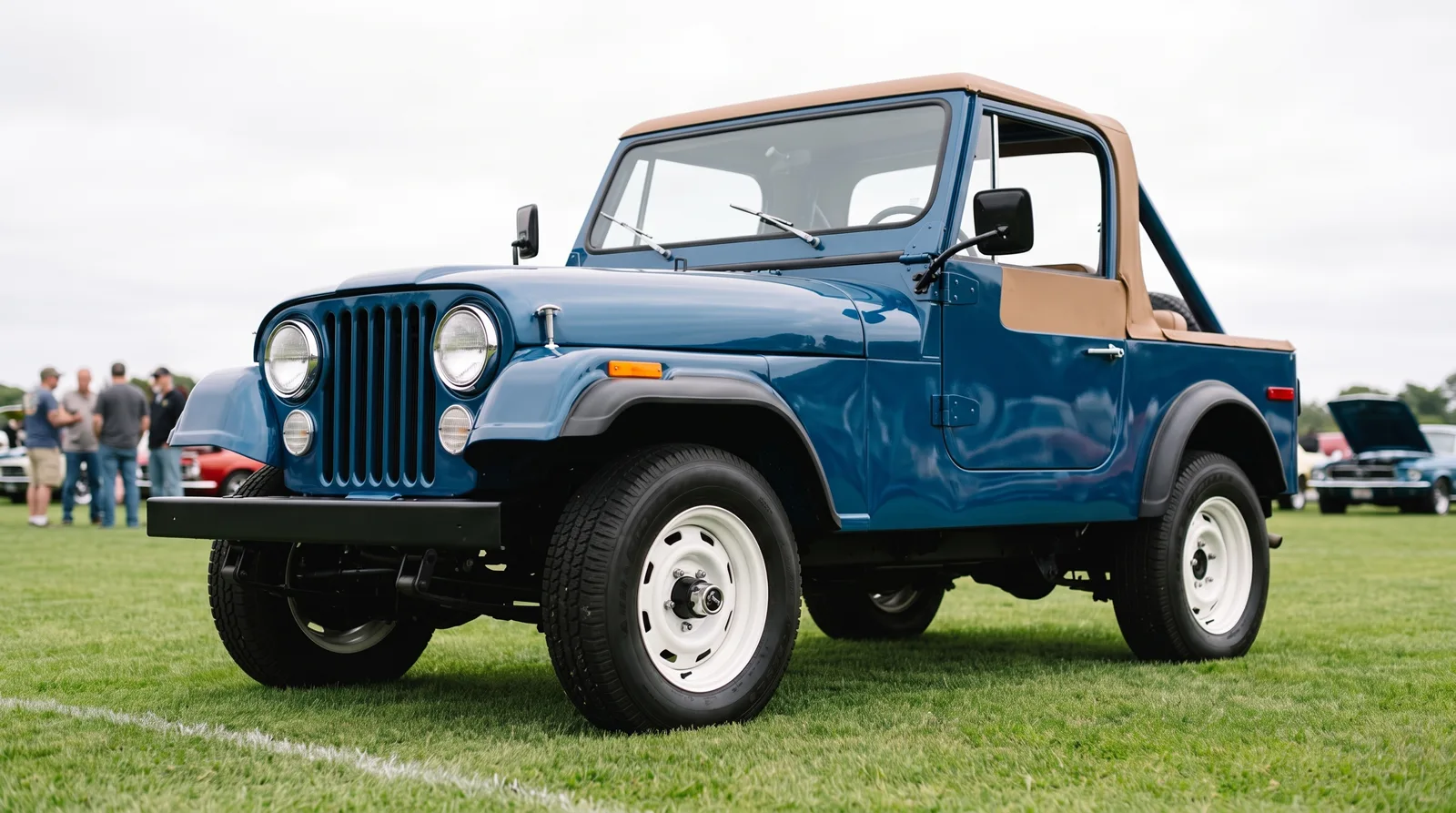
The jeep cj cj7 1976 debut gets summarized too often as a simple stretch of the CJ-5, a longer wheelbase and not much else, and that summary undersells what American Motors was actually attempting when it brought the CJ-7 to market. The factory record shows a more deliberate repositioning: a Jeep built to hold onto traditional buyers while reaching toward a customer who wanted more comfort and more usability without abandoning the CJ name entirely.
Car Features
7 min read
The 1976 CJ-7 Debut: A Bigger, Softer Kind of Jeep
A factory-record look at why AMC built the CJ-7 in 1976, what actually changed from the CJ-5, and why the two models sold side by side for years afterward.
Why AMC needed a new CJ in the first place
American Motors had acquired Jeep from Kaiser in 1970, and by the mid-1970s the CJ-5 was facing a market that had changed considerably since its own 1955 debut. Buyers increasingly wanted a vehicle that could handle daily street use, not just trail duty, and the CJ-5's short 84-inch wheelbase, stretched from an original 81 inches back in 1972 but still fundamentally a trail-first layout, produced a ride quality that read as harsh and unpredictable to a generation of drivers accustomed to more refined vehicles. AMC's engineering team addressed this directly rather than incrementally, extending the wheelbase to 93.5 inches for the new model and revising the frame accordingly. That single change reshaped the vehicle's on-road manners more than any other alteration in the model's early specification.
What actually changed for 1976
Beyond wheelbase, the CJ-7 introduced a squared-off rear body opening that, for the first time in the CJ lineage, could accept a factory steel hardtop with real integrated doors, a genuine departure from the removable soft top and half-doors that had defined the CJ-5 experience. This detail is easy to gloss over, but it mattered enormously to AMC's target buyer, someone who wanted year-round usability rather than a vehicle relegated to fair-weather driving. The CJ-7 also debuted with an available automatic transmission option, a first for the CJ line, opening the model to buyers who had never considered a CJ because of the manual-only requirement.
Correcting a common misconception
A persistent misunderstanding treats the CJ-7 as having simply replaced the CJ-5 the moment it launched. The factory production record does not support that reading. Both models were sold concurrently through the CJ-5's discontinuation in 1983, with AMC positioning them toward overlapping but distinct customer bases, the CJ-5 retaining its shorter, more traditional trail-oriented reputation while the CJ-7 pulled in buyers who wanted more interior room and highway composure. Treating the 1976 debut as an ending for the CJ-5 misreads what AMC's own sales strategy actually shows.
| Specification | CJ-5 (concurrent) | CJ-7 (1976 debut) |
|---|---|---|
| Wheelbase | 84 in (since 1972) | 93.5 in |
| Hardtop compatibility | Removable, non-integrated doors | Steel hardtop with integrated doors |
| Transmission options | Manual only through most of run | Manual and automatic available |
| Positioning | Traditional trail-focused buyer | Daily-use, comfort-minded buyer |
Reading the early production numbers
First-year CJ-7 production ramped cautiously as AMC evaluated demand for the new configuration, and the model's build codes from 1976 reflect a company still working out final specification details rather than a fully mature product line. Researchers relying on VIN decoding for early CJ-7s should expect more variation in build combinations during that first model year than in later, more standardized production runs. Total CJ-7 production across its full 1976-1986 run reached roughly 379,000 units, but a reliable breakdown of that first single model year alone is not something the surviving factory records make easy to isolate. This is a common pattern in a new model's debut year across the industry, but it matters specifically for CJ-7 buyers today trying to confirm whether an early example matches its claimed original specification, since the factory itself was still settling on consistent combinations.
"The 1976 debut wasn't a redesign for its own sake. Every dimension AMC changed traces back to a specific customer complaint about the CJ-5's ride and usability. That's a very different story than 'they made it longer.'"
- Tom Ramirez
How the press and dealers responded at launch
Period trade coverage of the CJ-7's introduction, drawn from dealer bulletins and contemporary automotive press, framed the vehicle less as a replacement for the CJ-5 and more as an expansion of what a Jeep dealer could offer a broader customer base. Dealers had spent years fielding the same objection from shoppers who liked the CJ-5's capability but balked at its ride quality and its limitations as a daily vehicle. The CJ-7 gave sales staff a genuine answer to that objection for the first time, a Jeep that could be positioned credibly against other 4x4s marketed for everyday use rather than purely recreational purposes. That shift in sales pitch matters historically because it explains AMC's marketing emphasis in the years immediately following the debut, which leaned noticeably harder into comfort and daily usability language than anything Jeep had used to sell the CJ-5.
How the debut set up everything after it
The 1976 CJ-7 established the longer-wheelbase, hardtop-capable formula that would carry the model through its own decade-plus production run and eventually inform the Wrangler that succeeded it in 1987. Later CJ-7 developments, including drivetrain and transfer case improvements introduced across subsequent model years, built directly on the foundation established in this first year. Understanding those later refinements makes more sense once the 1976 starting point is clear, and a related story covers one of the more significant of those later technical changes in detail.
Why the debut year still matters to buyers
Collectors and researchers examining a CJ-7 today benefit from understanding exactly what the 1976 model year represented, both mechanically and strategically, because it explains why certain features that seem obvious in later CJ-7s were genuinely new at the time. A buyer evaluating an early example should expect the build-quality variation typical of a debut year and should verify specification claims against known factory records rather than assuming every 1976 CJ-7 was built identically. For the complete arc of the model's development from this debut through the end of production, jeep cj7 history lays out the full timeline, and if the 1976 story has you looking to own a piece of that history, CJs for sale now is where to start comparing what survives against the record.
Researchers approaching the jeep cj cj7 1976 debut for the first time should resist the temptation to treat it as a single clean origin point. The factory record shows a company iterating in real time, correcting the CJ-5's most common complaints while still hedging its bets by keeping the older model in production. That kind of layered, cautious decision-making rarely survives in popular retellings, which prefer a tidier narrative, but the primary sources tell a more accurate and, frankly, more interesting story about how a fifty-year-old design got a genuine second act without AMC ever fully walking away from what made the original CJ formula work in the first place. That balance, expanding the customer base while preserving the vehicle's core identity, is the real achievement of the 1976 model year, and it deserves more credit than a simple wheelbase comparison usually gives it.
Sources and notes
Related Reading

About the author
Tom Ramirez
Corvette researcher and historian based in Bowling Green, Kentucky. Two decades documenting Corvette production history from original factory records.
Related Listings - Jeep CJ

Comments
Be the first to comment on this article.