
In 1976 American Motors did something Jeep had not done in twenty one years. It put a genuinely new CJ on the price list. The Jeep CJ-7 was not a facelift of the CJ-5 and not a parts bin exercise. It had its own wheelbase, its own doorway, its own frame and, more importantly, its own argument about what a small four wheel drive was supposed to be for. That argument is the reason the CJ-7 outlived every other model in the family and the reason the shape of the modern Wrangler still answers to it. Anyone reading through the jeep cj story in order will notice that this is the point where the line stops being a farm implement with a windshield.
Car Features
11 min read
The Jeep CJ-7: The AMC-Era Jeep That Changed Everything
Ten extra inches of wheelbase, an automatic option and a factory hardtop turned a farm machine into a weekend habit. The full AMC-era record.
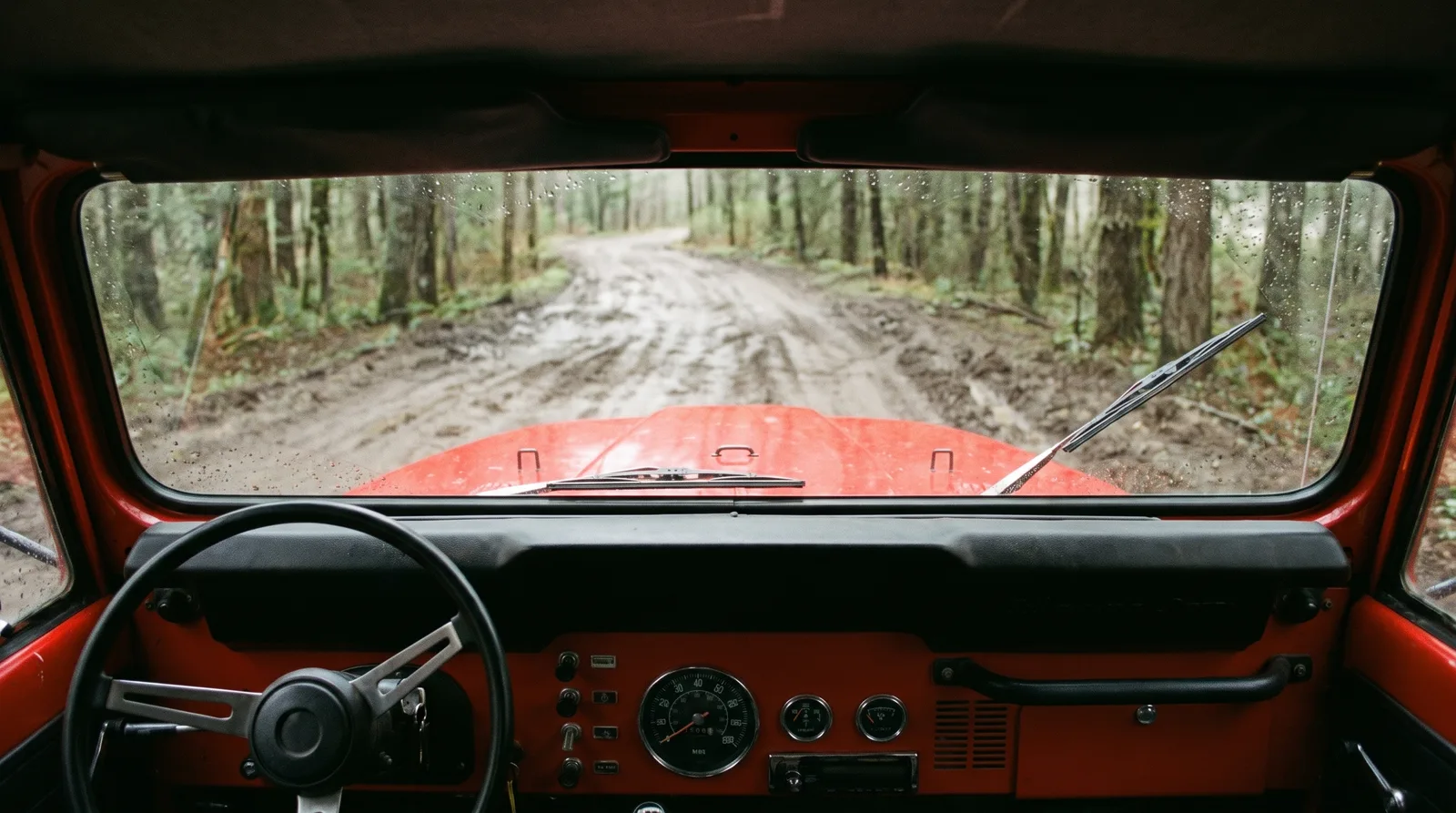
The paperwork tells it plainly enough. AMC bought Kaiser Jeep in 1970, spent five years learning what it had bought, and then spent development money on the one thing the CJ had never been given: room.
Why AMC needed a longer Jeep
By the mid 1970s the CJ-5 was selling to people who were not using it for work. They were buying it for weekends, for beaches, for snow, for the look of it in a driveway. AMC's own dealer research kept returning the same complaints. The vehicle was cramped, the doorway was awkward to climb through, there was no automatic transmission, and the aftermarket hardtops that people bolted on leaked and rattled.
None of those complaints could be fixed inside an 83.5 inch wheelbase. So the CJ-7 was drawn around a 93.5 inch wheelbase, ten inches longer, with a rear body cutout that curved instead of stepping. That curve is the fastest way to identify a CJ-7 from fifty feet, and it exists because a longer, rounder opening let a person with knees get in and out without a ritual.
The extra length also created space behind the seats, which turned the CJ from a two person machine with a parcel shelf into something a family could load for a weekend. Every commercial success the model had after 1976 flows from that decision.
Quadra-Trac, the automatic, and the hardtop
Three options defined the early CJ-7 and all three were firsts for the CJ line.
The first was Quadra-Trac, AMC's full time four wheel drive system, which meant an owner could leave the vehicle in four wheel drive on pavement without binding the driveline. Until then a CJ buyer had a part time system and a decision to make every time the weather changed.
The second was the automatic transmission. The CJ-7 could be ordered with a three speed automatic, a Turbo Hydra-Matic TH400 unit sourced from General Motors, paired with Quadra-Trac. That combination made the Jeep genuinely usable as a daily vehicle for somebody who had never driven a low geared manual in traffic, and it widened the buyer pool considerably.
The third was the factory hardtop. Instead of leaving it to the aftermarket, AMC offered a one piece molded top with steel doors and roll up windows. It is heavy, it is awkward to store, and it turned the CJ-7 into a vehicle that could survive a January commute. Original tops in sound condition now carry real money on their own, which says something about how many were removed in a driveway in 1979 and never seen again.
The specification did not stand still. For 1980 the full time system was set aside and the CJ-7 moved to a part time arrangement with a Dana 300 transfer case, along with revised axles and a wider track. Buyers who had complained that full time drive cost fuel got what they asked for, and in hindsight the change also simplified the vehicle at exactly the moment AMC needed to cut cost out of it. Two years later a five speed manual joined the list, which finally gave the CJ-7 an overdrive ratio and made highway use tolerable rather than merely possible.
It is worth remembering that for seven model years the CJ-7 was not the only CJ on the showroom floor. It was sold beside the CJ-5 until early 1983 and beside the CJ-8 Scrambler from 1981. Buyers chose between them on length and purpose, and dealers reported that the CJ-7 took sales from both.
| Specification | 1976 CJ-7 | 1985 CJ-7 |
|---|---|---|
| Wheelbase | 93.5 in | 93.5 in |
| Base engine | 232 cu in AMC six | 150 cu in AMC four |
| Optional engines | 258 cu in six, 304 cu in V8 | 258 cu in six |
| Transmissions | Three speed manual, four speed manual, three speed automatic | Four speed manual, five speed manual, three speed automatic |
| Four wheel drive | Part time, Quadra-Trac optional | Part time, Dana 300 transfer case |
| Rear axle | AMC 20 | AMC 20 |
| Roof | Soft top, molded hardtop optional | Soft top, molded hardtop optional |
The engine story, including the part owners argue about
The CJ-7 arrived with AMC's inline sixes, the 232 and the 258, and the 304 cubic inch V8 above them. The 304 is the one people remember, and it is the one the market pays for, but it was never a high output engine by the standards of the previous decade. Emissions equipment and low compression had done their work by 1976, and the 304 in a CJ-7 produced considerably less than its 1970 output, around 120 net horsepower by the mid 1970s. What it produced instead was low speed torque and a noise, and in a 3,000 pound open vehicle that was enough.
The V8 disappeared after 1981. In its place, for 1980, the base engine became a 151 cubic inch four sourced from General Motors, an engine AMC did not build and few Jeep owners loved. It was there for fuel economy compliance and for a low advertised price, and it made the CJ-7 slower than it had ever been. AMC replaced it for 1984 with its own 150 cubic inch four, which was a much better engine and shares its architecture with the six that would go on to power Jeeps into the next century.
The correction worth making here concerns the 258. Enthusiasts often describe it as a detuned truck engine. It was a passenger car six, used across AMC's range, and in the CJ-7 it was chosen for torque at low revs rather than peak output. Judged on what it was asked to do, it did the job for a decade without much drama.
"People treat the 1980 arrival of the four cylinder as the moment Jeep gave up. Read the corporate filings instead of the enthusiast press and it looks like the opposite: it was the compromise that kept the CJ-7 on sale through the worst years AMC ever had."
- Tom Ramirez
Renegade, Golden Eagle, Laredo, Limited
The trim ladder is where the CJ-7 becomes a cultural object. Renegade continued from the CJ-5, with wider wheels, a roll bar, decals and, for most of its run, the larger engine. Golden Eagle, offered from 1977 through 1979, put a wide eagle decal across the hood, gold painted wheels and a tan interior on an open four wheel drive, which is one of the most confidently 1970s decisions any American manufacturer made.
Laredo followed in 1980 and moved in the other direction. Instead of decals it used chrome. Chrome bumpers, chrome grille surround, chrome mirrors, higher back seats and better carpet. Then came the CJ-7 Limited in 1982, with leather, which is where the ladder finally reached a place the 1955 buyer would not have recognized at all.
There were commemorative runs as well. The 1982 Jamboree Edition marked the 30th anniversary of the Jeepers Jamboree on the Rubicon Trail and was built in small numbers, about 630 individually numbered units in two color combinations, well short of the larger run originally planned before the 1982 sales downturn cut it back. Those cars carry a premium today when the paperwork survives, and the paperwork often does not.
The CJ-7 on television and in the driveway
The single most photographed CJ-7 in America never went off road in earnest. Daisy Duke's Jeep on The Dukes of Hazzard, introduced during the 1980 season, was a Golden Eagle with a nickname painted on the hood, and for a generation of American children it was the first Jeep they could name. Toy versions outsold the real thing by orders of magnitude.
Television did what advertising could not. It moved the CJ-7 out of the four wheel drive club and into the general culture, and it did so at exactly the moment AMC needed volume. Watch period dealer advertising and you can see the strategy change: fewer photographs of mud, more photographs of coastlines. The Jeep was being sold as a way to spend a Saturday.
The end, and what replaced it
Production ended on 29 January 1986, and the CJ-7 took the whole CJ designation with it. The reasons were the same ones that had ended the CJ-5 three years earlier: mounting litigation and public argument over stability, tightening safety and emissions requirements, and a body and frame design whose roots ran back to the Eisenhower administration.
The replacement, the Wrangler YJ of 1987, kept the CJ-7's 93.5 inch wheelbase and much of its hard point geometry while adding wider track, better on road manners and, famously, rectangular headlights that the faithful never forgave. It is a fair descendant rather than a continuation, which is exactly why the CJ-7 is the model collectors treat as the end of the old line.
What the CJ-7 is worth caring about today
Of all the CJs, the CJ-7 is the one most people should actually buy. It is long enough to ride tolerably, common enough that parts are everywhere, and late enough that a good one can be used without ceremony. About 379,700 were built across eleven model years, so scarcity is not part of the value equation except at the trim package extremes.
Value tracks four things. Engine first, with 304 V8 cars and 258 six cars ahead of the four cylinder years. Trim second, with documented Renegade, Golden Eagle, Laredo, Limited and Jamboree cars above base models. Condition of the frame and tub third, since a Jeep CJ7 built in an era of thin coatings and used on salted winter roads can present well above the rockers and be finished below them. Completeness fourth, because a factory hardtop, original seats and correct decals are expensive to replace and impossible to fake convincingly to an experienced eye.
The honest warning is about modification. A very large share of surviving CJ-7s were lifted, re-engined and rebuilt during the 1990s, when they were cheap. That work is not automatically bad, but it changes what you are buying from a historical object into a used vehicle, and the two are priced differently. If you want an unmolested example, budget the time to look for one rather than assuming the next listing will do. It costs nothing to browse classic CJ listings for a few months before committing, and the education is worth more than the deposit.
The CJ-7 is the moment Jeep stopped designing around a government requirement and started designing around a customer. That sounds like a small distinction on paper. On the road it is the whole difference between a machine you tolerate and a machine you plan weekends around. If the earlier chapters interest you, the wartime and Willys years are another one worth knowing, and they explain why a 1976 product decision took thirty years to arrive.
Sources and notes
Related Reading
Article
The Jeep CJ Story: How the Civilian Jeep Became an American Icon
Article
The Jeep CJ-5: The Model That Defined the Civilian Jeep
Article
Willys Origins: From the War Jeep to the First Civilian CJ
Article
The 1976 CJ-7 Debut: A Bigger, Softer Kind of Jeep
Article
Quadra-Trac: The CJ-7 Feature That Changed the Game
Article
The First CJ With a Real Roof: The CJ-7 Hardtop Story

About the author
Tom Ramirez
Corvette researcher and historian based in Bowling Green, Kentucky. Two decades documenting Corvette production history from original factory records.
Related Listings - Jeep CJ







Comments
Be the first to comment on this article.