
Every August since 1953, a line of four-wheel drives has crawled up the granite spine of the Sierra Nevada on a route that would humble most modern SUVs. The Jeepers Jamboree started as a civic promotion for a Northern California town and turned into the most famous organized trail run in America, and eventually Jeep itself paid tribute to that event with a jeep cj cj7 jamboree special edition that put the Rubicon's reputation directly onto a showroom truck.
Car Features
7 min read
Jamboree: The CJ-7 That Celebrated Rubicon Heritage
The Jamboree special edition borrowed its name directly from the legendary Jeepers Jamboree run on the Rubicon Trail, giving the CJ-7 a badge with real off-road credibility behind the graphics.
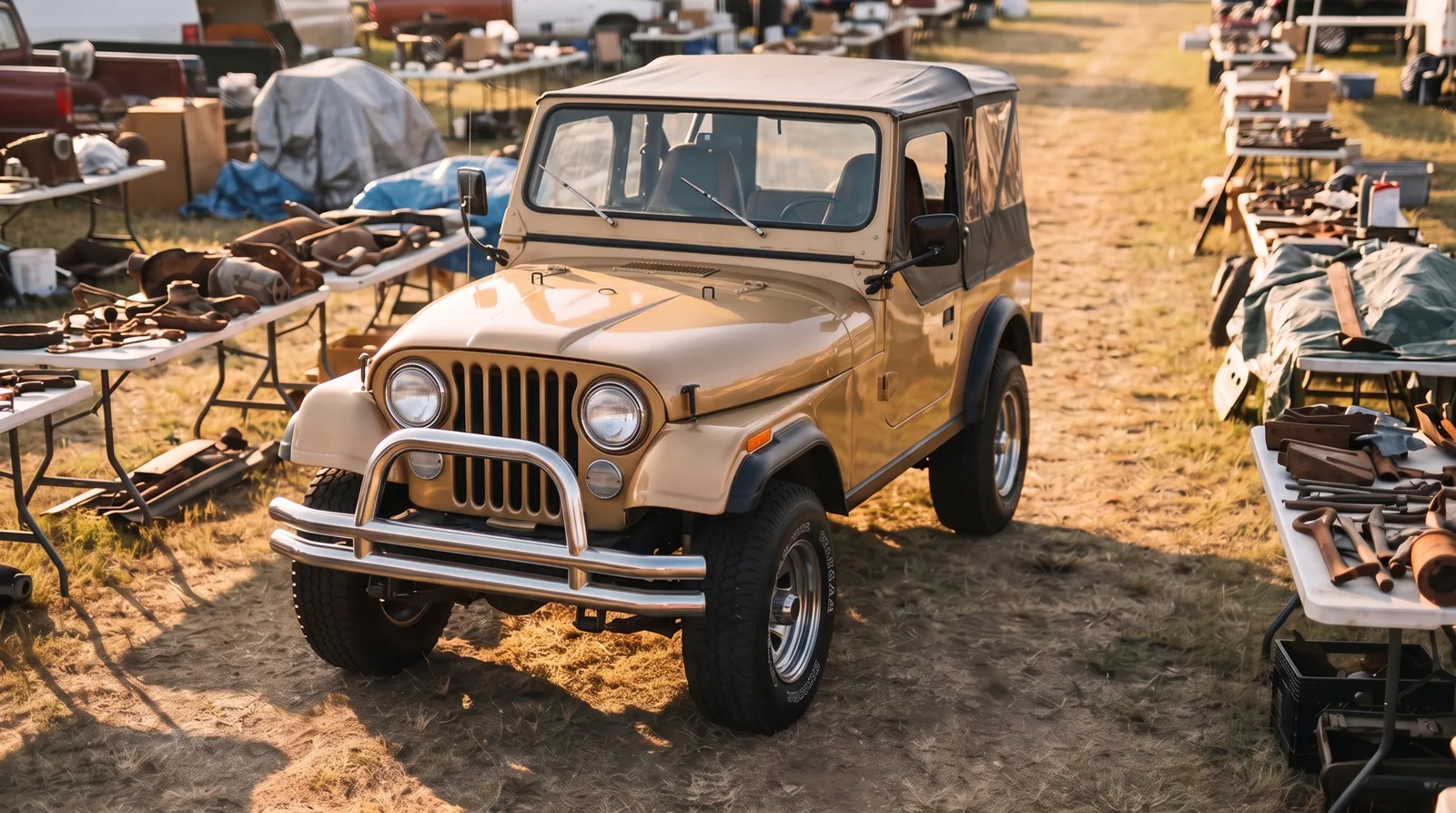
Borrowing a legend's name
The original Jeepers Jamboree run followed the Rubicon Trail, a punishing granite route across the Sierra that has tested drivetrains and driver patience since the event's founding. By the time the CJ-7 was in full production, the Jamboree name carried decades of credibility among off-road enthusiasts, the kind of grassroots reputation a marketing department cannot manufacture from scratch. Jeep leaned on that history directly, offering a Jamboree special edition CJ-7 that used the name and imagery to connect the showroom truck to the trail's mystique.
The package itself followed the same pattern as the CJ-7's other special editions: distinctive graphics referencing the Jamboree event, upgraded wheels, and trim details meant to signal that this was not a stripped work truck. It did not add unique four-wheel-drive hardware beyond what buyers could already option on a standard CJ-7, but the connection to the Rubicon Trail's reputation gave the package a credibility that pure styling exercises like some other special editions could not claim on their own.
Why the Rubicon connection actually mattered
Plenty of special-edition badges in the CJ-7's history sold on looks alone. Jamboree sold partly on looks and partly on a story that was true. The Jeepers Jamboree event was and remains a real proving ground, and a CJ-7 wearing that name was making an implicit claim about where its owner, or at least its badge, belonged. That distinction was not lost on period buyers who followed the off-road scene closely.
The trail itself demands low-range gearing, real ground clearance, and a driveline that tolerates abuse, and the standard CJ-7 chassis with its solid axles and available locking differentials was more than capable of handling the route when properly equipped. The Jamboree edition did not need to reinvent that formula. It just needed to remind buyers the formula already worked, using the name of the event that proved it every August.
"I met a guy at a trailhead who told me his grandfather ran the actual Jeepers Jamboree in a bone-stock CJ back in the sixties, and thirty years later that same family bought a Jamboree-edition CJ-7 just because the name meant something to them. That's not marketing working on somebody. That's a real story finding the right badge."
- Patrick Walsh
| Spec | Detail |
|---|---|
| Namesake event | Jeepers Jamboree, running the Rubicon Trail since 1953 |
| Package type | Special edition trim referencing the event and trail |
| Drivetrain | Standard CJ-7 options, no unique four-wheel-drive hardware |
| Key appeal | Credibility borrowed from a genuine off-road proving ground |
| Era | CJ-7 production years spanning the late 1970s into the early 1980s |
What running the actual Jamboree route asks of a truck
The Rubicon Trail is not a groomed fire road with some rocky patches. It is granite slab, tight ledges, and off-camber sections that punish anything with insufficient clearance or a driveline weak point. The original Jeepers Jamboree event was built around getting ordinary owners and their vehicles across that terrain with organized support, tow points staffed, mechanics on hand, a genuine community safety net for a route that would otherwise strand a lot of first-timers.
A stock CJ-7, Jamboree edition or not, could complete a supported run of the trail with careful driving and the right gearing, which is exactly why the event became such a fixture of Jeep culture. It was proof, repeated every August for decades, that the standard CJ formula, solid axles, decent clearance, low-range gearing, worked on some of the hardest terrain in the country. The Jamboree special edition simply put that proof on a fender badge.
What separates a true Jamboree edition from a look-alike
Because the package relied on graphics and trim rather than mechanical hardware, verifying an authentic Jamboree CJ-7 comes down to the same detective work required for any special edition: matching decal patterns, badging, and documented options against the correct model year. Enthusiasts researching the whole picture of the CJ-7's production history will find the special editions covered as a group, since they overlapped in years and often shared suppliers for graphics and trim.
A buyer should not assume every CJ-7 with rugged-sounding decals is a genuine Jamboree edition. Aftermarket and reproduction graphics referencing the Rubicon or the Jamboree event exist precisely because the name still carries weight with buyers today, decades after the original trucks left the factory.
Buying one with the trail in mind
For a buyer who actually intends to run technical terrain, a Jamboree edition CJ-7 is worth the same mechanical scrutiny as any CJ-7, frame condition, axle wear, transfer case health, regardless of the badge on the fender. The name adds heritage and a story worth telling at the trailhead, not a mechanical shortcut. Shoppers browsing shop classic CJ listings for a trail-capable classic should treat the Jamboree badge as a bonus on top of a sound truck, never as a substitute for a proper pre-purchase inspection. The Rubicon does not care what decals a truck is wearing when it starts testing the driveline for real.
The event itself, still running today
What makes the Jamboree name unusual among CJ-7 special editions is that its source material never became a nostalgic memory. The Jeepers Jamboree still runs every August, still crosses the Rubicon Trail, and still draws a mix of vintage and modern four-wheel drives attempting the same route their grandparents' generation tackled decades earlier. That continuity gives the special-edition badge a kind of ongoing relevance that a one-off styling exercise from the same era simply cannot claim.
For an owner who actually drives their Jamboree-edition CJ-7 on dirt, there is a real appeal in knowing the badge references a living event rather than a marketing campaign that quietly disappeared. It is one of the few special editions where showing up at the namesake location and driving the actual route is still something an owner can do, not just read about in an old brochure.
The community angle behind the badge
Organized trail runs like the Jeepers Jamboree built something the CJ-7's flashier special editions never had to worry about: a genuine, ongoing community of participants who returned year after year, brought their kids, and passed the tradition down. That community context is part of what gives the Jamboree name its staying power among enthusiasts, separate entirely from anything a marketing department dreamed up. A badge tied to a real, continuing event carries a different kind of weight than one tied to a passing style trend, and owners who understand that history tend to treat their Jamboree-edition trucks with a little more reverence than the badge alone would explain.
Sources and notes
Related Reading
Have a
Jeep CJ
for Sale?
Reach thousands of serious classic car collectors across the US.
Sell It Here →
Are You a Classic Car Dealer?
List your full inventory and connect with targeted classic car buyers.
Join as a Dealer →

About the author
Patrick Walsh
Automotive journalist covering classic car shows, events, and the enthusiast community across North America.
Related Listings - Jeep CJ

Comments
Be the first to comment on this article.