
Denim was not supposed to work on a truck seat. It stains, it wears thin at the seams, and it has none of the water resistance a soft-top off-roader actually needs. None of that stopped Jeep from doing it anyway, and the jeep cj cj7 levis edition remains one of the strangest, most memorable special editions the company ever put on a CJ-7 fender.
Car Features
7 min read
Denim on Wheels: The CJ-7 Levi's Edition
Jeep's licensing deal with Levi Strauss put denim-look vinyl upholstery and copper rivet detailing inside the CJ-7, one of the oddest and most memorable special editions the model ever wore.
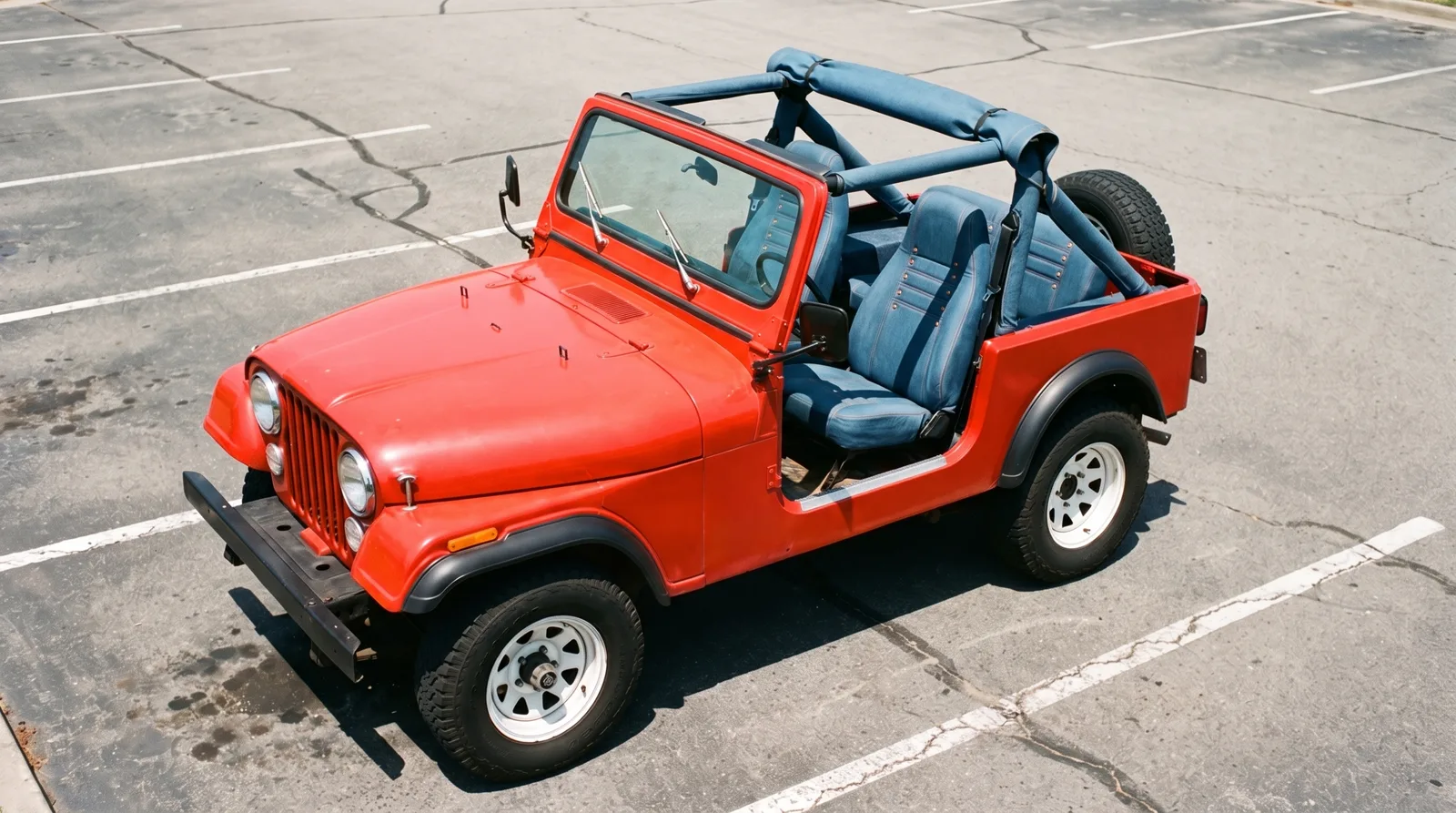
A licensing deal that made sense on paper and looked great on a fender
The Levi's tie-in began earlier on the CJ-5, with the arrangement dating to around 1975, when Jeep and Levi Strauss struck a licensing deal to trim CJ interiors in denim-look upholstery, complete with copper rivet detailing meant to echo actual Levi's jeans. When the CJ-7 launched for 1976, the Levi's Edition carried over onto the new, longer-wheelbase truck, and the pairing continued to make cultural sense. Denim was everywhere in American casual fashion by the mid-1970s, and putting it inside a rugged open-air vehicle was a genuinely clever piece of brand alignment, two products that both traded on durability and an outdoorsy, unpretentious identity.
Practically, the upholstery was not actual denim fabric, which would have fallen apart fast under sun and weather. It was a vinyl material styled to look like denim, stitched and detailed to mimic the real thing closely enough to sell the joke, with copper-toned rivets at the seams standing in for the real hardware on a pair of 501s. It was theater, and it was good theater.
What buyers actually got
Beyond the signature upholstery, the Levi's Edition typically included denim-look door panels, distinctive graphics or badging referencing the partnership, and the general trim upgrades common to CJ-7 special editions of the era. The drivetrain underneath stayed within the standard CJ-7 range of engines and transmissions, so a Levi's Edition drove like any comparably equipped CJ-7. The entire value proposition sat in the cabin and on the badge.
That is precisely why the package still generates conversation at shows decades later. It was a genuinely odd idea, a licensing deal between an automaker and a clothing brand, executed with enough commitment that it became one of the most recognizable special editions in CJ-7 history. Nobody forgets the first time they sit in a Levi's Edition and realize the seats are trying to look like their own jeans.
"I brought my dad to a show a few years back and he saw a Levi's Edition and just started laughing, said his buddy had one in high school and got endless grief for it. Forty years later people line up to photograph the same seats that used to get made fun of. That's the whole story of collector cars in one interior."
- Patrick Walsh
How the deal shaped brand thinking beyond the CJ
The Levi's tie-in was an early example of a kind of cross-brand licensing that would become far more common in the automotive world in later decades. Special editions built around a fashion label, a sporting goods brand, or a lifestyle name were not the norm in the mid-1970s the way they would become later on. Jeep and Levi Strauss essentially proved the model worked, a car company and a clothing company both benefiting from the association, each one's identity rubbing off a little on the other.
That proof of concept mattered inside AMC and Jeep beyond just the CJ line, feeding into a broader willingness to chase lifestyle and cultural relevance through special-edition trims rather than pure mechanical differentiation. Renegade and Golden Eagle both leaned on a similar instinct, that buyers responded to a truck telling a story about identity as much as a truck telling a story about capability. The Levi's deal got there first, and it got there with the strangest execution of the bunch.
The bigger CJ-7 story this fits into
The Levi's tie-in is one thread in a broader pattern of Jeep chasing lifestyle-brand credibility during the 1970s and 1980s, alongside packages like Renegade and Golden Eagle that leaned on graphics rather than a fashion license. Readers digging into the jeep cj7 story will find the full arc of how these special editions layered onto the base truck across the model's production run, while the full story traces the CJ platform's history back to its earliest postwar roots, well before Levi's ever got involved.
| Spec | Detail |
|---|---|
| Partnership origin | Levi Strauss and Company licensing deal, begun on the CJ-5 around 1975 |
| Carried to CJ-7 | Yes, continuing after the CJ-7's 1976 debut |
| Upholstery material | Denim-look vinyl with copper-toned rivet detailing |
| Drivetrain | Standard CJ-7 engine and transmission range |
| Distinct trim | Matching door panel treatment and edition-specific badging |
Buying and preserving one
Original Levi's Edition upholstery is now one of the harder items to source correctly, since it was a licensed material specific to the partnership rather than a generic period vinyl. Buyers should inspect seat seams, rivet condition, and door panel matching closely, and treat a truck with intact original denim-look trim as meaningfully more valuable than one where the interior has been reupholstered in standard vinyl or cloth, even a well-done replacement rarely gets the stitch pattern and rivet placement exactly right.
For collectors specifically chasing the novelty and cultural weight of the tie-in, hunting classic CJs on the market for a documented Levi's Edition is worth the extra search time. Few special editions in Jeep's history tell as clear a story about how a car company reads its cultural moment and puts that reading directly onto a seat cushion.
Spotting a fake in the wild
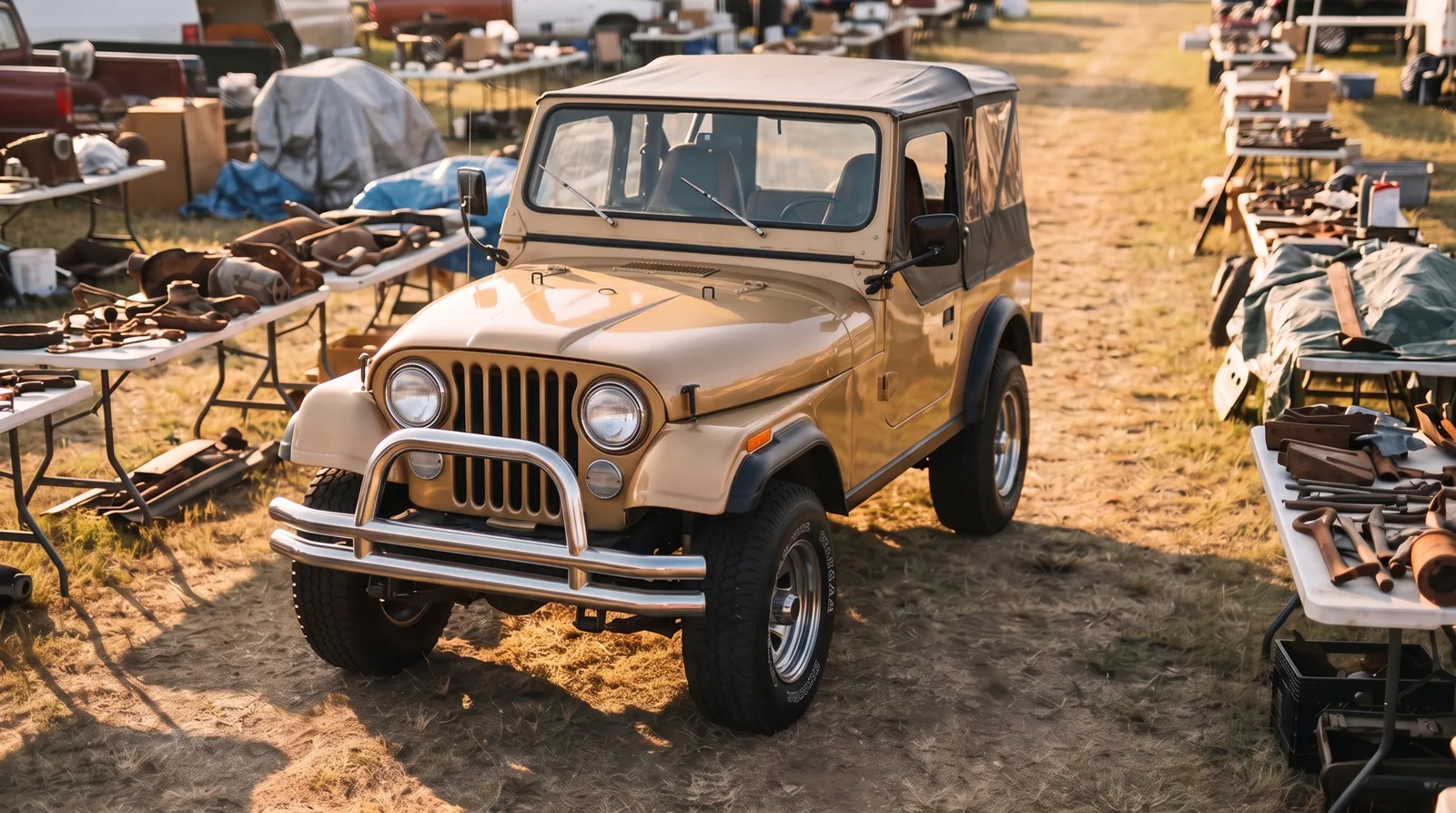
Because the Levi's name still carries recognition value, generic denim-look seat covers marketed as reproduction Levi's Edition trim show up regularly at swap meets and online listings without the copper rivet detailing or stitch pattern that made the original licensed material distinctive. A careful buyer should compare rivet placement, stitch spacing, and the specific vinyl texture against documented original photos before paying a premium for what is being sold as authentic trim. The difference between a correct reproduction and a generic aftermarket seat cover is usually visible up close, even if it photographs similarly from a few feet away in a listing photo.
Why this one gets talked about more than its sales numbers suggest
The Levi's Edition was never the CJ-7's best-selling special edition, and it did not need to be to become one of the most talked-about. Novelty travels further in enthusiast circles than volume does, and a genuinely strange, well-executed idea like denim seats in an off-roader sticks in memory in a way a more conventional trim upgrade never could. Ask any longtime CJ-7 owner to name the special editions they remember most vividly, and the Levi's truck almost always makes the list, right alongside or ahead of packages that sold in far greater numbers. That is the quiet power of a good story attached to a good gimmick, executed with enough commitment to actually work.
Sources and notes
Related Reading
Have a
Jeep CJ
for Sale?
Reach thousands of serious classic car collectors across the US.
Sell It Here →
Are You a Classic Car Dealer?
List your full inventory and connect with targeted classic car buyers.
Join as a Dealer →

About the author
Patrick Walsh
Automotive journalist covering classic car shows, events, and the enthusiast community across North America.
Related Listings - Jeep CJ

More in Car Features
Comments
Be the first to comment on this article.