
Every Jeep club has a guy who shows up with the loudest truck in the lot, and for a long stretch of the late 1970s and early 1980s, that truck was a jeep cj cj7 renegade. I heard the name before I ever saw the badge, mentioned by an old-timer at a swap meet who called it "the one with the flares," and he was not wrong. The Renegade package was Jeep's answer to a question the CJ-7 itself had already started asking: what happens when a working truck starts getting treated like a personality?
Car Features
7 min read
The CJ-7 Renegade: Carrying the Badge Into a New Body
The Renegade package turned the CJ-7 into the Jeep that announced itself at every gas station, and the story behind those flares is more style than substance, and all the more beloved for it.
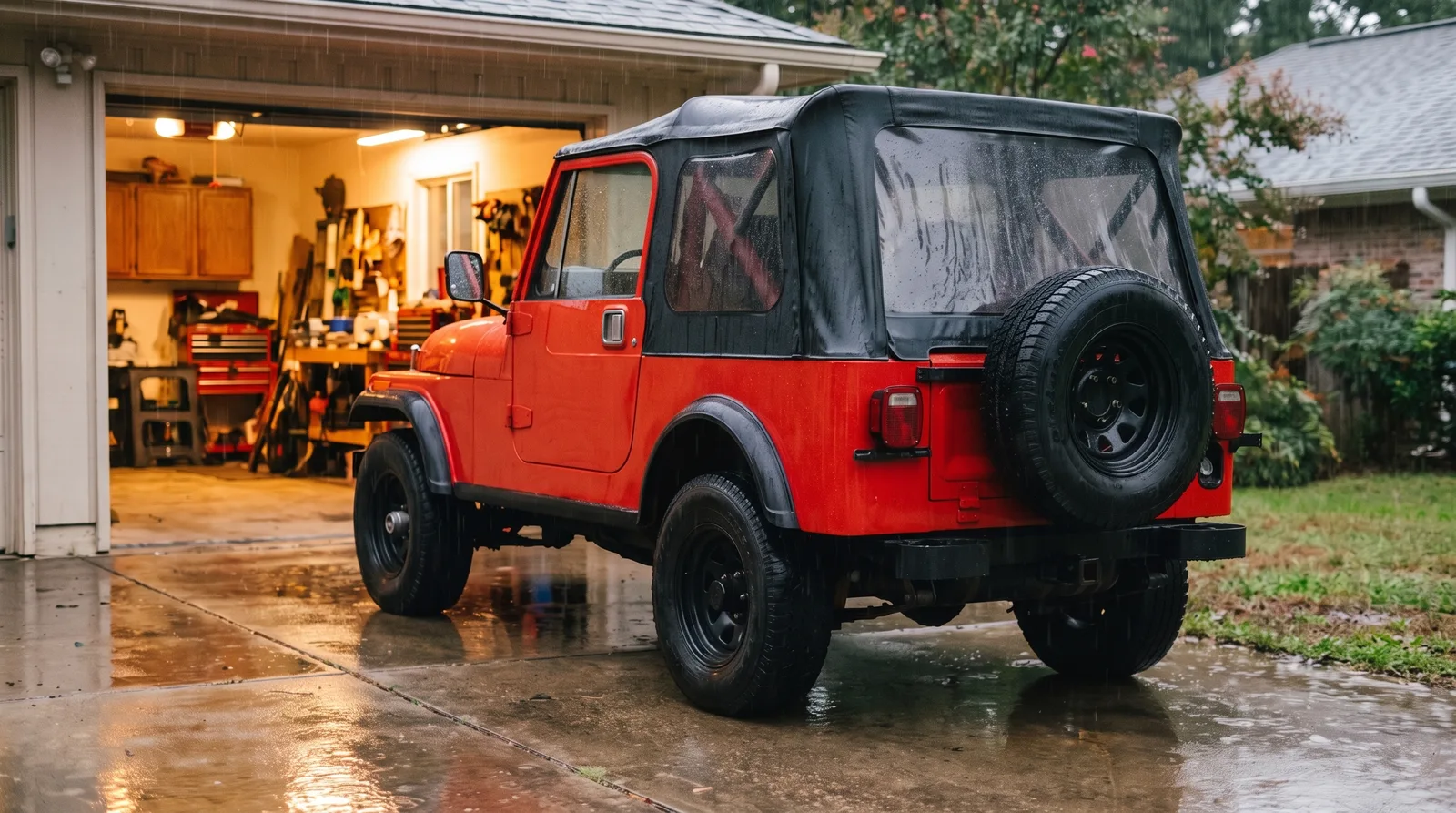
The package that started on the CJ-5 and found its real home on the CJ-7
Renegade did not begin with the CJ-7. Jeep ran a Renegade trim on the CJ-5 starting in the early 1970s, a limited run at first, more of an experiment than a strategy. But once the CJ-7 arrived for 1976 with its longer wheelbase and more road-friendly manners, the Renegade package found a body that suited it. The flared fenders, wider tires, and blacked-out trim that had looked almost aggressive on the stubby CJ-5 looked purposeful on the CJ-7's longer stance.
By the time AMC had fully absorbed Jeep's product planning, Renegade had settled into a recognizable formula: wider Goodyear tires on styled steel wheels, fender flares to cover them legally, a roll bar, and graphics packages that changed year to year but always announced themselves. Some years leaned into bold decal treatments running the length of the hood and sides. Others toned it down. What never changed was the intent. Renegade buyers wanted people at the gas station to know they had bought the sporty one.
What was actually under the graphics
Here is where I have to be the guy who corrects the assumption at the swap meet table: Renegade was mostly an appearance and convenience package, not a mechanical one. The engines available were the same engines available on any CJ-7, the AMC 232 straight six as the early standard and the 258 straight six that replaced it, with the AMC 304 V8 offered as an option through most of the run, into the early 1980s, for buyers who wanted more grunt. Renegade did not come with a locking differential standard, did not come with a lift, and did not come with anything you could not order separately on a base CJ-7 if you knew the option sheet.
What it did bring, consistently, was the wider track and tire package, and that had a real effect on how the truck sat and handled. A Renegade rode a little wider, looked a little more planted, and, if the owner kept the tires aired up and the alignment honest, cornered with slightly more confidence than a narrow-track base CJ-7. It was a styling exercise that happened to deliver a small, genuine handling benefit. Not every trim package in Detroit's history can say that.
"Half the guys who buy a Renegade today think they're getting a factory-built rock crawler. What they're really getting is the CJ-7 that already knew how to make an entrance, and that's worth something on its own."
- Wayne Coburn
What the graphics packages looked like year to year
If you line up a run of Renegade CJ-7s from different model years, you would be forgiven for thinking Jeep could not make up its mind. Early Renegade trucks carried relatively restrained pinstriping and modest decal work. By the early 1980s, some model years wore bold, multi-color side graphics running the full length of the body, a look that has aged into either nostalgic charm or garish overkill depending on which generation is doing the judging. I lean toward charm, but I will admit the club has arguments about it every year.
That variation is actually useful for anyone trying to date a Renegade CJ-7 from photos alone, since the graphics changed often enough to serve as a rough visual timeline. It also means restoration shops need to know exactly which year they are working on before ordering reproduction decals, because applying the wrong year's pattern to the wrong truck is an easy and common mistake among sellers who are not paying close attention.
Why the badge still moves people at a show
I have stood next to Renegades at three different regional shows this year alone, and the conversation is always the same. Somebody's dad had one, or somebody's older cousin drove one to high school, and the memory attaches to the flares and the decals before it attaches to anything mechanical. That is the trick of a good appearance package. It does not need to be the fastest or the most capable variant to be the one people remember.
Production numbers for Renegade-specific CJ-7s were never broken out cleanly by Jeep in period literature, which is a polite way of saying nobody should trust a precise figure quoted with confidence. Even the earliest Renegade run on the CJ-5, back in 1970, is generally estimated at only a few hundred trucks, which gives a sense of how thinly Jeep's own records track this package. What is not in dispute is that Renegade sold well enough, year after year, to stay on the option sheet for most of the CJ-7's production run, which tells you Jeep's marketing department knew exactly what it had.
Anyone chasing the model's full arc should read where this started, since Renegade only makes sense as a chapter in the larger CJ-7 story rather than a standalone truck.
Buying one now, and what to actually look for
The trouble with a package built on flares, decals, and wheels is that all three are the easiest things in the world to fake decades later. A base CJ-7 with reproduction Renegade graphics and a set of wide tires looks convincing in a driveway photo. Verifying an original Renegade means chasing the build sheet or the VIN decode, checking for the factory roll bar mounting points, and comparing flare styles to the correct year, since Jeep revised the shape more than once during the run.
The lasting appeal
What keeps a Renegade CJ-7 desirable is not that it did anything the base truck could not do. It is that Jeep, for once, let a working vehicle look like it was having fun, and enough buyers responded to that honesty that the package outlived most of its contemporaries. Anyone shopping classic CJ for sale listings today will find the Renegade badge still carries a premium, not because it changed the mechanics underneath, but because it changed how the truck felt to own. That is a harder thing to fake than a decal, and it is why the name still means something at every club gathering I have ever stood in.
A word on parts and restoration reality
Restoring a Renegade back to correct spec is more forgiving than restoring some of the CJ-7's other special editions, if only because the mechanical components underneath are shared with every other CJ-7 of the same year. Axles, transfer cases, engines, all sourced from the same normal supply chain that keeps any CJ-7 on the road. The challenge is entirely cosmetic, and cosmetic problems have straightforward, if sometimes expensive, solutions.
Reproduction decal suppliers who cater to the Jeep CJ community have gotten good at matching factory color and pattern, provided the buyer or restorer knows exactly which model year they are chasing. That knowledge gap is where most restoration mistakes happen, not in a lack of available parts. A little research before ordering saves a lot of regret after the decals are already applied and curing under a Sunday afternoon sun.
Sources and notes
- Jeepfan.com: CJ Renegade 1970-1975 Spotters Guide
- Hagerty Valuation Tools: 1974 Jeep CJ-5 Renegade
- RealTruck: The Rise and Fall of the Jeep Renegade
- Jeep: History in the 1970s
- ExtremeTerrain: How to Identify Jeep CJ-5, CJ-6, CJ-7 and CJ-8 Models and Years
- Bernie's Jeep Parts: AMC 232/258 Six Cylinder Engine Reference
Related Reading

About the author
Wayne Coburn
Longtime Corvette owner, judge and club figure who knows the cars, the records and the people behind them.
Related Listings - Jeep CJ



Comments
Be the first to comment on this article.