
For its first two model years the Mustang topped out at a small-block V8. The 1967 car changed that. It was wider, it had a bigger engine bay, and the top engine on the order sheet was a 390 cubic inch FE V8 with a four-barrel carburetor and an S in the VIN. That S-code car is the 390 big block Mustang, the one most people mean when they say "390 GT." It was rated at 320 hp and 427 lb-ft, and no Mustang engine before it had come close to that torque figure.
Car Features
8 min read
The 390 GT: Ford's First Big-Block Mustang
The S-code 390 FE made the 1967 Mustang a big-block car: 320 hp, 427 lb-ft, a wider body to fit it, and a three-year run that ended in 1969.
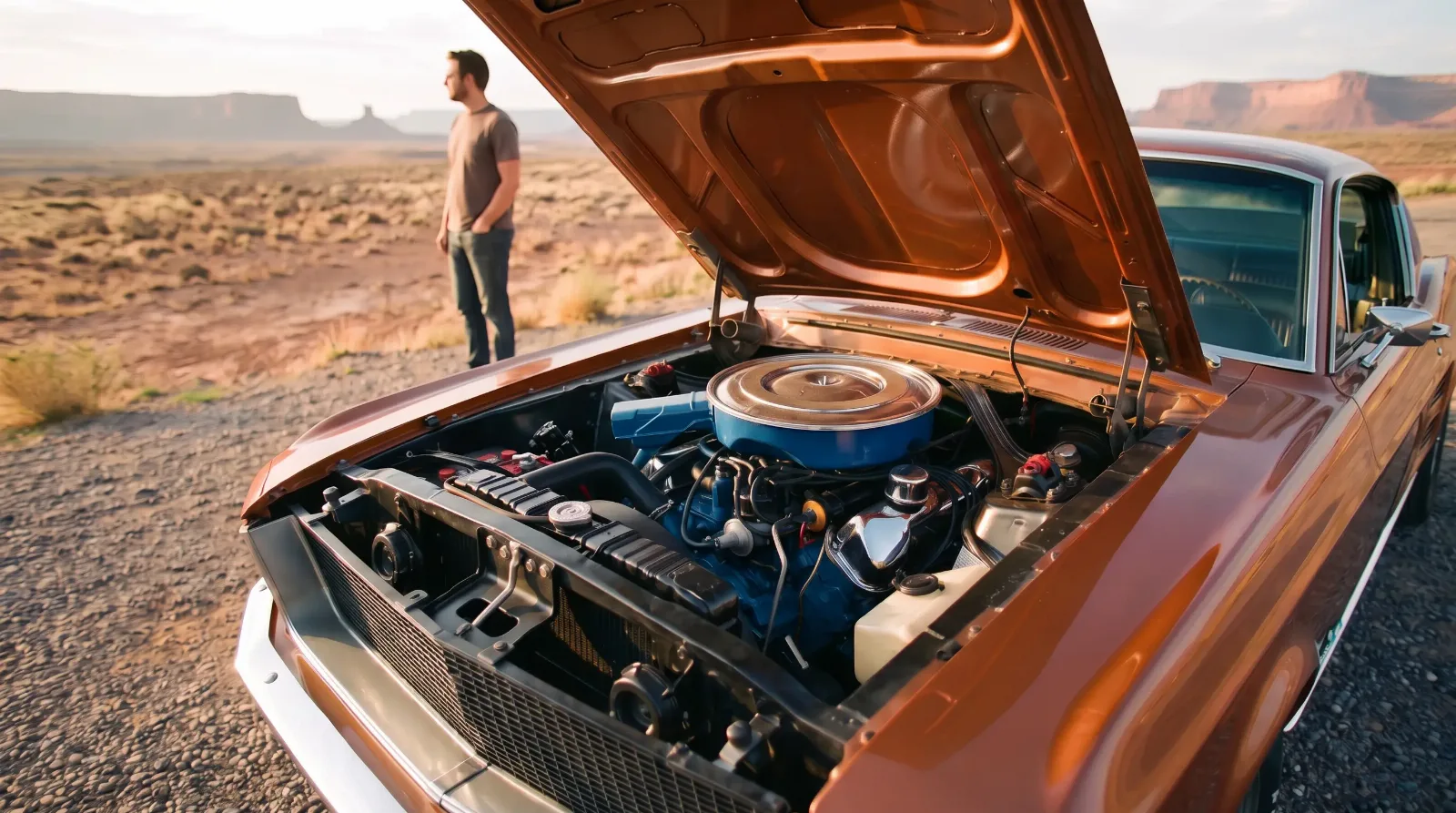
I have had my hands on enough of these to tell you the number on the air cleaner is the least interesting part. What matters is how Ford got a big-block into a car that was never drawn for one, what the engine was actually like, and why it was off the order sheet after three model years. It belongs with the other Mustang performance legends, but it came first. Every big-block Mustang after it used the room the 390 car opened up.
Why the 390 big block Mustang needed a new body
The original Mustang was drawn around a six and the 289. An FE V8 is a physically bigger engine, and Ford never offered one in the 1965 and 1966 car. So for 1967 Ford enlarged the body to take big-block V8s. The car grew 2.0 inches longer, to 183.6 inches, and 2.7 inches wider, to 70.9 inches. The wheelbase stayed at 108 inches. The engine came first in that redesign, not the styling.
The FE family itself was not new. Ford had introduced it in 1958. What was new was putting it in a car that weighed about 2,758 pounds as a base hardtop. That is the base six-cylinder figure, mind you. When Car Life tested a 1967 390 fastback, it found the 390 and C6 automatic added about 490 pounds over a six-cylinder fastback, 276 pounds more than a 289 with the C4 automatic. Most of that sits over the front tires.
Even with the extra width, the engine bay on a 390 car is full. You notice it the first time you change plugs on the back cylinders or try to get a wrench on the exhaust manifold bolts. Ford gave the engine enough room to go in. It did not give the mechanic much room to work on it afterward.
What the S-code 390 actually made
The 390 four-barrel was rated at 320 hp at 4,800 rpm and 427 lb-ft at 3,200 rpm for 1967, SAE gross. One source puts the horsepower peak at 4,600 rpm instead, which is the figure the 1969 rating uses. For 1968 the four-barrel was rated at 325 hp, and Ford added a two-barrel X-code version at 270 hp. For 1969 it went back to 320 hp at 4,600 rpm with the same 427 lb-ft.
| Engine | VIN code | Carburetor | Rated power (SAE gross) | Rated torque |
|---|---|---|---|---|
| 1967 390 four-barrel | S | 4-bbl | 320 hp @ 4,800 rpm | 427 lb-ft @ 3,200 rpm |
| 1968 390 four-barrel | S | 4-bbl | 325 hp | 427 lb-ft @ 3,200 rpm |
| 1968 390 two-barrel | X | 2-bbl, 9.5:1 compression | 270 hp @ 4,400 rpm | 401 lb-ft @ 2,600 rpm |
| 1969 390 four-barrel | S | 4-bbl | 320 hp @ 4,600 rpm | 427 lb-ft |
| For comparison: 1965-66 289 Hi-Po | K | 4-bbl | 271 hp @ 6,000 rpm | 312 lb-ft @ 3,400 rpm |
Look at the last row against the first. The 390 made 49 more horsepower than the K-code, and it made them 1,200 rpm lower. The torque gap is the real story: 427 lb-ft against 312, a difference of 115 lb-ft. The 289 Hi-Po before it was a revving engine built around solid lifters, and if you want the details of how it got its power, that story sits right next to this one. The 390 got there with displacement. It pulled hard off the line and ran out of interest well before the small-block did.
That is not a complaint. On the street, where nobody holds a car at 6,000 rpm for long, the big engine was the easier car to drive fast. You put your foot in it at 2,500 rpm and the car went. The trade was weight in the nose. Car Life judged its 390 car quicker than a four-barrel 289, but not by enough to pay for the handling it gave up against the lighter, less nose-heavy small-block. The brakes were the bright spot: with the optional power front discs, that test car stopped from 80 mph better than most cars the magazine had tested.
The 390 and the GT package
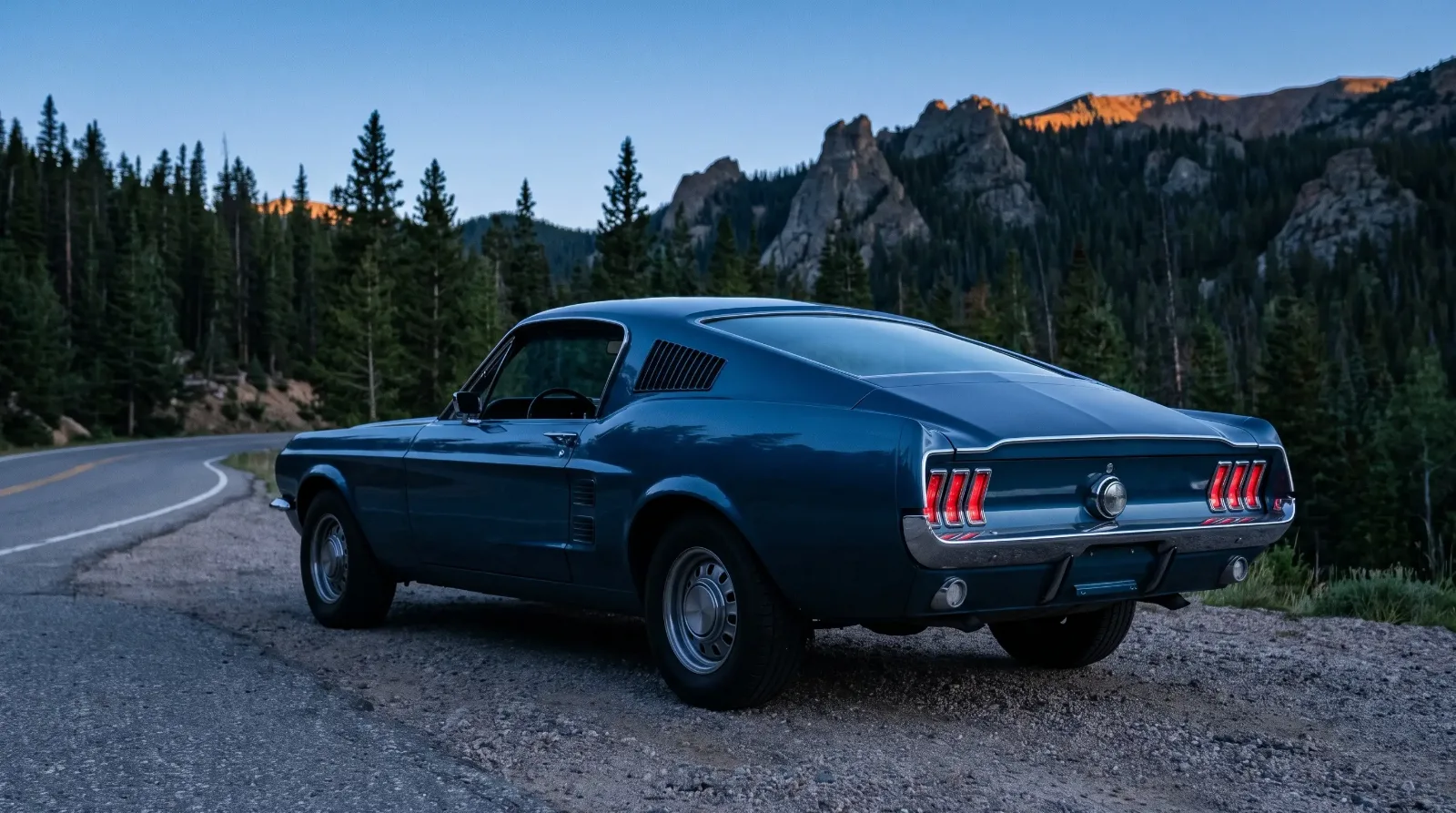
People say "390 GT" as if it were one option. It was two. The engine was one line on the order form and the GT equipment group was another. For 1967 the GT group brought fog lamps, power front disc brakes, a quad-outlet dual exhaust, F70x14 tires, the handling package and Le Mans-style stripes. Ford built 24,079 GTs that year.
About 28,800 buyers chose the 390 in 1967. More 390s than GTs means plenty of big-block cars left the plant without the GT group, so a 390 car with plain sides and single exhaust tips is not automatically a fake. It might just be a car somebody ordered for the engine and nothing else. Out of 472,121 Mustangs built for 1967, that 390 figure works out to roughly six percent of production.
A GT ordered with the automatic wore a "GTA" fender badge in 1967, a one-year marking. Later S-code counts are murkier: one enthusiast site gives 9,228 for 1968 and 10,464 for 1969, while another page on the same site prints 10,494 for 1968. Treat them as a rough guide, not a count.
Bullitt, the X-code and the engine that crowded it out
The 1968 model year is when the 390 got famous and started losing its place at the same time. The famous part is the movie. The two cars built for Bullitt were Highland Green 1968 Mustang GT fastbacks with the S-code 390 four-barrel and a four-speed. Hollywood picked the big-block car, and a lot of people still picture that car first when they hear the word Mustang.
The losing part arrived in April 1968. Ford started building the 428 Cobra Jet on the regular production line, rated at 335 hp at 5,200 rpm and 440 lb-ft. On paper that was only 10 more horsepower than the 1968 S-code. In practice it was a different class of engine, widely believed to be underrated, and buyers who wanted the fastest Mustang now had a better answer. The 390 stayed on the sheet as the step below it.
"The 390 gets talked about like the warm-up act for the Cobra Jet, and that sells it short. It was the engine that made Ford widen the car. Everything big that went in after it went into a hole the 390 paid for."
Mike Sullivan
For 1969 the 390 four-barrel returned at 320 hp in the restyled car, still with the S code, alongside the 428 Cobra Jet and the new 351s. It did not survive the year. Ford dropped the 390 for 1970, the same year the GT option disappeared, and the new 351 Cleveland four-barrel at 300 hp took over the middle of the range.
Reading the evidence on a 390 car
Start with the VIN. On a 1967 to 1969 car the fifth character is the engine code, and S means the 390 four-barrel. A 1968 car with an X has the two-barrel 390. A car with a small-block code in that spot left the factory with a small-block, no matter what sits between the shock towers today. FE engines are easy to come by and they bolt into the later body, which is exactly why so many small-block cars wear a 390 now.
The good news for 390 owners is the paperwork. Marti Reports cover the 1967 model year onward, so unlike a 1965 or 1966 car, a 390 Mustang can usually be checked against Ford's own build data. That report will tell you whether the S was there from the start and what the car was ordered with. I would not spend serious money on one without it.
After that it is the usual work on factory iron. Casting numbers and date codes on the block and heads should make sense for the build date. Then check whether the GT parts are really GT parts or a catalog kit added later. A correct 390 car does not need to be a GT, as the production numbers show. It just needs to be honest about what it is. If you want to see how the big-block fits into the rest of the year's lineup, the 1967 Mustangs are the place to start, because that is the year the whole car was redrawn around this engine.
Sources and notes
Related Reading
#Ford Mustang
#1967 Mustang
#1968 Mustang
#mustang gt
#Ford big block
#classic Mustang engines
#390 FE
#S-code

About the author
Mike Sullivan
Detroit-area muscle car enthusiast and restoration specialist with three decades of hands-on experience working on American iron.
Related Listings - Ford Mustang
More in Car Features

Comments
Be the first to comment on this article.