
Numbers tell a cleaner story than nostalgia does, and the k5 blazer 1972 engine lineup is a good example of why. By the final year of the first-generation body style, Chevrolet had settled into an engine strategy that balanced buyer expectations against what the truck's chassis and drivetrain could reasonably handle, and looking at what was actually on the order sheet tells you more about the truck's real character than any amount of marketing copy from the period ever could.
Car Features
7 min read
The Engines That Powered the 1972 K5 Blazer
From the economy-minded 250 six to the torque-rich 350 V8, the 1972 K5 Blazer's engine lineup reveals a truck built for two very different kinds of buyers.
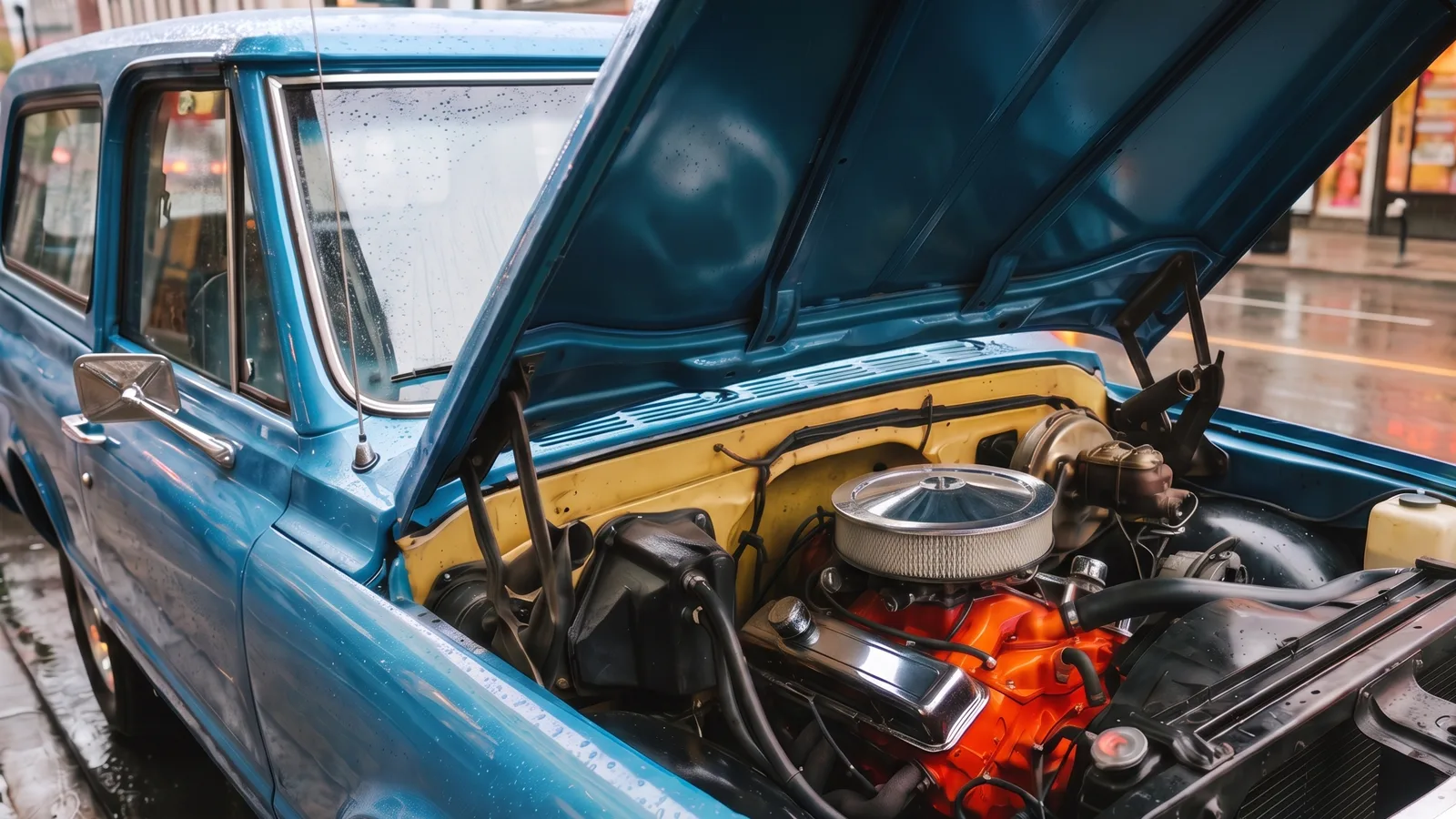
The base inline-six and why it mattered
Chevrolet's 250 cubic inch inline-six served as the standard engine across much of the early K5 lineup, and by 1972 it represented a mature, well-understood unit rather than an afterthought base option. The appeal of the six was straightforward: lower cost, simpler maintenance, and adequate power for buyers who prioritized the Blazer's off-road capability and utility over outright performance. It is easy, from a modern vantage point, to dismiss the six as the option nobody wanted, but that undersells its actual role. A meaningful share of 1972 buyers chose it deliberately, particularly commercial and agricultural customers who valued fuel economy and long-term reliability over acceleration numbers. For the full context of what else defined this model year, more on the 1972 k5 blazer covers the surrounding details.
The V8 options: where the real demand was
Most 1972 buyers, based on surviving production patterns and dealer literature from the period, opted into one of the available V8s, most commonly the 350 cubic inch small block that had already established itself as GM's workhorse engine across multiple truck and car lines. The 350's appeal in the K5 application was less about raw output and more about the torque curve it offered relative to the six, which mattered enormously for a vehicle regularly asked to move real weight off-road or tow a trailer. Exact horsepower and torque figures for the 1972 350 varied by carburetion and emissions calibration, and 1972 was also the model year the industry began shifting from SAE gross to the more conservative SAE net rating method, so published numbers from this specific year should be read with that context rather than compared directly to earlier or later model years. A smaller 307 cubic inch small block was also offered during the first-generation run for buyers who wanted V8 smoothness with less displacement than the 350, though it saw comparatively limited uptake next to the 350. The larger 400 cubic inch small block did not arrive on the K5 Blazer until the second-generation redesign, so it was not an option on the 1972 truck.
What the engine lineup reveals about the truck's real market
Looking at the spread of engine choices across 1972 production tells an evidence-based story about who was actually buying these trucks. A buyer population split between a economy-minded six and a torque-focused V8 suggests Chevrolet was still targeting two distinct customer bases with a single model: work-first buyers who wanted the K5 as a tool, and recreation-minded buyers who wanted enough power to comfortably tow, tackle trails, or simply keep up with highway traffic without strain. That dual identity is a recurring theme across the entire early K5 story, one that traces back to the model's original 1969 launch and the market gap it was built to fill.
Readers who want the origin point for this entire discussion, including why Chevrolet built the K5 the way it did in the first place, should look at where the story actually begins.
For that foundational context, where this started lays out the reasoning behind the original 1969 platform decisions that shaped every engine choice that followed.
| Engine | Displacement | Typical buyer profile |
|---|---|---|
| Inline-six | 250 cu in | Economy, commercial, agricultural use |
| Small block V8 | 350 cu in | Balanced power and towing capability |
| Small block V8 (lighter option) | 307 cu in | V8 smoothness, limited uptake vs. 350 |
"People assume the six was a compromise engine, but the data doesn't fully support that. Plenty of buyers picked it on purpose, because it did exactly what they needed and nothing they didn't. That's not a failure mode. That's a correctly matched spec."
- Emily Chen
Known failure points worth understanding
No engine from this era is without its documented weaknesses, and being honest about them is more useful to a prospective buyer than pretending every option aged perfectly. Carburetion systems from the early 1970s, across both the six and the V8 options, are sensitive to ethanol-blended modern fuels in ways they were never designed for, which shows up as harder starting and inconsistent idle on unmaintained examples. Cooling system capacity on the V8-equipped trucks, particularly when paired with air conditioning or heavy off-road use, runs closer to its margin than later engine designs, meaning overheating under sustained load is a documented issue on tired or poorly maintained examples rather than a rare edge case. None of this makes either engine a bad choice for a collector today. It does mean buyers should treat cooling system condition and fuel system originality as real evaluation criteria rather than afterthoughts.
Transmission and drivetrain pairing considerations
Engine choice on the 1972 K5 did not exist in isolation. Both the six and the available V8 options were paired with a transmission lineup that included manual and automatic choices, and the combination a given buyer selected says as much about intended use as the engine alone. A manual-equipped six-cylinder truck represents the most cost-conscious, work-oriented configuration Chevrolet offered that year, while an automatic-equipped V8 leaned toward buyers prioritizing ease of use and comfort alongside capability. Evaluating a surviving 1972 truck today means looking at the engine and transmission as a matched system rather than judging the engine in isolation, since a mismatched or later-swapped combination changes both the truck's originality value and its real-world driving character in ways that matter to a serious buyer.
Choosing between the six and the V8 as a buyer today
From a pure ownership standpoint, the calculus has shifted somewhat since 1972. Fuel cost differences that once mattered a great deal to a work-truck buyer matter less to a collector who drives a few thousand miles a year, which tilts modern preference toward the V8 for its stronger performance margin and broader parts support. That said, a documented, original six-cylinder 1972 K5 has its own collector appeal precisely because it represents the less common, more overlooked configuration, and originality tends to carry real weight regardless of which engine a given truck left the factory with. Buyers evaluating either configuration should prioritize documented originality and mechanical condition over a simple preference for more displacement.
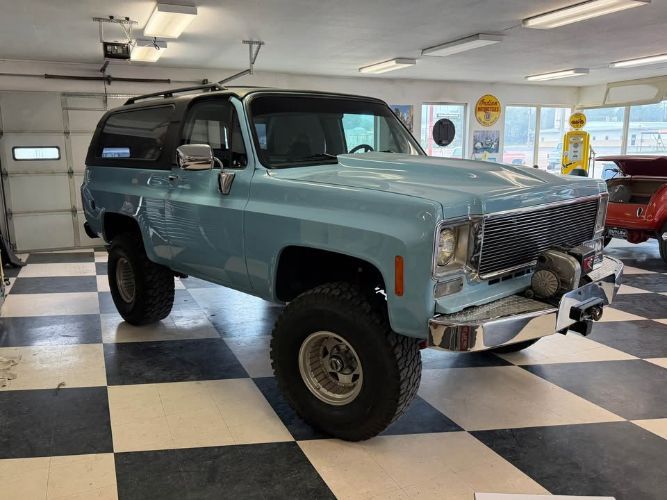
Anyone comparing six-cylinder and V8 examples side by side should look at what's actually available before making that call. Interested buyers can review classic K5 Blazers on the market and compare drivetrain condition and documentation across both engine configurations.
Sources and notes
Related Reading


About the author
Emily Chen
Bay Area engineer with a deep focus on vintage Japanese and European performance cars. Approaches classic car research and restoration with an analytical eye.
Related Listings - Chevrolet Blazer

More in Car Features
Comments
Be the first to comment on this article.