
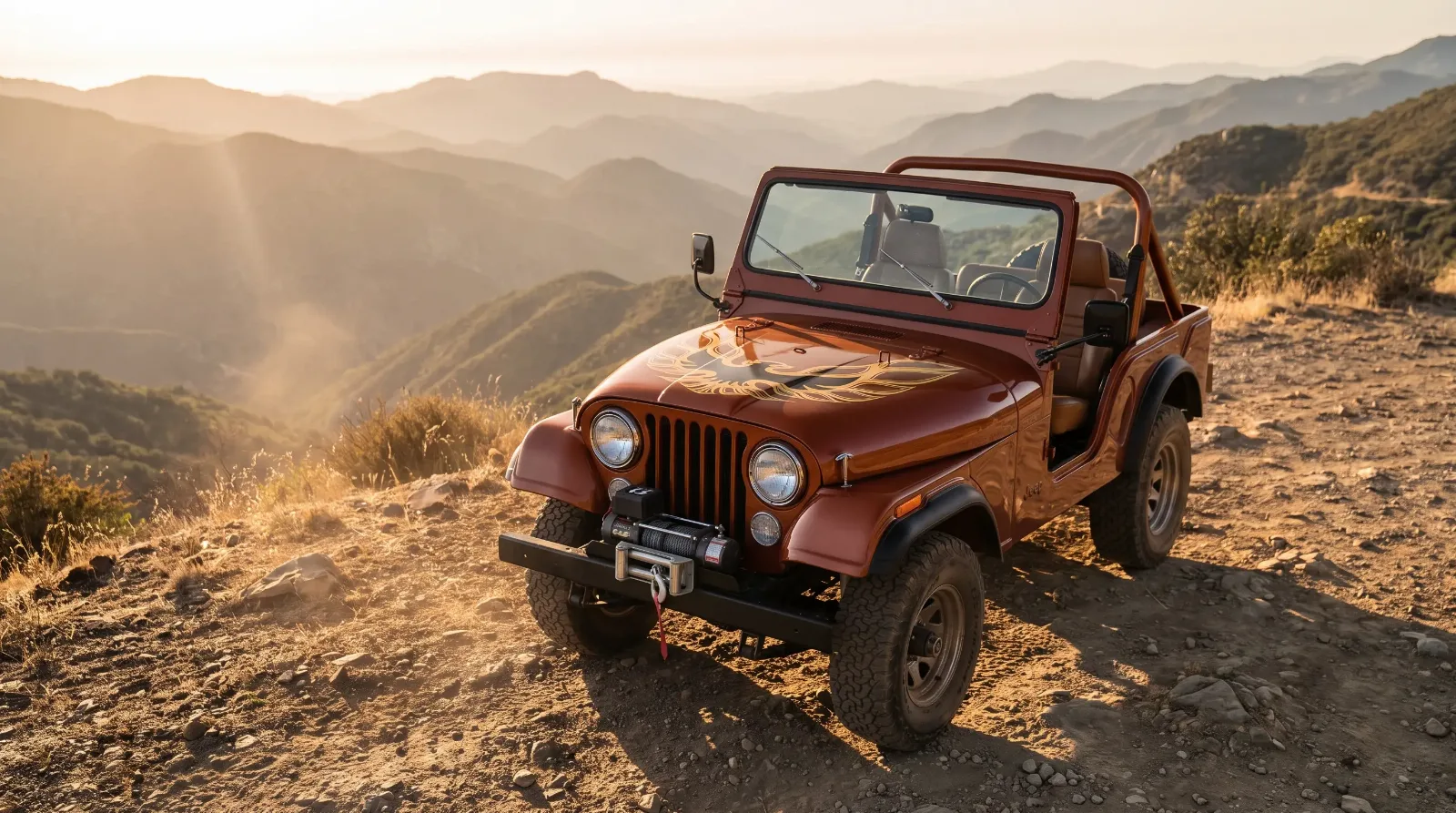
Every parking lot has one guy who remembers the bird. Ask anyone who was buying trucks in 1977 about the jeep cj culture golden eagle package and they will not describe a trim level. They will describe a hood. A screaming, wings-spread eagle decal running nose to windshield on a CJ-5, usually gold on a black or brown truck, sometimes reversed, always loud enough to be seen from two lots over at the dealership. The Golden Eagle was never really about what was under the hood. It was about what was painted on it.
Car Features
8 min read
The Golden Eagle: The Hood Bird of the Seventies
The Golden Eagle turned the CJ-5 into a rolling billboard, and its hood decal became one of the most recognized symbols of 1970s Jeep culture.
A decal born out of a sales problem
By the mid-1970s, American Motors owned Jeep and needed the CJ line to sell to a buyer who had never towed a boat or hauled hay in his life. The oil embargo had reshuffled the whole market, gas prices were up, and a strange thing had happened to the utilitarian little Jeep: it had become desirable to people who just wanted to look like they went off-road on weekends, even if the farthest dirt they saw was a gravel driveway. AMC's answer, following the lead of the Renegade package that came before it, was the appearance package. Big graphics, bold colors, and a name that sounded like a fighter squadron.
The Golden Eagle launched for the 1977 model year on the CJ-5, and it worked exactly as intended. It gave a buyer a way to spend a modest amount of extra money and walk away with a truck that looked nothing like the one parked next to it. Underneath, the mechanicals were whatever the CJ-5 already offered that year, most commonly the AMC 304 V8 or the inline sixes, riding on the same leaf springs and live axles every CJ-5 buyer got. The eagle was the entire pitch.
The bird itself
Design-wise, the Golden Eagle decal was not subtle, and it was not meant to be. The bird stretched across the hood with its wings spread toward the fenders, rendered in gold, sometimes with orange or black outline work depending on the body color underneath. Body colors leaned dark and rich: Golden Eagle metallic, Honey Gold, black, and deep brown were common pairings, chosen specifically so the decal would pop rather than blend. AMC also dressed the package with gold pinstriping, styled steel wheels, a rear-mounted spare with a matching cover, and interior trim upgrades that pushed the CJ-5 further from work truck and closer to weekend statement.
Roll bars, wider tires, and a tachometer often came bundled in as part of the option sheet buyers checked when they ordered the Golden Eagle, alongside tan Levi's vinyl seats, full carpeting, gold painted steel wheels, and a rally clock, though exact content shifted by year. What did not shift was the basic formula: take a CJ-5 that already sold on its own merits, dress it in the loudest graphics package AMC's design studio could put together, and let the truck do the marketing on the street rather than in a brochure.
Why the bird stuck around in memory
Appearance packages are usually forgettable. Most disappear from a model's history within a couple of years, remembered only by the people who ordered them. The Golden Eagle did not fade the same way, and the reason has more to do with visibility than rarity. A hood decal that size is impossible to ignore, which means it burned itself into the memory of anyone who grew up near a Jeep dealer, or anyone flipping through a car magazine in 1978 looking at the full-page eagle spread across a glossy CJ-5.
That visibility carried the Golden Eagle into pop culture in a way plain trim levels never manage. It became shorthand for a specific era of Jeep, the disco-and-CB-radio years when a truck built for farm gates and fire roads got a graphics treatment that belonged on a van. Collectors today chase original, unrestored Golden Eagle decals specifically because so many were peeled, faded by sun, or painted over by later owners who wanted a plainer truck. A clean, factory-correct eagle hood is now a selling point rather than an afterthought, which is a fairly remarkable reversal for a decal package that some contemporary reviewers dismissed as a gimmick.
Where it fits in the wider decal era
The Golden Eagle did not appear in a vacuum. It sat alongside the Renegade, the Levi's Edition, and later packages like Laredo and Limited, all competing for the same customer's attention on the same showroom floor. Jeep club members and swap-meet regulars sometimes debate which package aged best, and the eagle usually wins that argument on pure boldness, even among people who would never put one on their own truck. For our complete history of how these appearance packages stacked up against each other across the CJ-5 and CJ-7 years, the full trim story is worth reading start to finish.
What separates the Golden Eagle from a lot of period graphics is that it never pretended to be anything else. It was not marketed as a performance package or a serious trail package. It was decoration, honestly sold as decoration, at a moment when American buyers wanted their trucks to say something about them before the engine ever turned over.
"You could spot a Golden Eagle CJ from across a fairground before you could hear the engine. That was the whole point of the thing, and nobody at AMC ever pretended otherwise."
- Patrick Walsh
The competition it was answering
To understand why AMC pushed so hard on the Golden Eagle, it helps to remember what else was happening in the small-truck market in the mid-1970s. Ford had its own graphics-heavy specials on the Bronco, Chevrolet was dressing up the Blazer, and International Harvester was doing similar work on the Scout. None of these companies were competing purely on payload capacity or ground clearance anymore. They were competing on which truck looked like more fun sitting still in a driveway, and AMC needed something with real punch to keep the CJ-5 in that conversation.
The eagle motif itself was not chosen randomly. It carried an obvious patriotic undertone at a moment, just after the American bicentennial celebrations of 1976, when that kind of imagery resonated strongly with buyers. A gold eagle spread across a hood in 1977 read as confident and unmistakably American, which fit neatly with how AMC wanted the CJ-5 positioned against imported competitors that were starting to nibble at the edges of the domestic truck market. The timing was not an accident, even if AMC's own marketing rarely spelled that connection out directly.
Dealers reported that the Golden Eagle package moved inventory that might otherwise have sat on the lot, since it gave salespeople an easy visual hook during a walkaround. A plain CJ-5 needed a pitch built around specifications and capability. A Golden Eagle CJ-5 sold itself the moment a customer walked into the lot and saw the hood from thirty feet away, which cut down considerably on how much technical explanation a salesperson needed to do before a customer's interest was already engaged.
Buying one today
A genuine Golden Eagle CJ-5 commands a premium over a plain example in similar mechanical condition, and the premium is almost entirely about the graphics and trim being present, correct, and in good shape. Reproduction decal kits exist for owners restoring a faded original, but purists want to see factory-applied work or at least a documented, period-correct restoration. Rust and mechanical condition still matter more than the decal in the long run, since a beautiful eagle on a rotted frame is not worth chasing.
Anyone shopping seriously for one of these should expect real variation in condition and originality across the used market, since forty-plus years is a long time for a hood decal to survive intact. If the golden eagle look has you hunting, you can find a classic CJ currently listed and compare trim, color, and documentation before committing to one. The Golden Eagle remains one of the more entertaining detours the CJ ever took, a truck that spent a few model years wearing its personality on its hood instead of hiding it under the paint.
Sources and notes
- Jeep History in the 1970s (Jeep official archive)
- Hagerty Valuation Tools: 1980 Jeep CJ-7 Golden Eagle
- Barn Finds: 1978 Jeep CJ-7 Golden Eagle
- Barn Finds: 1979 Jeep CJ-7 Golden Eagle
- Collins Bros Jeep: 1977 Jeep CJ-5 Golden Eagle listing detail
- ExtremeTerrain: Identifying Jeep CJ-5, CJ-6, CJ-7 and CJ-8 Models and Years
Related Reading
Have a
Jeep CJ
for Sale?
Reach thousands of serious classic car collectors across the US.
Sell It Here →
Selling a classic? Here's how: where to sell your classic car online
Are You a Classic Car Dealer?
List your full inventory and connect with targeted classic car buyers.
Join as a Dealer →

About the author
Patrick Walsh
Automotive journalist covering classic car shows, events, and the enthusiast community across North America.
Related Listings - Jeep CJ





Comments
Be the first to comment on this article.