
In the spring of 1970, a Toledo line worker set a roll bar into a CJ-5 painted a color that had no business on a farm vehicle, and somebody in the plant almost certainly made a joke about it. That Jeep was a Renegade I, one of a few hundred built that year, and it is where the Jeep CJ Renegade begins. Before it, a CJ was a tool with a color chart. After it, a CJ could be a statement about the person driving it. Everything the brand became in the decades that followed, the denim seats and the eagle decals and the chrome, starts in that small run of loud Jeeps.
Car Features
10 min read
Jeep CJ Trims and Culture: Renegade, Golden Eagle and the Off-Road Legend
A few hundred loud Jeeps in 1970 proved people would pay extra for the idea of a CJ. Everything after it, the denim seats and the eagle decals and the chrome, followed from there.
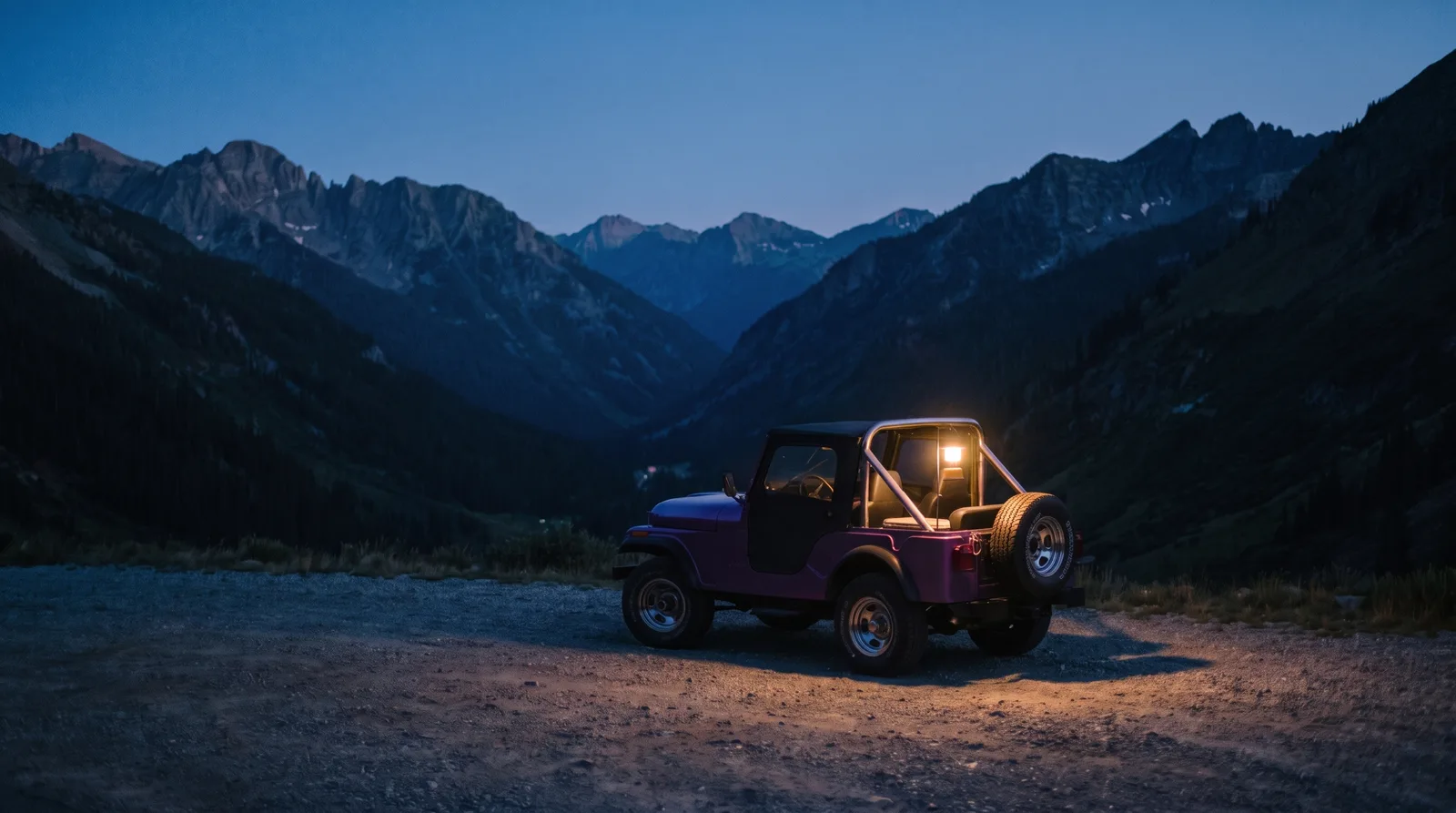
Renegade I and Renegade II, a few hundred at a time
The first Renegade was not a trim level in the way we use the phrase now. It was a limited run, a test, a way of finding out whether anyone would pay extra for a Jeep that did nothing more usefully than the standard one. Kaiser built an estimated 250 to 500 Renegade I units for 1970, then followed with a similarly small run of Renegade II units for 1971, with exact factory figures not consistently documented. Both used the Dauntless V6, wide wheels, a roll bar, and paint chosen to be seen from the far side of a parking lot.
They sold. That was the finding, and it changed the product plan. From 1972 the Renegade became a regular option package rather than a special run, available with the AMC V8, wearing bold side lettering along the body and a hood stripe that made an 83.5 inch wheelbase look longer than it was. The name has never really left Jeep since, which for a badge invented as an experiment is a remarkable career.
What the Renegade proved is easy to state and was not obvious in 1970. People did not buy CJs because they needed one. Some did. Ranchers, county road crews, fire departments. But a growing share of buyers wanted the idea of the vehicle, and the idea could be sold with paint. You can follow how that shift reshaped the whole line in our jeep cj retrospective, but the Renegade is where it becomes visible for the first time.
The Levi's Jeep and the strangest license in Toledo
There is something quietly funny about a car company calling a denim manufacturer to ask permission. That is what happened in the early 1970s, and the result was the Levi's edition CJ, with seats and door panels trimmed in a spun nylon fabric made to look and feel like blue denim, complete with a small red tag stitched into the upholstery in the place a jeans pocket would carry one.
It was not real denim. Real denim in an open vehicle in Arizona would have been a cruelty. But the association worked because it was honest about what the buyer already believed. A Jeep was work clothes on wheels. The Levi's tie-in ran through the 1970s in tan and blue, appeared on CJ-5 and CJ-7 alike, and it remains one of the most recognizable interior treatments of the decade. Restorers pay real money for correct material now, and the fabric is one of the first things a knowledgeable buyer checks, because reproductions vary and the original weave has a specific look under sunlight.
Golden Eagle, or the decade of the hood decal
By 1977 the graphics had escaped the flanks and colonized the hood. The Golden Eagle package put an enormous eagle across the front of the Jeep in gold, added gold-painted wheels, tan denim-look upholstery, a roll bar, and a spare tire cover that continued the theme. It ran through 1979 on the CJ-5 and CJ-7, and it appeared on Jeep pickups too.
You can read the Golden Eagle as a period joke, and plenty of people did in 1990 when these Jeeps were worth almost nothing and the decals were the first thing owners scraped off. That was a mistake, financially and otherwise. The eagle is one of the clearest visual signatures the brand ever produced, and an original unfaded decal on straight hood metal is now a genuine value item. Cars that kept their graphics through the years when nobody wanted them are the ones that photograph best today.
"There is a particular kind of grief in hearing an owner say they stripped the eagle off in 1988 because it looked dated. It did look dated. That was never the point of it."
- Nora Beckett
Laredo, Limited, and the year the CJ got chrome
The 1980s arrived and the packages changed character. Laredo, introduced for 1980, was not about graphics. It was about brightwork and comfort: chrome bumpers, a chrome grille, chrome mirrors, chrome wheels, higher-back seats, a better interior, and a general effort to make a CJ feel like something a person might choose over a normal car rather than in spite of one. The CJ-7 Limited that followed took it further with leather and air conditioning, which in a vehicle with a removable roof is an act of optimism.
These are the packages that tell you the CJ was ending. Not because they were bad, they were not, but because the brief had drifted so far from the 1945 original that a redesign was inevitable. The buyer who wanted chrome and leather in 1982 was going to want doors that sealed and a windshield that did not leak, and the Wrangler that replaced the CJ in 1987 was built for exactly that person.
| Package | Approx. years | Signature details |
|---|---|---|
| Renegade I | 1970 | Limited run, Dauntless V6, roll bar, bold paint |
| Renegade II | 1971 | Second limited run, revised colors and wheels |
| Renegade (option) | 1972 onward | Side lettering, hood stripe, V8 availability |
| Levi's edition | mid to late 1970s | Denim-look spun nylon trim with licensed red tag |
| Golden Eagle | 1977 to 1979 | Gold eagle hood decal, gold wheels, tan interior |
| Silver Anniversary CJ-5 | 1979 | Quick Silver metallic paint, black striping and top, dash plaque marking 25 years of CJ-5; roughly 800 to 1,000 built |
| Laredo | 1980 to 1986 | Chrome bumpers, grille and wheels, upgraded interior |
| CJ-7 Limited | early 1980s | Leather, air conditioning, wide flares |
| Jamboree Commemorative Edition CJ-7 | 1982 | Marked the 30th anniversary of the Jeepers Jamboree; planned for 2,500 units but only 630 were built (560 Topaz Gold Metallic, 70 Olympic White) |
Where the culture actually lived
None of this explains why people loved these vehicles, because trim packages do not create loyalty. Events do. The Jeepers Jamboree first ran the Rubicon Trail in 1953, before the CJ-5 existed, and it turned a rock-strewn route across the Sierra Nevada into a pilgrimage that people plan their year around. Moab's Easter Jeep Safari started in 1967 as a local outing and grew into a week that fills a Utah town. Both predate every graphics package in the table above, and both are still running.
That is the culture: a long weekend, a trail, somebody else's winch, and a story told afterward that improves slightly each time. The CJ was the vehicle that took ordinary people to places they had only seen in photographs, and it did it cheaply enough that a school teacher could afford one. The packages were how the factory tried to bottle that feeling and sell it back. Sometimes it worked beautifully. The Golden Eagle looks like 1977 in the best possible way.
Color deserves its own note here. Through the 1970s Jeep sold the CJ in shades with names like Sunshine Yellow, Nugget Gold, and Firecracker Red, and those choices did as much cultural work as any decal. A yellow CJ-5 parked outside a diner in 1976 announced something about its owner that a white one did not. Collectors now treat original color as close to sacred, partly for authenticity and partly because the period palette is so specific that a repaint in a modern shade drains the character out of the car. Restorers who have lived through a color change will tell you the vehicle looks right again the moment the correct yellow goes back on.
Television helped. A bright CJ-7 driven by a character on a Friday night network show in the early 1980s put the shape in front of millions of people who had never considered a Jeep, and dealers noticed. Pop culture did not invent the CJ's appeal, but it broadcast it, and the timing lined up with the Laredo and Limited years when Jeep most needed the attention.
What the badges are worth now
Trim matters to value in this market more than it does in most. A documented Renegade sits above an equivalent base CJ-5. A correct Golden Eagle with unfaded graphics and an intact interior sits above a repainted plain car of the same year. Laredo Scramblers and Laredo CJ-7s command a premium that has held steady through several market cycles. The early Renegade I and II cars are their own category entirely, because a few hundred units of anything, forty-five years later, means most of them are gone. Verified survivors of those two runs surface rarely enough that the community tends to know each one by name and owner, which is its own form of provenance.
The trap is obvious once stated. Decals can be bought. Anyone can order a Golden Eagle kit and apply it to a 1978 base CJ-5, and plenty of people have, sometimes without any intention to deceive. The defense is paperwork: build sheets, original window stickers, dealer records, and the small details that reproduction kits get slightly wrong. Buy the documentation, not the stripe. If you are working out which body style and which package suits you, keep exploring before you commit, and when you are ready to compare real cars, look at what is listed as a classic CJ for sale and note how consistently the packaged cars outrun the plain ones.
Forty-one years of CJ production produced a lot of paint schemes and a small number of genuinely important ones. The Renegade is important because it proved the audience existed. The rest, the denim and the eagle and the chrome, are the industry answering a question a few hundred loud Jeeps had already settled in 1970.
Sources and notes
Related Reading

About the author
Nora Beckett
Automotive features writer and photographer who tells the human stories behind the cars, from show fields to cross-country road trips.
Related Listings - Jeep CJ





Comments
Be the first to comment on this article.