
A birthday is a strange thing to put on a work truck, but Jeep did it more than once. The jeep cj culture anniversary editions mark the moments when the company paused its usual model-year cycle to remind buyers exactly how long the CJ had been on the road. The most notable of these came in 1979, when American Motors marked twenty-five years of CJ-5 production, and the CJ-5 wore that milestone in the form of a genuine special edition.
Car Features
6 min read
Marking the Years: The CJ Anniversary Editions
In 1966 Kaiser Jeep marked twenty-five years of the Jeep name with a Silver Anniversary CJ-5, starting a tradition of anniversary special editions that outlived the CJ itself.
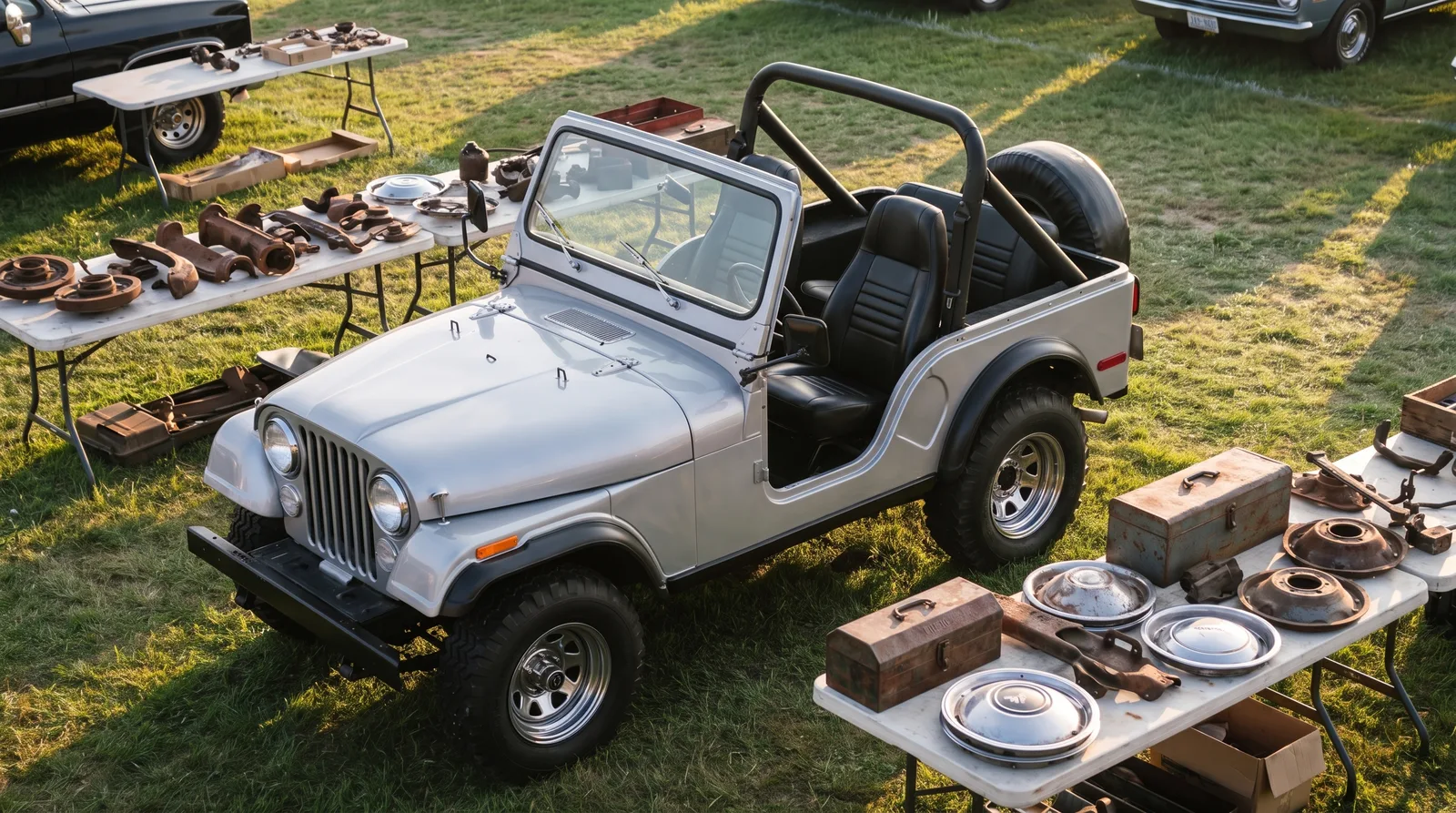
Twenty-five years of a name that started in mud
The CJ-5 traces back to 1954, when it replaced the CJ-3B as Jeep's core civilian offering. By 1979, twenty-five years later, American Motors, which had owned Jeep since buying Kaiser-Jeep in 1970, had ample reason to celebrate. The CJ-5, by then a fixture of the lineup, received a Silver Anniversary treatment that year, distinguished by Quick Silver metallic paint, black-to-silver accent striping, Renegade decals on the hood sides, a black soft top, a custom spare tire cover, black vinyl bucket seats, and a dashboard plaque noting the CJ-5's production run from 1954 to 1979.
The anniversary framing mattered because it let Jeep tell a story about continuity. A quarter-century earlier, the CJ-5 had replaced an older, narrower Jeep design built mostly for farm and light-duty work. By 1979 it had become a fixture on American farms, in national parks, and increasingly in the driveways of buyers who simply liked the look and capability of a small, tough truck. The Silver Anniversary edition gave Jeep a moment to connect those two identities explicitly, work truck and cultural icon, in a single special-edition package.
What the badge actually meant
Anniversary editions across the CJ's run tended to be modest in scope compared to some of the more elaborate appearance packages that followed later in the 1970s. The Silver Anniversary CJ-5 carried specific badging and trim touches to mark the occasion, but it did not fundamentally rework the truck's mechanical layout or design. That restraint fits the moment: Jeep in 1979 was celebrating survival and continuity more than reinventing itself, and the anniversary package reflected that quieter kind of pride rather than a loud sales pitch.
Production of the Silver Anniversary package was limited to around 1,000 units, making it a genuinely scarce find compared to the regular-production Renegade or Golden Eagle packages sold in the same era. The anniversary framing itself became something of a recurring idea in Jeep marketing, one the company would return to again in later decades on vehicles well beyond the CJ line, including well after the CJ gave way to the Wrangler.
A pattern that outlasted the CJ
Anniversary-themed editions did not end with the CJ line's retirement in 1986. Jeep would revisit the anniversary concept repeatedly on later Wrangler generations, marking twenty-five, thirty, fifty, and further milestones with dedicated special editions that echo the same basic instinct the 1979 CJ-5 package established. Whether any individual buyer of a modern anniversary Wrangler realizes the tradition traces back to a 1979 CJ-5 is another matter entirely, but the lineage is real, and it started with the CJ.
Anniversary editions also sat alongside a broader wave of CJ special editions and appearance packages that spanned the vehicle's production run, from decal-heavy 1970s options through the comfort-focused trims of the early 1980s. For our jeep cj renegade retrospective and the fuller trim history it covers, the anniversary editions fit into a much longer pattern of Jeep marking distinct eras through special badges and packages rather than wholesale redesigns.
"An anniversary edition tells you a company believes in its own history enough to put it on the hood. The CJ earned that kind of confidence by the time 1979 rolled around."
- Nora Beckett
How anniversary marketing differed from decal marketing
It is worth drawing a clear line between anniversary editions and the appearance packages that came to define the CJ-5's later 1970s catalog, since the two approaches sold fundamentally different ideas even though both used special badging and trim to stand apart from a base truck. Renegade and Golden Eagle sold personality and boldness aimed at a buyer thinking about the truck's future, how it would look at a campsite or a drive-in that weekend. The Silver Anniversary package sold heritage instead, asking a buyer to think backward across twenty-five years of a name's history rather than forward toward a lifestyle image.
That distinction mattered for who each approach actually reached. A buyer drawn to an anniversary edition tended to already understand and value the Jeep name's history, often someone who had grown up around the vehicle or served alongside one during the war years that gave the brand its start. A buyer drawn to Renegade or Golden Eagle a decade later often had no personal connection to that wartime history at all and was responding purely to contemporary style. Jeep effectively ran two different conversations with two different generations of customers, sometimes within the same decade of production.
Later anniversary packages on the Wrangler and beyond would blend both approaches, pairing heritage-focused badging with more contemporary styling cues borrowed from whatever appearance trends were current at the time. That blended formula traces its roots directly back to lessons Jeep learned from running these two distinct marketing tracks separately during the CJ years, making the 1966 Silver Anniversary package an early, comparatively simple version of an idea the company would refine for decades afterward.
Related territory worth exploring
Readers interested in how Jeep used decals and named packages to mark different moments in the CJ's story should also look at how the decal era unfolded more broadly through the 1970s, since anniversary badging and full graphics packages grew out of similar marketing instincts even if they served different purposes. A related story covers that decal-heavy period in detail, and reading the two together fills out a fuller picture of how Jeep used special trim to keep the CJ feeling fresh across four decades of production.
Tracking one down
A genuine 1979 Silver Anniversary CJ-5 is a scarce, specific find, and buyers should expect limited paperwork and provenance compared to more common CJ-5s from the same era. Verified badging and documentation matter enormously for anyone chasing this exact piece of Jeep history rather than a plain CJ-5 dressed up to look the part. For collectors interested in this corner of CJ history, or anyone simply drawn to the story a well-preserved anniversary truck can tell, CJs for sale now is a good place to start comparing what is actually available against the history behind it.
Sources and notes
Related Reading
Have a
Jeep CJ
for Sale?
Reach thousands of serious classic car collectors across the US.
Sell It Here →
Selling a classic? Here's how: compare the places to sell classic cars
Are You a Classic Car Dealer?
List your full inventory and connect with targeted classic car buyers.
Join as a Dealer →

About the author
Nora Beckett
Automotive features writer and photographer who tells the human stories behind the cars, from show fields to cross-country road trips.
Related Listings - Jeep CJ
Comments
Be the first to comment on this article.