
In August 1953, a small group of businessmen in Georgetown, California needed a way to draw visitors to a town that tourists usually drove past. They settled on an idea that sounded reckless on paper: take a caravan of Jeeps across twenty two miles of the Sierra Nevada's most unforgiving granite, from Georgetown to Lake Tahoe, and let word of mouth do the rest. The Jeepers Jamboree that resulted became one of the founding events of American off road culture, and the classic Jeep CJ was its vehicle of record for more than three decades.
Car Features
7 min read
The Jeepers Jamboree: How a Trail Run Built a Culture
A 1953 publicity idea from a small California town became the Jeepers Jamboree, the annual Rubicon Trail crossing that turned the Jeep CJ into an off road icon.
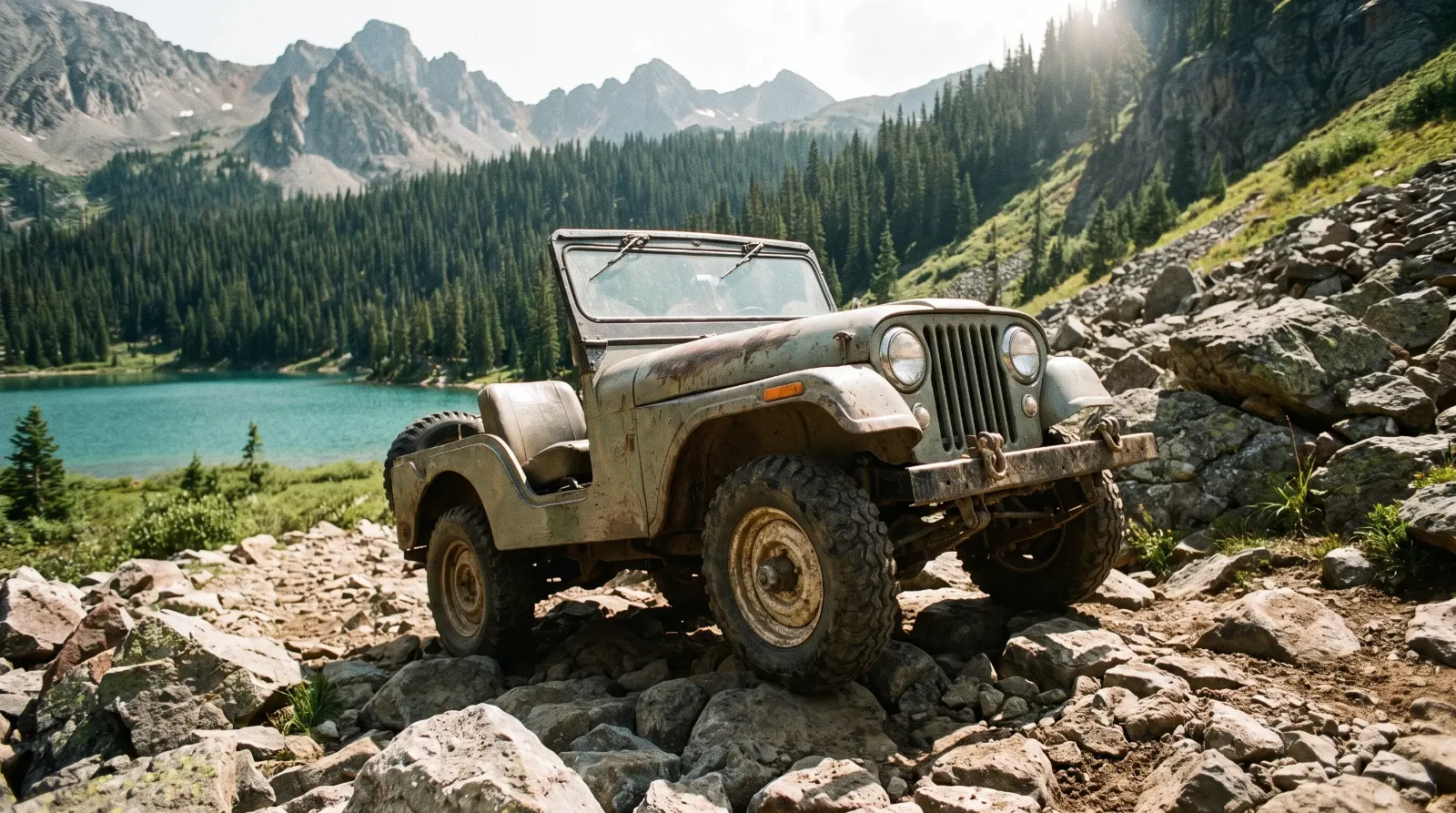
A publicity idea that became a proving ground
The first Jeepers Jamboree drew fifty five vehicles and about 155 people, a number that seems modest until you consider what those drivers were actually attempting. The Rubicon Trail was not a marked recreational route in 1953. It was a rough wagon and mining road across exposed bedrock, largely unmaintained, that had been used by loggers, cattlemen, and prospectors going back to the nineteenth century. Running it in a Jeep CJ, most of them recently civilianized war surplus vehicles or their close postwar descendants, was as much an experiment as an event.
It worked. Vehicles broke, axles bent, and drivers walked out with stories, and every one of those stories became free advertising for both the town of Georgetown and for Jeep itself, even though the event was never officially sponsored by the manufacturer in its early years. Attendance grew steadily through the 1950s and 1960s, and the Jamboree evolved its own calendar, its own volunteer support crews, and its own reputation as the event a serious CJ owner attended at least once.
Why the CJ was the right tool for a granite trail
The trail's obstacles rewarded a specific kind of vehicle: short wheelbase, solid axles front and rear, low range gearing, and enough ground clearance to climb ledges without dragging the frame. The CJ-3B, with its taller hood and F-head engine, and later the CJ-5, fit that profile closely. Their narrow track let drivers pick a precise line between boulders that stopped wider, longer vehicles outright, and their light weight meant a stuck Jeep could often be muscled free by a handful of people rather than requiring a winch truck.
None of that made the trail easy. Obstacles that Jamboree veterans nicknamed Little Sluice, Big Sluice, and Cadillac Hill broke axle shafts and cracked oil pans with enough regularity that the event organized trailing mechanics and parts support as a matter of course. A first time participant quickly learned that finishing the Rubicon in a CJ was less about the vehicle's specification sheet and more about how well it had been maintained, and how much luck the driver had with the line they chose.
A community built one crossing at a time
What separated the Jamboree from a simple off road excursion was the community that formed around repeating it. Families returned year after year in the same CJ, sometimes handing the vehicle down a generation while the trail crossing became a standing tradition. Veterans of the event traded stories at the Saturday night gathering in Georgetown, comparing notes on which obstacles had claimed which parts that year, and newcomers were absorbed into a culture that valued self reliance, patience, and a willingness to get out and look at the rock before committing a tire to it.
That community has its roots documented across the full story of how the CJ became more than a farm and military vehicle, but the Jamboree deserves particular credit for building the social infrastructure, the clubs, the informal mentorship, the shared vocabulary of trail obstacles, that off roading still runs on today. Long before internet forums organized meetups, the Rubicon crossing was doing exactly that in person, once a year, on foot beside a stalled Jeep.
The event also shaped how manufacturers and dealers thought about promoting capability. Photographs of CJs perched on granite ledges above Lake Tahoe circulated in dealer showrooms and enthusiast publications, giving buyers a visual argument for the vehicle's toughness that no brochure copy could match. That imagery outlived the CJ itself, feeding directly into the reputation that later Jeep products, including the Wrangler Rubicon decades afterward, would trade on.
"There was a particular quiet that settled over the group the first time they saw Cadillac Hill up close. Everyone had heard about it. Nobody quite believed a stock Jeep was meant to climb it until they watched one do exactly that, tires clawing at bare rock, and then it was their turn."
- Nora Beckett
What the Jamboree still means to CJ owners
The event outlasted the CJ's production run, which ended in 1986, but it never stopped drawing CJ owners specifically. Restored CJ-5s and CJ-7s remain a fixture of the modern Jamboree roster, often driven by people who inherited both the vehicle and the tradition from a parent or grandparent who first crossed the Rubicon decades earlier. A CJ with genuine, documented Jamboree history, dash plaques, event patches, period photographs, carries a kind of provenance among collectors that a purely cosmetic restoration cannot match, because it proves the vehicle did what it was built to do rather than simply looking the part in a garage.
For anyone drawn to that history, the appeal is less about horsepower figures and more about continuity, a trail that has not changed much since 1953, and a machine that was, for most of that history, the only realistic way to see it from the driver's seat. Those interested in owning a piece of that story can look at a classic CJ for sale and weigh how much of the vehicle's trail heritage survives intact.
A trail run that became a tradition
Seven decades on, the Jeepers Jamboree still runs the Rubicon every year, still breaks parts, and still produces the same kind of stories that filled the Saturday night gathering in 1953. The CJ is no longer the dominant vehicle on the trail, replaced largely by modern trucks and SUVs with far more suspension travel, but its early decades on that granite are the reason the event, and the trail itself, carry the weight they do in American off road history.
The organizational structure the Jamboree built in those early decades also outlasted the CJ era in ways that are easy to overlook. Volunteer trail marshals, staged parts and mechanical support, and a formal registration and safety process were not standard features of off road events in the 1950s and 1960s, and the Jamboree's steady refinement of that model influenced how other trail runs across the country came to organize themselves. What began as a way to get a caravan of CJs safely across a dangerous, unmarked trail became, in effect, a template for running any large scale off road event responsibly.
The financial structure mattered too, in a quieter way. Jamboree registration fees have historically funded not just the event itself but ongoing trail maintenance and access advocacy for the Rubicon corridor, a model that helped keep the route open to recreational use even as land management priorities shifted over the decades. Long time participants often describe a sense of stewardship that grew directly out of repeated crossings, a feeling that a trail this demanding, and this central to a shared history, was worth protecting rather than simply using up.
Sources and notes
Have a
Jeep CJ
for Sale?
Reach thousands of serious classic car collectors across the US.
Sell It Here →
Selling a classic? Here's how: where to sell your classic car online
Are You a Classic Car Dealer?
List your full inventory and connect with targeted classic car buyers.
Join as a Dealer →

About the author
Nora Beckett
Automotive features writer and photographer who tells the human stories behind the cars, from show fields to cross-country road trips.
Related Listings - Jeep CJ


Comments
Be the first to comment on this article.