
The Model T lasted from October 1908 to May 1927 in the United States. The Model A that replaced it was sold as a 1928, 1929, 1930 and 1931 model, and then it was gone. Four model years for a car that sold close to 4.85 million copies looks abrupt, and the question of why the Model A ended so quickly gets answered with a lot of loose talk: that it failed, that the Depression killed it, that Henry Ford lost interest. The records tell a more specific story. The car did not fail. The market it was built for changed shape under it, and Ford decided to answer with something new rather than keep refining a four-cylinder car.
Car Features
6 min read
Why the Model A Ended After Four Years
The Model A sold close to 4.85 million cars, then ended after the 1931 model year. Production records, the Chevrolet six and Henry Ford's V8 decision.
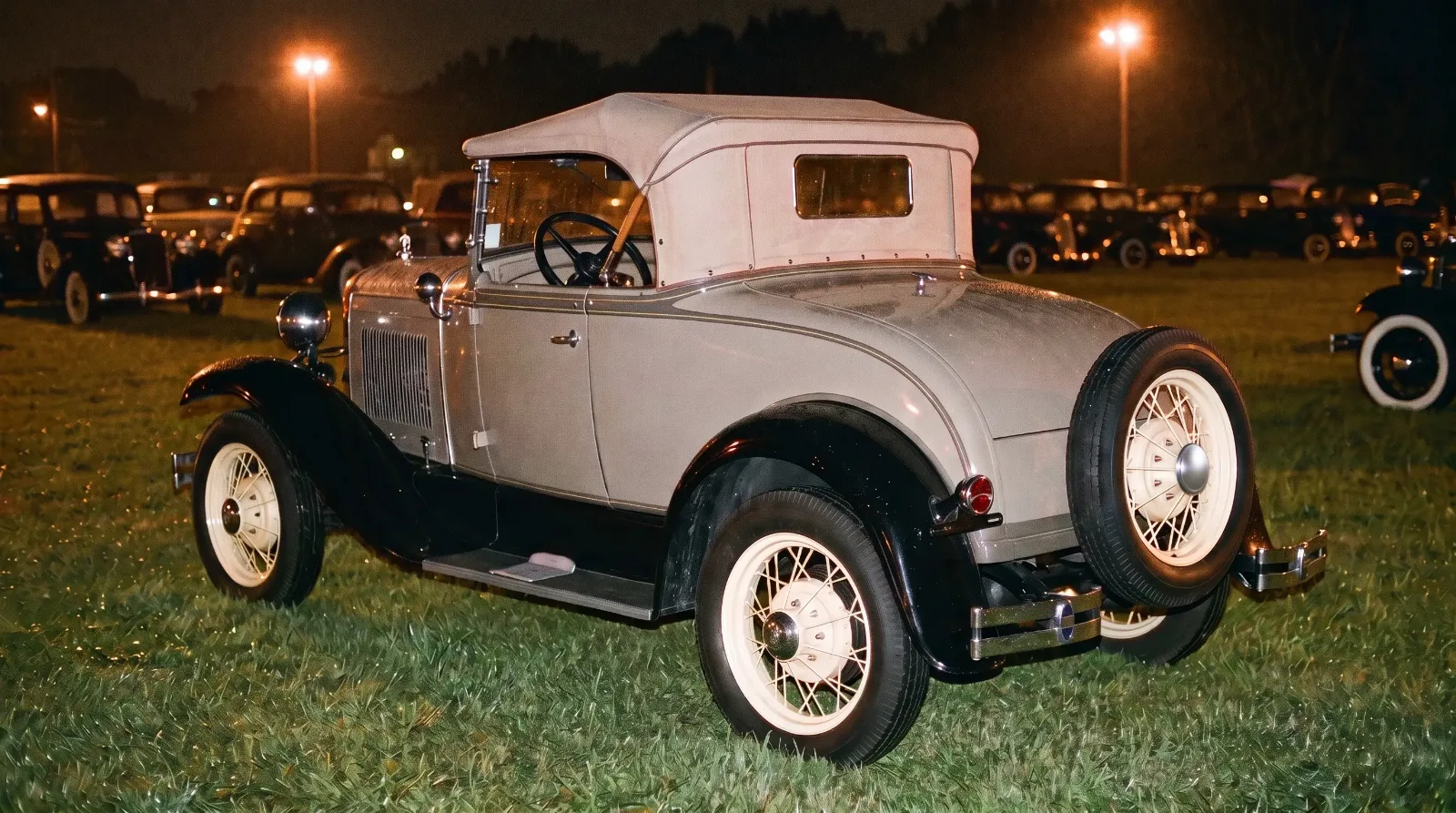
The record first: what "ended" means
Before getting to causes, it helps to fix the dates, because "1931" is only part of the answer. The 1931 model was the last Model A model year. Final assembly did not stop on a single day; it ran on to March 1932, with most of the last cars built in Canada. Engine production tells the same story from the other end: 4,830,806 Model A engines were built between October 1927 and November 1931. Total Model A production is given as 4,849,340 by the Model A club and 4,858,644 in other references, both counting all body styles worldwide from October 1927 to March 1932.
You will sometimes read that the Model A stopped on a single day in 1931. The production record does not support that: cars were still being assembled into early 1932. It is safer to say that 1931 was the final model year and that the line wound down over the following winter. The full year-by-year picture is in the Model A history chapter.
Why the Model A ended: the numbers that turned
The clearest single reason is in Ford's own output. US Ford passenger car production climbed from 633,594 in 1928 to 1,507,132 in 1929, the car's best year, when Ford passed Chevrolet to regain the US sales lead. After that, the line slopes down.
| Year | US Ford cars | US Ford trucks | Note |
|---|---|---|---|
| 1928 | 633,594 | 110,342 | Chevrolet still out-produced Ford |
| 1929 | 1,507,132 | 355,453 | Peak year; Ford back to first place |
| 1930 | 1,155,162 | 272,897 | Restyled cars, falling market |
| 1931 | 541,615 | 186,394 | Last model year; Chevrolet back in front |
| 1932 | 287,285 | 105,283 | Model A run-out, then the new cars |
Car output fell by more than half between 1930 and 1931. The Henry Ford museum puts it plainly: the Depression halved Ford's annual production to 541,000 cars. The whole industry suffered the same way, with US vehicle output dropping from 5,337,000 in 1929 to 1,332,000 in 1931. The yearly breakdown by body style is in the production figures.
But the Depression alone does not explain why Ford replaced the car. A collapsing market hurts every maker; it does not, by itself, tell a company to retire its product. What made the difference was where Ford stood inside that shrinking market. Chevrolet took the US sales lead back in 1931. In a smaller pie, losing first place hurt more.
Four cylinders against six
The Model A was designed as a four-cylinder car in 1927, with 40 horsepower from 201 cubic inches. That was a big step up from the Model T's 20, and for one season it was enough. Then, on 17 November 1928, Chevrolet introduced its 1929 six: a 194 cubic inch overhead-valve inline six rated at 46 horsepower, six more than the Model A, priced from $525 to $725. Chevrolet sold it as a six in the price range of a four, and the engine became known as the "Stovebolt."
That put Ford in an awkward position. The Model A was a good car, but on paper it was now the smaller engine with fewer cylinders, and buyers in the low-price field compared exactly those things. Ford refreshed the A for 1930 and again for 1931 with new bodies, lower lines and smaller wheels, but the engine stayed a four. Body changes could keep the car current to the eye. They could not change the cylinder count.
"The Model A did not wear out. Ford sold it in the millions, and the last ones were as well built as the first. What changed was the question buyers asked in the showroom, and by 1931 the question was how many cylinders."
Tom Ramirez
Henry Ford's decision of October 1931
The decision that closed the Model A chapter came from the top. In October 1931 Henry Ford decided to introduce a V8 for 1932. That choice, rather than any failure of the A itself, set the end date. Ford answered the Chevrolet six not with a six but with eight cylinders, and building an inexpensive V8 in volume meant new engine tooling and a new car around it.
Here a common myth needs correcting gently. The Model A is sometimes described as a stopgap Ford rushed out after the T and dropped as soon as possible. The record does not support that. The A was planned as a complete new car, with no parts carried over from the Model T, and it ran four full model years with yearly updates. It ended because Ford chose a bigger change, made in a year when Ford's output had halved, when the cost of keeping a four-cylinder car on top was rising and the volume to pay for it was falling.
It is often said that the gap between the aging Model A and a V8 that was not yet ready for production sent buyers to General Motors during 1931. The rank order is documented; the reasons customers gave are not, so treat that as interpretation.
What carried on after the last Model A
The Model A did not vanish from the world at once. Overseas production was still building up as US production wound down: Dagenham's first vehicle off the line, in October 1931, was a Model AA truck, and Ford's new Cologne plant began production with the Model A on 4 May 1931. In the Soviet Union, the GAZ-A, a copy of the 1930 Model A, was built from December 1932 to 1936, with 41,917 made. The AA truck line ran through 1932 before the Model BB took over.
In the United States, the 1932 Ford V8 and the four-cylinder Model B were introduced on 31 March 1932, and you can follow that thread in the flathead V8 that followed.
Sources and notes
Related Reading
Have a
Ford Model A
for Sale?
Reach thousands of serious classic car collectors across the US.
Sell It Here →
Selling a classic? Here's how: compare the places to sell classic cars
Are You a Classic Car Dealer?
List your full inventory and connect with targeted classic car buyers.
Join as a Dealer →

About the author
Tom Ramirez
Corvette researcher and historian based in Bowling Green, Kentucky. Two decades documenting Corvette production history from original factory records.
Related Listings - Ford Model A




Comments
Be the first to comment on this article.