
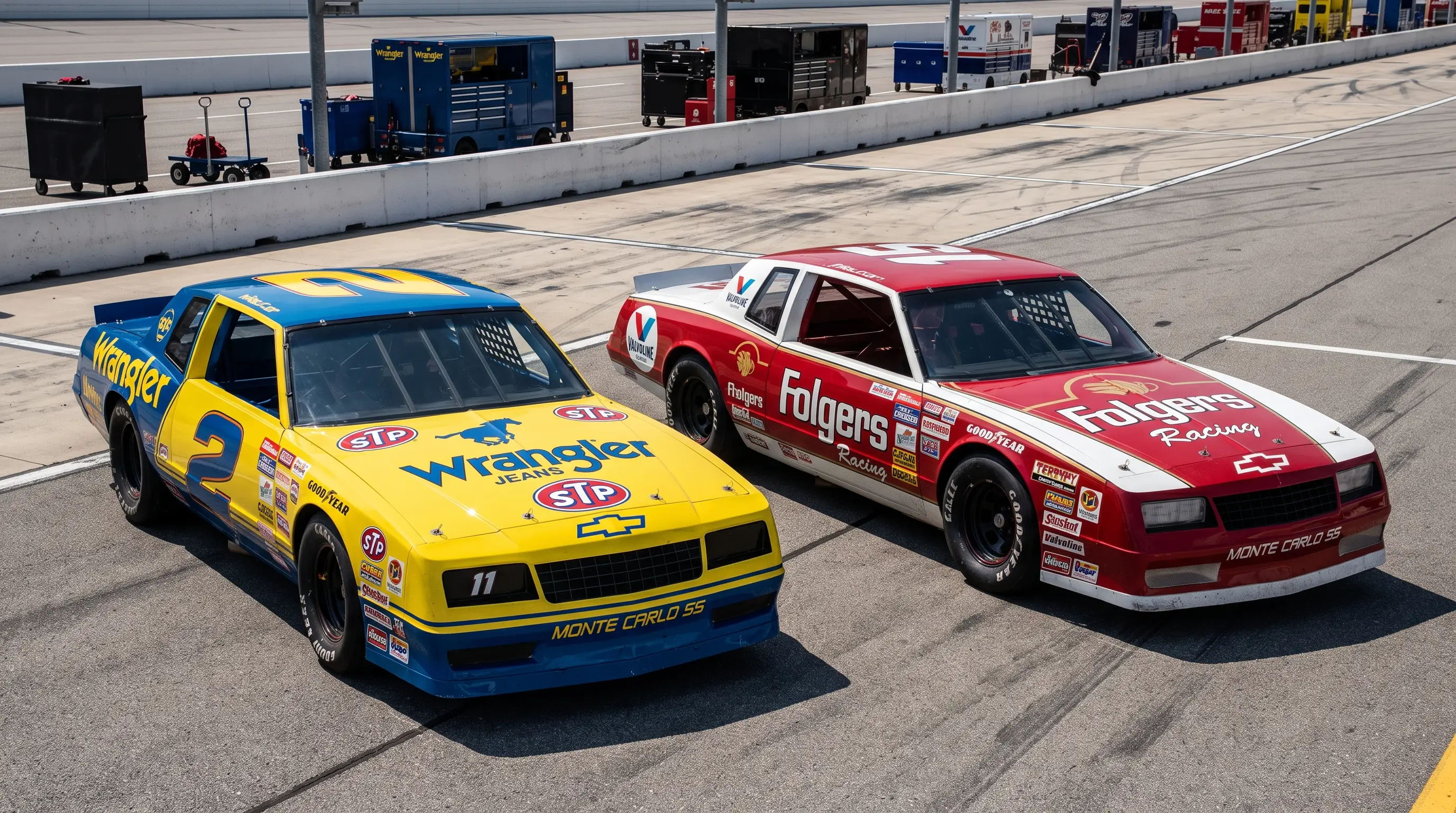
I used to sit at a card table folding table in a garage with a handful of Monte Carlo guys, and one of them, an old NASCAR mechanic who worked shorter tracks in the eighties, told the same story every time somebody brought up the Aerocoupe. He said the first time he saw one on the track next to a standard notchback Monte Carlo, he thought somebody had swapped the back glass off a different car entirely. That is the monte carlo nascar aerocoupe 1987 dominance story in a nutshell, a car whose whole purpose was hiding in one stretched piece of rear glass.
Car Features
7 min read
The Aerocoupe and Chevy's Speedway Dominance
A garage story about the Monte Carlo Aerocoupe's reshaped rear glass, the homologation rules behind it, and why documentation matters more than looks.
A back window built to solve a problem
By the mid-1980s, the standard Monte Carlo SS notchback that had returned Chevrolet to competitiveness in 1983 was starting to lose ground again as rival manufacturers refined their own aero packages. The Aerocoupe's answer was a more steeply raked rear window and a longer, smoother deck lid, changes that look modest in a photograph but mattered enormously at superspeedway velocities. The old mechanic's point about the back glass was not exaggeration. That single panel change was the whole reason the car existed.
Like the 1983 SS before it, the Aerocoupe had to be homologated, meaning Chevrolet built a limited run of production cars carrying the new rear glass and deck lid so the race version could legally compete. Those production Aerocoupes are the cars collectors chase hardest today, and every one of them exists because of a NASCAR rulebook requirement rather than a styling department's whim.
What the shape actually bought the team
Drivers running the Aerocoupe at Daytona and Talladega noticed the difference the way the mechanic noticed it from the pits, immediately and without needing a stopwatch to confirm it. The car sat cleaner in the draft, gave up less speed in traffic, and held its line better at the top of the corner where the old notchback body had been more prone to aerodynamic push. That stability translated into better finishes across the superspeedway schedule during the years the Aerocoupe raced.
It also built on everything that had already been proven with the 1983 return to aero competitiveness. The Aerocoupe was not a separate idea. It was the same engineering philosophy pushed one generation further once the earlier SS nose alone was no longer enough to hold the advantage against rival manufacturers who kept refining their own bodies in response.
Why the shape mattered more than the badge
Plenty of casual fans assumed the Aerocoupe name referred to some kind of engine or trim upgrade, and the mechanic used to get a kick out of correcting that assumption. He would point out that the whole car was mechanically identical to a standard Monte Carlo SS underneath. The engine, the suspension, the interior, none of it changed. The only thing that mattered was the sheet metal from the B-pillar back, and that narrow scope is exactly why the homologation rule existed in the first place. NASCAR was not regulating horsepower with this requirement. It was regulating shape, because shape was what actually decided who won on the biggest tracks.
That distinction matters for anyone trying to understand why the car gets talked about with such reverence today. It was not a performance model in the traditional sense, built around a bigger engine or a stiffer suspension. It was an aerodynamic model, built around a single insight about how air moved over the back of the car, and that narrow but decisive change is what earned it a permanent place in NASCAR history.
The garage stories that outlasted the racing
A production run small enough to matter
Because the Aerocoupe only existed to satisfy a homologation minimum, Chevrolet built far fewer of them than a standard Monte Carlo SS in the same model years, and that scarcity is baked into the car's reputation today. The old mechanic used to say most of the guys at his shop back then treated the Aerocoupe as a curiosity rather than something worth chasing, since at the time it was simply the tool that let the race team compete rather than a collectible in its own right. Nobody in the garage in the mid-1980s was thinking about resale value decades down the road. They were thinking about whether the car would hold its line at Talladega on Sunday.
That lack of contemporary appreciation is exactly why so many original Aerocoupes did not survive in unmolested condition. Some got parted out, some got repainted into something else entirely, and some simply got driven hard and used up the way any daily-capable performance car from that era eventually did. The ones that survived with their original glass, original deck lid, and original paperwork intact are genuinely rare today, and that rarity is a direct consequence of nobody realizing at the time how significant the car would become.
What stuck with me from that folding table conversation was not the technical explanation, which I had heard plenty of times from other people. It was how the mechanic talked about the paperwork. He said the real proof of a legitimate Aerocoupe was never the car itself, since a determined shop could fake the look. The real proof was the build sheet, the dealer invoice, the documentation trail that showed the car left the factory with that rear glass already installed rather than added later by somebody chasing a trend.
That is a lesson that has stuck with every serious Monte Carlo collector I have ever met. The romance of the racing story gets people interested, but the paperwork is what actually separates a real Aerocoupe from a well-built imitation, and the old-timers who lived through the racing era are usually the first to say so.
"Anybody can chop a back window and call it an Aerocoupe. The car that actually raced left the factory with a build sheet proving it, and that piece of paper is worth more than any story you can tell about it."
- Wayne Coburn
Why the story still gets told
Every generation of Monte Carlo enthusiast eventually hears some version of the mechanic's story, whether it comes from an old racer, a longtime club member, or a magazine article decades after the fact. The details shift depending on who is telling it, but the core of it never changes. A single reshaped panel took Chevrolet from playing catch-up to genuinely competing at the front of the pack on NASCAR's fastest tracks. For the our complete history of how that racing program unfolded across the whole decade, the fuller story fills in everything that happened before and after this particular chapter.
And if hearing these stories has you wanting to track one of these cars down yourself, you can always find a classic Monte Carlo worth chasing, documentation and all. Just remember what the old mechanic always said. The car tells half the story. The paperwork tells the rest.
Sources and notes
- Silodrome - A NASCAR Homologation Special: The Chevrolet Monte Carlo SS Aerocoupe
- Barn Finds - NASCAR-Inspired: 1987 Chevrolet Monte Carlo Aerocoupe
- Autoblog - The Forgotten Chevy Monte Carlo That Was Built Just to Win NASCAR
- Moto Gallery - 1986-1987 Chevrolet Monte Carlo Aerocoupe
- Chevrolet Monte Carlo - Wikipedia
- Old Cars Weekly - Car of the Week: 1987 Chevrolet Monte Carlo SS Aerocoupe
Related Reading
Have a
Chevrolet Monte Carlo
for Sale?
Reach thousands of serious classic car collectors across the US.
Sell It Here →
Selling a classic? Here's how: sell my classic car
Are You a Classic Car Dealer?
List your full inventory and connect with targeted classic car buyers.
Join as a Dealer →

About the author
Wayne Coburn
Longtime Corvette owner, judge and club figure who knows the cars, the records and the people behind them.
Related Listings - Chevrolet Monte Carlo
More in Car Features
Comments
Be the first to comment on this article.