
For years, everybody at a Shelby gathering knew there were six 1966 GT350 convertibles. People said it with confidence, "one of six" followed those cars around, and nobody had much reason to argue. Then, in 1987, someone went through papers in Shelby's old Gardena office and found an order dated June 7, 1966, for "four experimental convertibles." Four. Not six. The hobby had been counting two cars that never existed, and it took a piece of paper to settle it.
Car Features
6 min read
Shelby Production Numbers and the SAAC Registry
Shelby Mustang production numbers for 1965 to 1970, where the sources disagree, and how the SAAC Registry turned owner records into the yardstick.
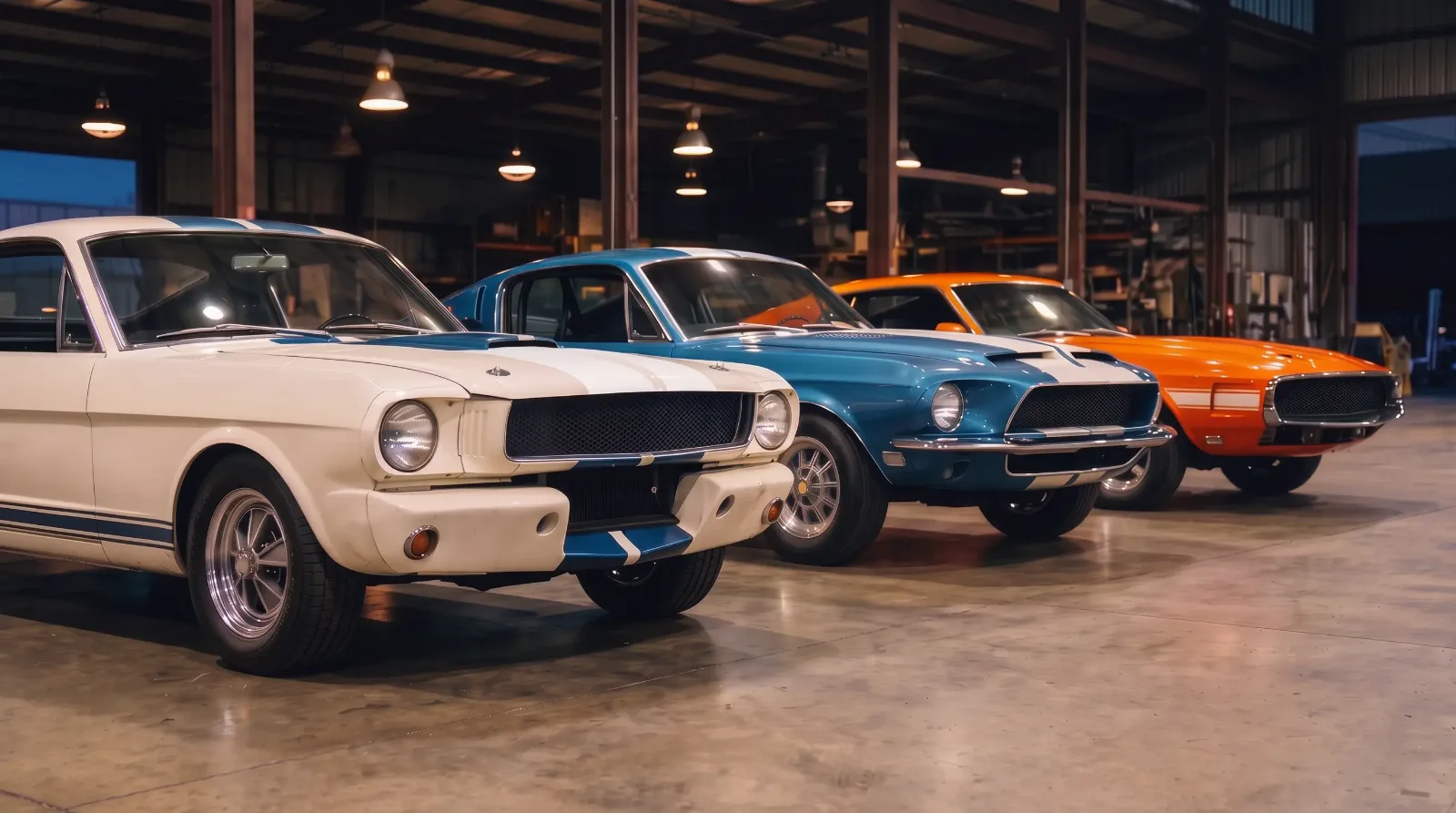
That story is the whole subject in miniature. Shelby Mustang production numbers are not just trivia; they are the yardstick every claimed car gets held against, and most of them trace back to records kept by owners rather than by the factory. The cars and the people behind them are told as Shelby Mustang history in full elsewhere. This piece is about the counting.
Shelby Mustang production numbers, year by year
Here are the totals as the best-supported references give them, with the breakdowns that matter most to buyers.
| Model year | Total built | Breakdown on record |
|---|---|---|
| 1965 | 562 | 504 street cars, 34 R-models, 1 street prototype, 2 competition prototypes, 4 drag cars, 17 other prototypes |
| 1966 | 2,378 | About 1,000 Hertz GT350H, about 1,370 regular GT350s, 4 convertibles |
| 1967 | 3,223 | 2,048 GT500, 1,175 GT350 |
| 1968 | 4,450 | GT350 fastback 803 + 224 Hertz, GT350 convertible 404, GT500 fastback 1,044 + 2 Hertz, GT500 convertible 402, GT500KR fastback 1,053, KR convertible 517, 1 Trans-Am coupe |
| 1969 and "1970" | 3,150 | GT350 SportsRoof 935 + 152 Hertz, GT350 convertible 194, GT500 SportsRoof 1,534, GT500 convertible 335 |
Add the five rows and you get 13,763 cars for 1965 through 1970. Treat that as arithmetic, not gospel: it is a sum of the year totals above, not a single grand total published by the club, and the one-off cars at the edges of each year can move it by a handful either way.
The Mexican cars sit outside all of this. Shelby de Mexico built 169 cars in 1967, 203 in 1968 and 306 in 1969, and none of them are in the US totals.
Inside each year: where the counts get slippery
The 1965 count is the tidiest, because the run was small. Even so, notice how much of the 562 is not a street car: prototypes, race cars and drag cars make up more than ten percent.
The 1966 numbers are where references start to disagree. The regular GT350 count shows up as 1,356, 1,365, 1,368 and 1,372 depending on who you read, which is why "about 1,370" is the honest way to say it. The Hertz fleet is 999, 1,001 or 1,003, and the gap is mostly whether two prototypes get counted. None of these sources is lying. They are counting slightly different things.
For 1967, most references agree on 2,048 GT500s and 1,175 GT350s, while one gives 2,050 and 1,173. That same year also produced oddities that sit awkwardly in any table: a single GT500 convertible, a notchback prototype, up to three 427-powered GT500s and 26 coupes built for FIA Group 2 racing.
The 1968 model year brought a new address. Production moved to A.O. Smith in Ionia, Michigan, in August 1967, a shift covered here in detail, and base cars came from Ford's Metuchen plant. The mid-year KR is the usual source of argument: about 1,570 or 1,571 in total, with the convertible count given as 517 or 518. One auction catalog once printed 318, which looks like a transposed digit rather than a real number. The full story of the GT500KR is worth reading before you trust any single figure.
Then there is 1970, which technically does not exist. No 1970 Shelbys were built. Roughly 789 unsold 1969 cars were given 1970 serial numbers instead. One source says 601, but most agree on 789.
The SAAC Registry: how a club counted every car
Most of the precision in those tables comes from the Shelby American Automobile Club. SAAC was founded in 1975 by a handful of owners, has published its magazine, The Shelby American, continuously since 1976, and has held a national convention every year since 1976.
The club's Registry is the real prize. It was built from serial numbers and owner records gathered by members over more than thirty years, each record matched to a car. A 1997 Registry edition drew in part on documents loaned from Shelby's own files, papers that had turned up in his attic. One telling detail: about three quarters of the Ford VIN records came from sources other than Shelby. The club did not inherit a tidy factory ledger. It assembled one, piece by piece, from the cars themselves.
That is why the Registry carries weight in a sale. A car whose serial number appears in it, with a traceable chain of owners, is a known quantity. A car with a story and no Registry trail is a story. When a serial number is in question, start with the classic Mustang VIN decoder story, then check the Registry.
"I have heard a hundred good stories about Shelbys. The ones I believe are the ones where the owner reaches into a folder instead of into his memory."
Wayne Coburn
When Shelby and the club parted ways
The relationship between the club and the man had its own paperwork. On October 31, 2007, Shelby's side announced Team Shelby, billed as the only club recognized by the factory, to launch on January 11, 2008, his 85th birthday. Two weeks later, on November 14, 2007, Shelby's attorney wrote that SAAC's license, which had cost the club one dollar a year, would not be renewed when it expired on January 31, 2008, Shelby also demanded the return of the documents he had loaned the club. The Registry's value, though, was never in the license. It was in the decades of serial-number work behind it.
The six-convertible myth survived until 1987. It ended because someone found a document and the club wrote it down. Every number in the table above survives for the same reason, and every car that claims a place in it has to clear the same bar.
Sources and notes
- Shelby Mustang (Wikipedia): yearly production, 1970 re-serialing, Shelby de Mexico
- Shelby FAQ (archived): 1968 and 1969 production breakdowns
- MustangSpecs: 1965 Shelby GT350 production breakdown
- Shelby American Automobile Club: about the club
- Sports Car Market (Colin Comer, 2008): Shelby sacks SAAC
- Sports Car Market: Team Shelby announcement, October 2007
Related Reading
Have a
Ford Mustang
for Sale?
Reach thousands of serious classic car collectors across the US.
Sell It Here →
Selling a classic? Here's how: the best sites to sell a classic car
Are You a Classic Car Dealer?
List your full inventory and connect with targeted classic car buyers.
Join as a Dealer →
#Ford Mustang
#Shelby GT350
#shelby mustang
#saac registry
#shelby gt500
#mustang provenance
#Shelby production numbers
#SAAC

About the author
Wayne Coburn
Longtime Corvette owner, judge and club figure who knows the cars, the records and the people behind them.
Related Listings - Ford Mustang
More in Car Features
Comments
Be the first to comment on this article.