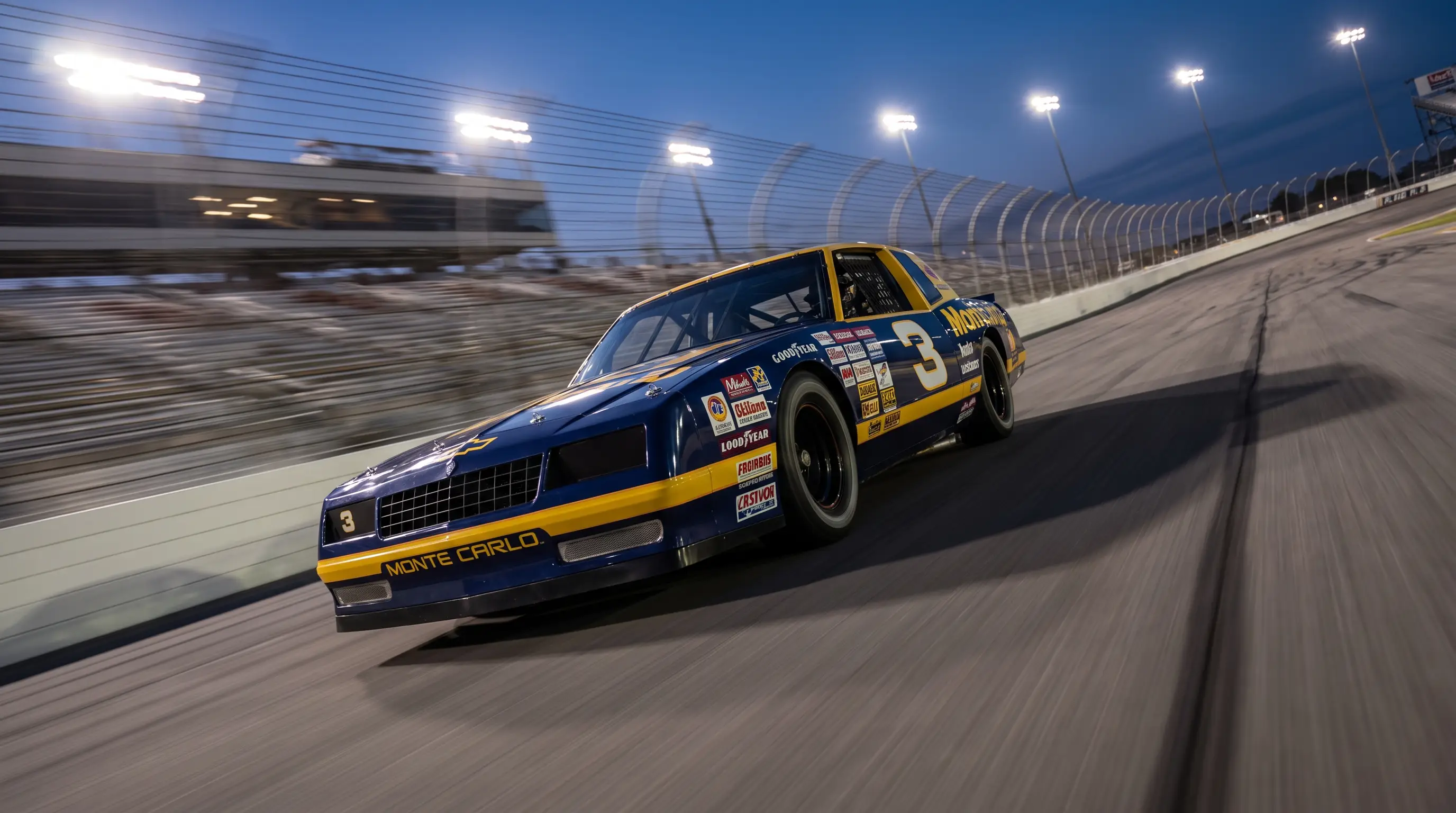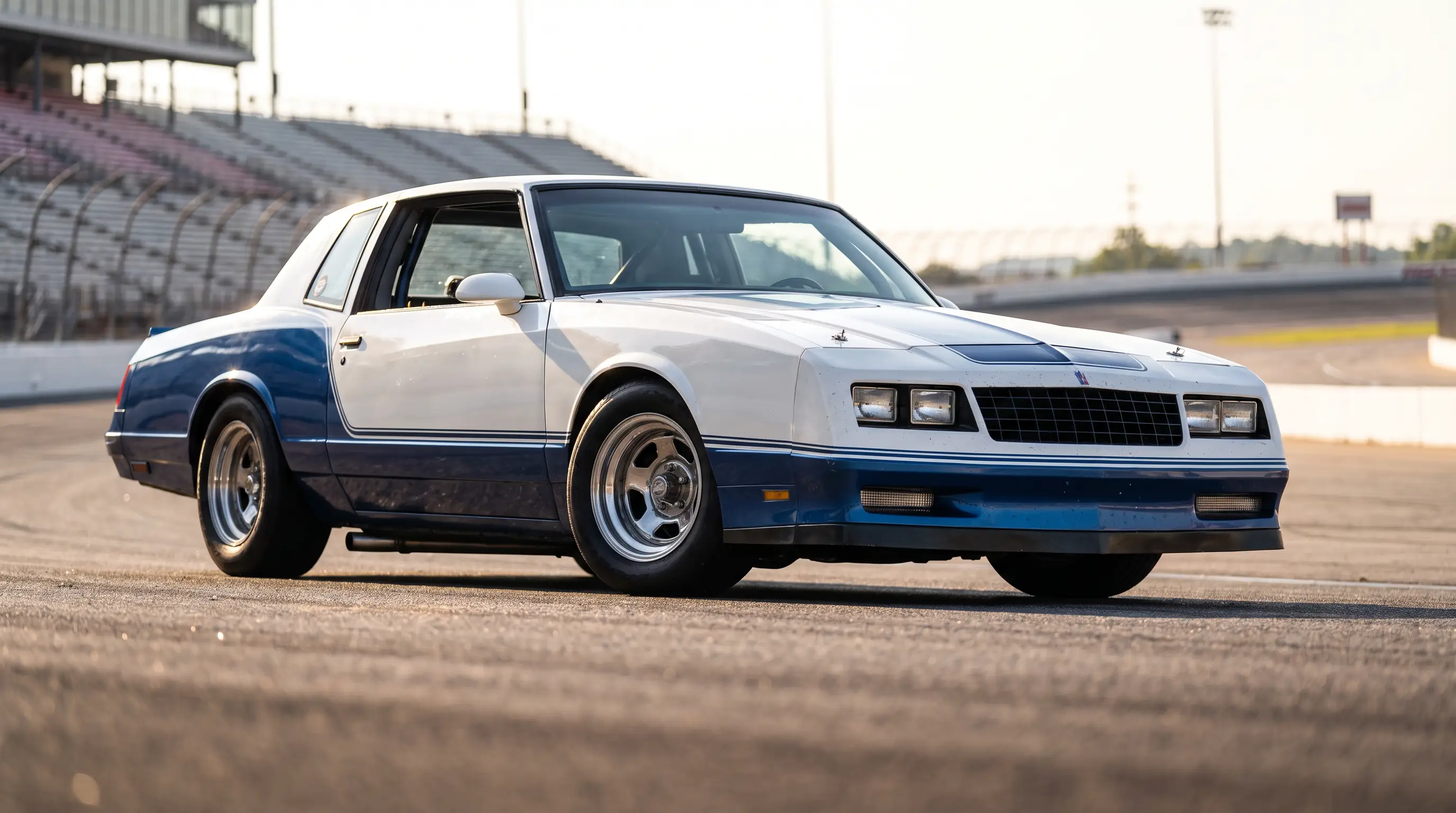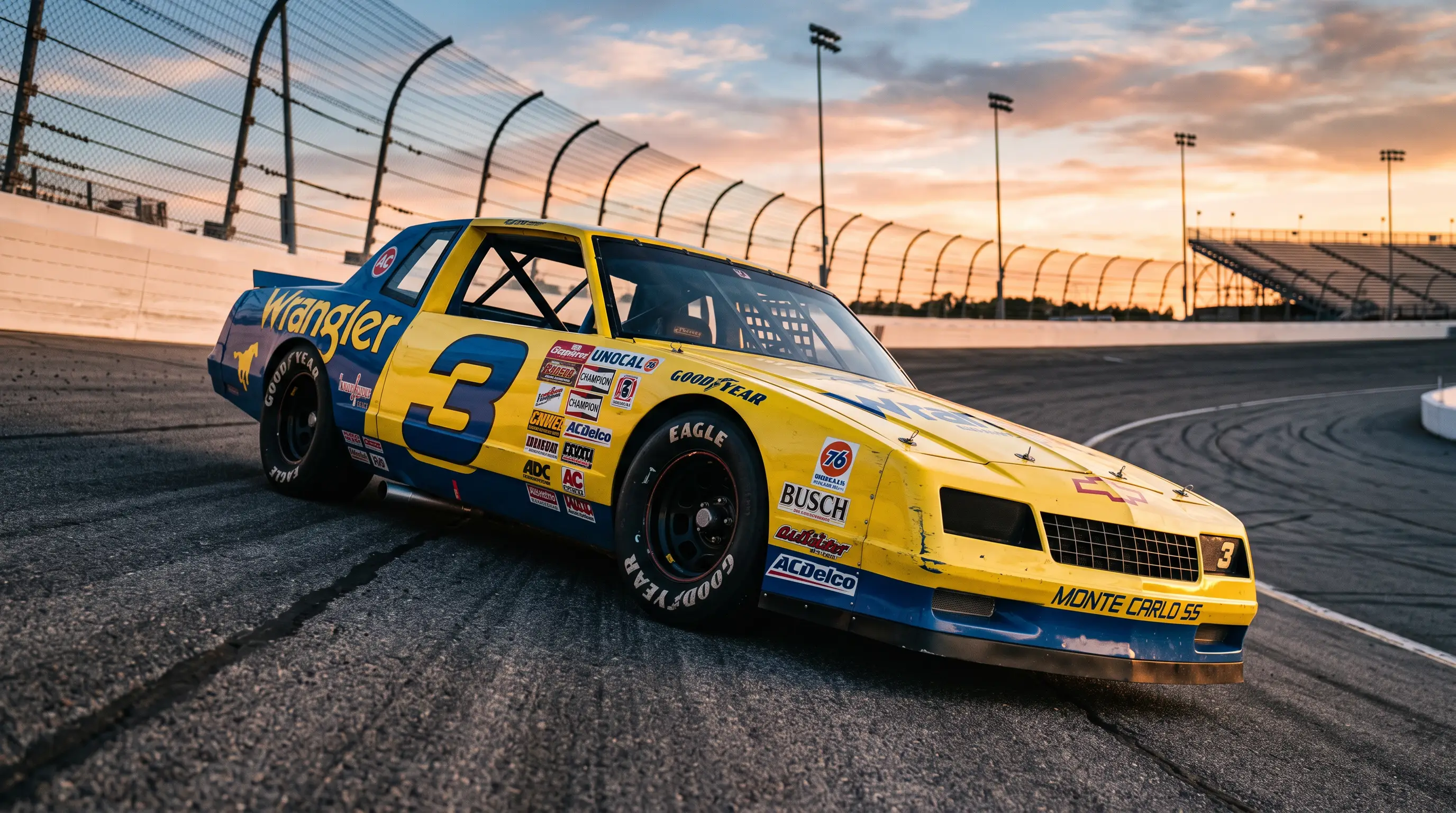
Close your eyes and picture a NASCAR Chevrolet Monte Carlo from the 1980s and there is a good chance blue and yellow shows up before you even try to remember whose car it was. Dale Earnhardt's Wrangler Jeans livery on the Richard Childress Monte Carlo did more to define how a whole generation remembers that decade of racing than most drivers manage with an entire career of results, and it is only one of several liveries that turned a race car into something closer to a piece of pop culture.
Wrangler blue, yellow, and the birth of a look
The Wrangler scheme ran on Earnhardt's Monte Carlo through much of the mid-1980s, and its bold blue and yellow blocking was simple enough to read at a glance from the top of the grandstands, which mattered more than most fans realize. A livery that only looks good on a magazine cover is not doing its job on race day. The Wrangler car worked at speed, at a distance, and in bad lighting, and that practical clarity is part of why it became the scheme most associated with Earnhardt's early championship years, before he ever wore the black and silver colors that came to define his later career.
What made the scheme stick culturally was the pairing of a genuinely aggressive driver with a design that photographed as well parked in Victory Lane as it did blurring past at 190 mph. Merchandise sales, die-cast models, and t-shirt sales through the 1980s and 1990s kept that specific blue and yellow combination circulating long after Earnhardt himself moved to different sponsors, and it remains one of the most recognizable Monte Carlo liveries ever built.
Junior Johnson's Budweiser Monte Carlo
Darrell Waltrip's Budweiser-sponsored Monte Carlo out of Junior Johnson's shop was another scheme that defined the era on its own terms, a bright red and white design that matched Waltrip's own larger than life personality on and off the track. The car was loud in a way that suited a driver who never shied away from a microphone, and the pairing of sponsor, driver, and livery became one of the more talked about combinations of the mid-1980s Cup schedule.
Where the Wrangler car read as tough and no-nonsense, the Budweiser Monte Carlo read as brash, and that difference in personality between two of the era's most successful liveries says something about how much room the sport had for contrasting styles built on the same basic Monte Carlo shape.
"A good scheme does not just look good sitting still. It has to read from the grandstands doing 190 miles an hour, and the best Monte Carlo liveries of the 1980s all understood that instinctively."
- Patrick Walsh
Hendrick's Levi Garrett and Kodak colors
Geoff Bodine's Hendrick Motorsports Monte Carlo carried a handful of memorable sponsor liveries through the mid-1980s, including designs for Levi Garrett and later Kodak, both of which favored cleaner, more corporate color blocking than the bolder Wrangler and Budweiser schemes. Those liveries did not carry quite the same cultural weight as Earnhardt's or Waltrip's cars, but they mattered to the story in a different way, representing the newly formed Hendrick organization establishing its own visual identity in a garage that already had several dominant, well-known looks competing for attention.
Tim Richmond's red and gold Folgers scheme, run out of the Hendrick stable later in the decade, added yet another instantly recognizable look to the Monte Carlo's paint scheme history, one that fans still associate with Richmond's flamboyant, larger than life driving style as much as with the coffee brand that paid for it.
A quick reference to the era's signature liveries
| Livery | Team / Owner | Driver | Colors |
|---|---|---|---|
| Wrangler Jeans | Richard Childress Racing | Dale Earnhardt | Blue and yellow |
| Budweiser | Junior Johnson | Darrell Waltrip | Red and white |
| Levi Garrett | Hendrick Motorsports | Geoff Bodine | Yellow and black |
| Kodak | Hendrick Motorsports | Geoff Bodine | Yellow and red |
| Folgers | Hendrick Motorsports | Tim Richmond | Red and gold |
None of these schemes existed in isolation. Sponsors competed for visibility on television broadcasts that were becoming more sophisticated through the decade, and a livery that stood out in a fast-moving pack of cars was worth real money to the brand paying for it. That commercial pressure pushed teams toward bolder, simpler color blocking rather than intricate designs, and the Monte Carlo's fairly flat, uncluttered bodywork gave designers a clean canvas to work with compared to some of the more sculpted shapes fielded by other manufacturers.
Collectors restoring cars from this era often treat getting the livery details exactly right, down to the correct decal placement and sponsor logo revision for a given season, as seriously as getting the mechanical specification correct. A Monte Carlo tribute car with the wrong shade of Wrangler blue or an anachronistic Budweiser logo will draw criticism at a serious car show just as quickly as one with the wrong engine under the hood.
Why these liveries still matter to the car's story
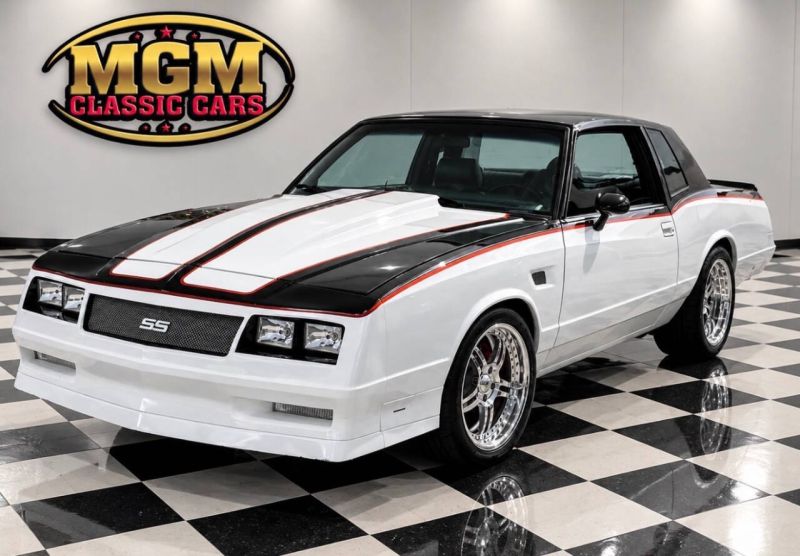
Paint schemes are easy to dismiss as marketing rather than history, but for the Monte Carlo they became inseparable from how the car is remembered at all. A stock, unsponsored Monte Carlo SS from 1985 is a good looking coupe on its own merits. The same shape wearing Wrangler blue and yellow, or Budweiser red and white, or Folgers red and gold, carries a specific season and a specific driver's reputation along with it, and that layered meaning is a large part of why period-correct tribute cars and restored show cars from this era draw such strong interest at cruise nights and swap meets today.
Readers curious about the broader arc that produced these liveries can read the background on how the Monte Carlo became NASCAR's dominant Chevrolet entry through the 1980s in the first place, a story that these paint schemes rode along on for the better part of a decade. For anyone who wants the shape itself rather than the decals, it is still possible to find a classic Monte Carlo today wearing nothing more than factory paint, a quieter but no less genuine piece of the same history.
What ties all of these liveries together, beyond the shared shape underneath them, is timing. Every one of them ran during a stretch when the Monte Carlo was NASCAR's dominant Chevrolet entry, which meant the cars carrying these colors were competing for wins nearly every weekend rather than running mid-pack in obscurity. A striking paint scheme on a car that finishes fifteenth rarely becomes iconic. A striking paint scheme on a car that wins races and championships becomes part of the sport's visual memory, and that is exactly what happened to Wrangler blue and yellow, Budweiser red, and the rest of the schemes that carried Monte Carlos through the decade.