
The 1966 Nova redesign gets described in a lot of casual writing as a facelift, and that undersells what Chevrolet actually did to the car. The first-generation Chevy II had run essentially unchanged in structure since 1962, and for 1966 the division didn't just restyle the sheet metal. It reworked the platform, trimmed the body-style lineup down to what was actually selling, and opened up enough room under the hood to let the Nova become something closer to a small Chevelle than a plain compact.
Car Features
6 min read
The 1966 Nova Redesign
The 1966 Nova redesign was more than a facelift. Chevrolet reworked the platform, dropped two body styles, and opened the engine bay to a proper V8.
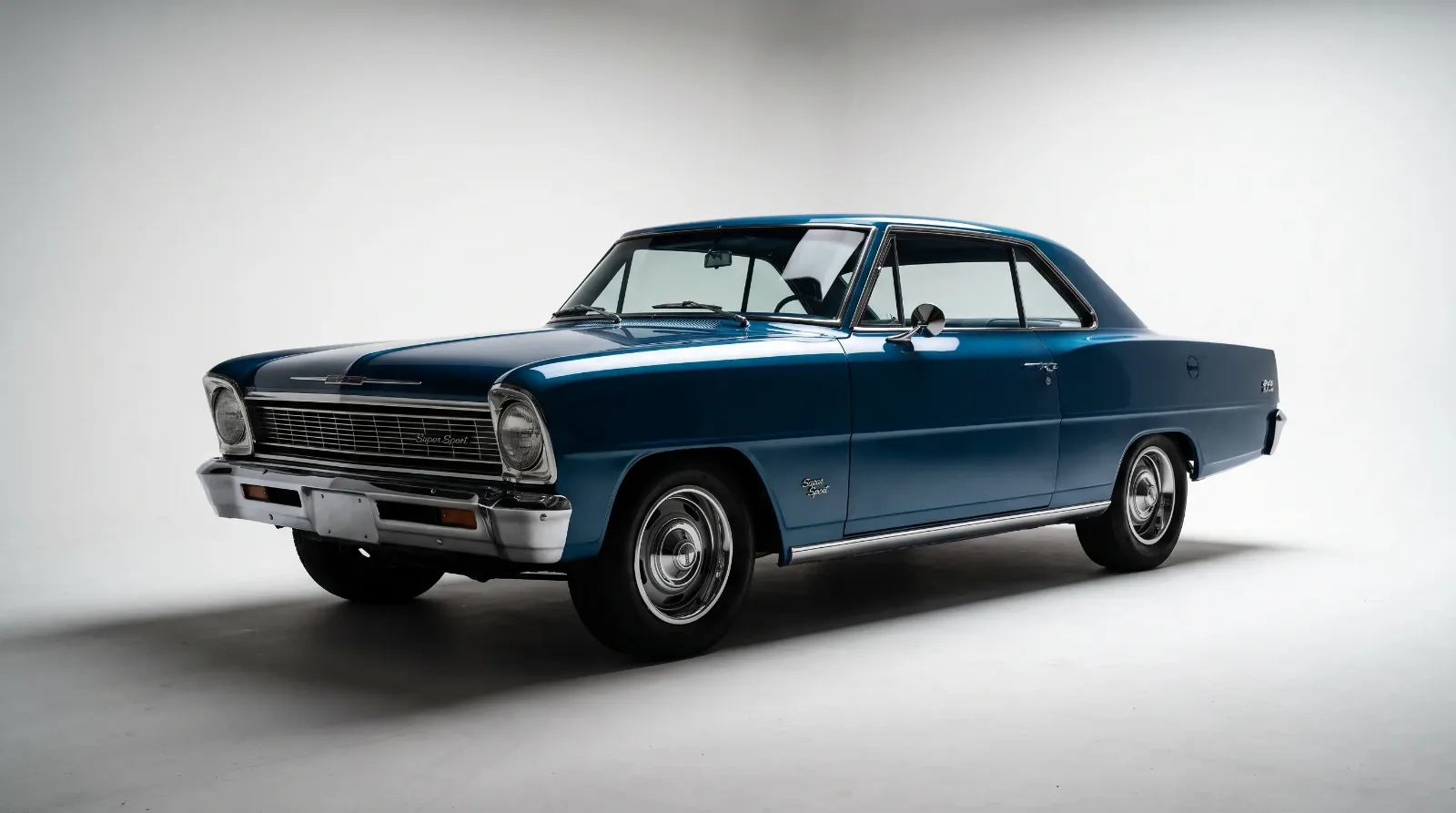
A platform overhaul, not just a facelift
Chevrolet's engineers carried over the 110 inch wheelbase from the first generation, but very little else stayed the same. The body sat lower, the greenhouse was reshaped into a semi-fastback profile that borrowed directly from the corporate styling language Chevrolet was applying across its mid-size cars, and the cowl and firewall were reworked to make room for engines the original 1962 chassis was never built to carry. This was the point where the Chevy II Nova stopped looking like an economy car with sportier trim and started looking like a genuinely handsome coupe on its own terms.
Buyers who want the fuller origin story of the platform this redesign replaced should start with the second-gen Nova, which covers the whole 1966-67 generation this redesign introduced.
What Chevrolet borrowed from the Chevelle
The styling resemblance to the Chevelle was not an accident. GM's design studios were working from a shared set of proportions across the compact and mid-size lines in the mid-1960s, and the 1966 Nova picked up the sculpted body sides, the creased rear quarters, and a roofline that read as a scaled-down version of the same basic shape. It made the Nova look more expensive than it was, which was exactly the intent. Chevrolet needed the car to compete not just against the Falcon anymore, but against the growing wave of sportier compacts that buyers were cross-shopping.
The body styles that didn't survive the change
This is one part of the 1966 Nova story that is easy to get wrong. The convertible did not carry over, but it was already gone well before this redesign, Chevrolet dropped the Chevy II convertible after the 1963 model year and never brought it back for any later generation. The station wagon, by contrast, did carry over onto the redesigned platform and remained in the lineup for both 1966 and 1967. For these two years, Chevrolet sold the Chevy II Nova as a four-door sedan, a four-door wagon, or a two-door Sport Coupe. The wagon and the Sport Coupe were the body styles Chevrolet actually cut, and that cut came with the next full redesign for 1968, not this one.
| Body style | Offered 1962-65 | Offered 1966-67 |
|---|---|---|
| 4-door sedan | Yes | Yes |
| 2-door Sport Coupe | Yes | Yes |
| Convertible | Yes (1962-63 only) | No |
| Station wagon | Yes | Yes |
Carrying the wagon forward while retiring the convertible reflected where the buyers actually were: family and fleet customers still wanted a wagon, but convertible demand in this segment had never been strong enough to justify tooling it into the new platform. Chevrolet's attention went instead to the two body styles that mattered most to the buyers the redesign was chasing, the Sport Coupe as the performance-image car and the sedan as the practical daily driver, with the wagon carried along for buyers who needed the cargo room.
The interior received its own quiet overhaul alongside the exterior. Instrument panels were redesigned with a more horizontal layout, and Chevrolet moved away from some of the flatter, more utilitarian door panels and seat patterns that had carried over from the early 1960s. None of it was radical on its own, but taken together it made the cabin feel like it belonged to a newer, more deliberately styled car rather than a running holdover from 1962.
Under the sheet metal: engine bay and chassis updates
The real significance of the 1966 redesign, from a factory-documentation standpoint, is what it did to the engine bay. The original Chevy II chassis had been engineered around four-cylinder and six-cylinder engines, and while a small-block V8 had been squeezed in partway through the first generation, it was a tight fit. The reworked 1966 structure widened the engine compartment and reinforced the front subframe to accept small-block V8s properly, including the 327 cubic inch engine in multiple states of tune.
That single chassis decision is why this generation is the one collectors talk about when the L79 327 comes up. Without the wider engine bay and the reinforced subframe from the 1966 redesign, the Nova's most celebrated factory performance option would not have fit under the hood at all. Anyone researching that engine specifically should read a companion piece covering the L79 in detail, since the two stories share the same chassis history.
The front suspension and steering geometry also came in for revision, not just the sheet metal around them. Chevrolet's engineers tightened up the front end enough that period road testers noted a more composed ride than the outgoing generation offered, even before anyone ordered the performance-oriented SS suspension package. That baseline improvement mattered because it meant the redesigned Nova drove like a more modern car regardless of which engine ended up under the hood, not just when a buyer checked the performance boxes on the order form.
What the redesign set up for 1966-67
I've spent a lot of time with build sheets from this era, and what strikes me about the 1966 Nova redesign is how deliberately it was staged. Chevrolet didn't just make the car look faster. It rebuilt the platform so the car actually could be faster, then let the option sheet catch up over the following two model years. The SS package, the L79, and the broader small-block lineup all followed directly from decisions made in this one redesign cycle.
"People assume Chevrolet restyled the Nova and the performance stuff came later almost by accident. The build records don't support that. The subframe and the firewall were reworked before a single L79 order went through, which tells you the performance car was planned into the redesign, not bolted on after the fact."
Tom Ramirez
It is worth remembering how narrow this window actually was. The redesigned platform ran for only two model years, 1966 and 1967, before Chevrolet moved to a third generation for 1968. Within that short run, though, the Nova went from a car nobody cross-shopped against a Mustang to one that genuinely could be ordered as a small, quick coupe with real documentation behind the engine under its hood. That is the actual legacy of the 1966 redesign: not the new roofline by itself, but the chassis work underneath it that made everything that followed possible.
Sources and notes
Related Reading
Have a
Chevrolet Nova
for Sale?
Reach thousands of serious classic car collectors across the US.
Sell It Here →
Are You a Classic Car Dealer?
List your full inventory and connect with targeted classic car buyers.
Join as a Dealer →
#classic chevrolet
#1966 nova
#chevy ii nova
#Nova redesign
#Chevrolet Nova history
#second-gen Nova

About the author
Tom Ramirez
Corvette researcher and historian based in Bowling Green, Kentucky. Two decades documenting Corvette production history from original factory records.
Related Listings - Chevrolet Nova
Comments
Be the first to comment on this article.