
A guy at a Chevy II show in Bowling Green once told me his 1966 car was "a Nova, not a Chevy II," and got genuinely annoyed when I pointed at his own trim tag, which said Chevy II Nova, full stop, no hyphen, no argument. He wasn't wrong about what people call these cars today. He was wrong about what Chevrolet called them the year his was built. That mix-up is common enough that it's worth settling properly, because the name didn't change overnight, and the paper trail tells a cleaner story than the bench-racing does.
Car Features
6 min read
When Chevy II Became Nova
Nova started as a trim level on the Chevy II, not a car name of its own, and the paperwork tells a cleaner story than the swap-meet arguments do.
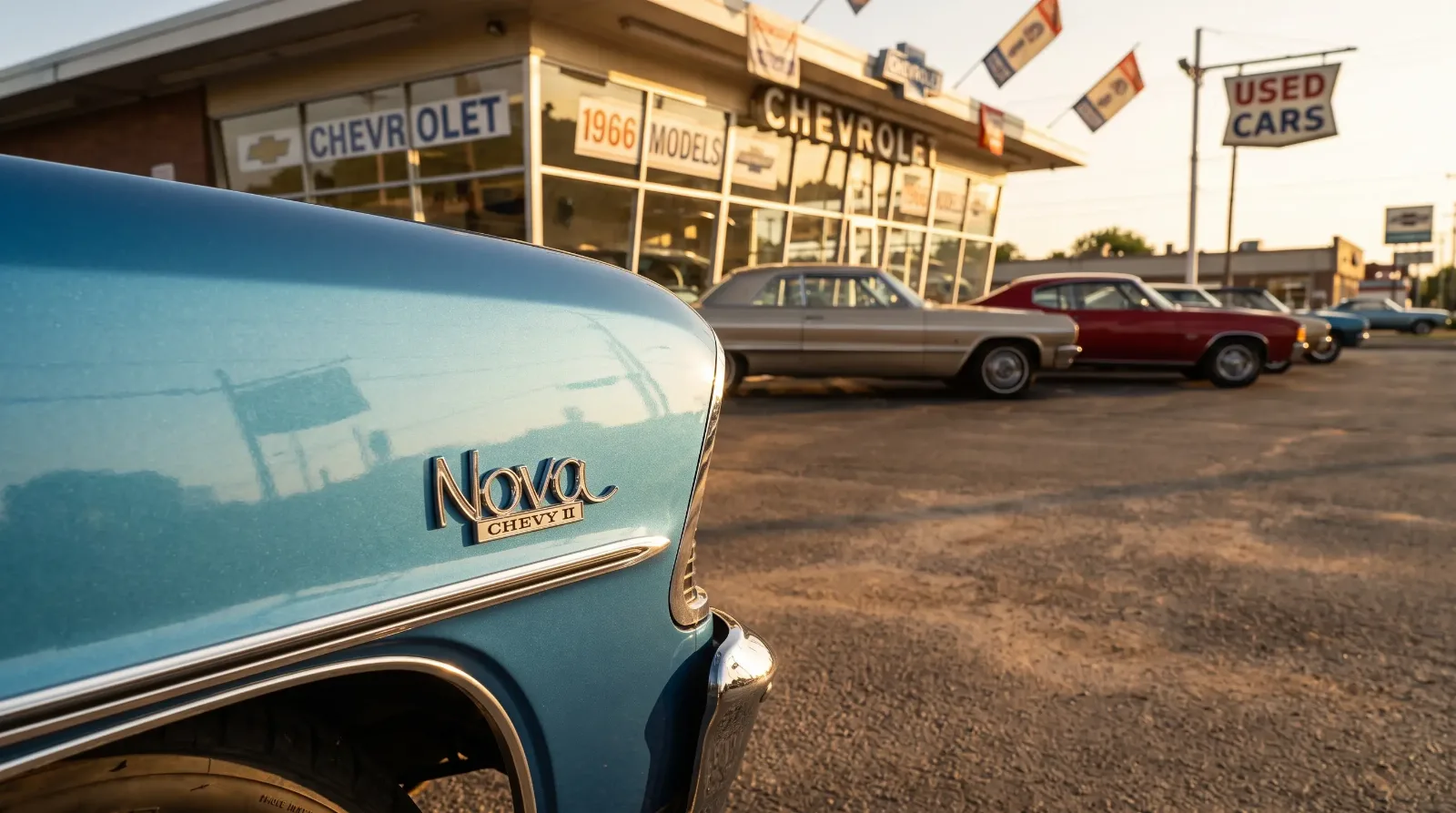
Nova started as a trim level, not a car
When Chevrolet launched the Chevy II in 1962, Nova was the top trim within that lineup, sitting above the plain Chevy II 100 and Chevy II 300 designations. The full factory name on a loaded car was Chevy II Nova, and that stayed true through the redesign for 1966 and into 1967, which you can read about in the gen2 chapter. Somebody buying the nicest Chevy II on the lot in 1966 drove home in a car whose glovebox literature and window sticker both said Chevy II Nova, not just Nova. The distinction mattered on paper even when everybody at the diner just called it a Nova because that's the word that stuck in conversation.
That's the part people get backwards. The car wasn't renamed from Chevy II to Nova all at once. It was always heading that direction, one trim badge at a time, well before Chevrolet made it official.
Why "Chevy II" started disappearing from the paperwork
By the late 1960s, Nova had become the trim buyers actually wanted, and Chevrolet noticed. Base Chevy II 100 and 300 models sold in shrinking numbers next to Nova-trimmed cars, and dealers were already advertising and talking about "Novas" more than "Chevy IIs" in the showroom. Chevrolet responded the way a factory usually does: it followed the market instead of fighting it. For 1969, the corporate name for the car dropped Chevy II altogether, and the model was sold simply as the Chevrolet Nova. The "Chevy II by Chevrolet" trunk lid script was replaced with "Nova by Chevrolet," and the "Chevy II" badge above the grille gave way to the bowtie.
It wasn't a marketing stunt dreamed up in a boardroom disconnected from the cars themselves. It was Chevrolet catching up to what its own customers and dealers had already decided the car was called.
Dealer advertising from the period backs this up better than any single factory memo could. Newspaper ads and brochure copy from the mid-1960s already lean on "Nova" as the headline word, with "Chevy II" reduced to fine print or dropped from the copy entirely in a lot of regional advertising well before the corporate name caught up. Salesmen were selling Novas years before the paperwork agreed with them, which is a pattern that shows up across the industry whenever a trim name outgrows the model it started on.
What this means for anybody dating a car by its badge
This gets argued about at swap meets more than it should, mostly because people assume badges and marketing copy are interchangeable with the factory build sheet. They aren't. A 1966 or 1967 car wearing Nova script on the fender is correctly described as a Chevy II Nova, full name, even though everyone in the hobby just says Nova for short and always has. A 1969 or later car is correctly just a Nova, no Chevy II attached, because that's what the factory itself called it by then.
If you're trying to place a car in the timeline just from what somebody's grandfather called it, don't. Family nicknames outlive factory paperwork by decades, and half the "Chevy IIs" at any given show are actually badged Novas from years when the two names still overlapped. The trim tag and the factory literature settle it. Everything else is just what people got used to saying.
The VIN doesn't settle the naming question the same way the trim tag does, but it does confirm the rest of what a seller claims about a car, and that habit of checking the paper trail rather than the story is worth building regardless of which year you're looking at. A seller who gets the Chevy II versus Nova naming wrong on a listing isn't necessarily lying about anything else. It's usually just somebody repeating what they were told, the same way the guy in Bowling Green was.
Where the body style itself was heading
The name change landed right around the time the car itself was also changing shape. The two-year 1966-67 body gave way to a new generation for 1968, and body style choices narrowed at the same time the naming simplified. If you want to see how the body style side of that story played out, another angle on this same period covers exactly that. Names and sheet metal don't always move together, but in this case they landed close enough that it's easy to see why people conflate a naming decision with a redesign. They were two separate things that happened to line up.
None of this is a knock on anybody who calls a 1966 car a Nova without the Chevy II in front of it. That's how the hobby talks, and it always has been. It's just worth knowing, the next time somebody at a show gets particular about it, that the factory paperwork on an early car will back up either version, and the only real mistake is insisting Chevrolet used one name when the tag in the door jamb says otherwise.
"Half the arguments about what a car is 'really called' end the second somebody actually opens the door and reads the tag instead of repeating what they heard at a swap meet twenty years ago."
Wayne Coburn
Sources and notes
Related Reading
Have a
Chevrolet Nova
for Sale?
Reach thousands of serious classic car collectors across the US.
Sell It Here →
Are You a Classic Car Dealer?
List your full inventory and connect with targeted classic car buyers.
Join as a Dealer →
#classic chevrolet
#chevy ii
#chevy ii nova
#Chevrolet Nova history
#Nova name origin
#Nova trim levels

About the author
Wayne Coburn
Longtime Corvette owner, judge and club figure who knows the cars, the records and the people behind them.
Related Listings - Chevrolet Nova




Comments
Be the first to comment on this article.