
I once spent an entire swap meet lunch listening to two guys argue about whether a "real" Firebird could come from anywhere other than Michigan. Neither one was right, and both of them owned cars built somewhere else entirely. That argument happens more than you'd think, because most people assume Pontiac built the Firebird at some Pontiac, Michigan plant simply because the name matches. It never did. The Firebird was built on the shared F-body line with the Camaro, at a small handful of plants scattered across the country and, eventually, across the border.
Car Features
6 min read
Where Firebirds Were Built: The Pontiac Assembly Plants
The Firebird was never built in Pontiac, Michigan. It came from Norwood, Ohio, Van Nuys, California, and eventually a plant in Quebec, all shared with the Camaro.
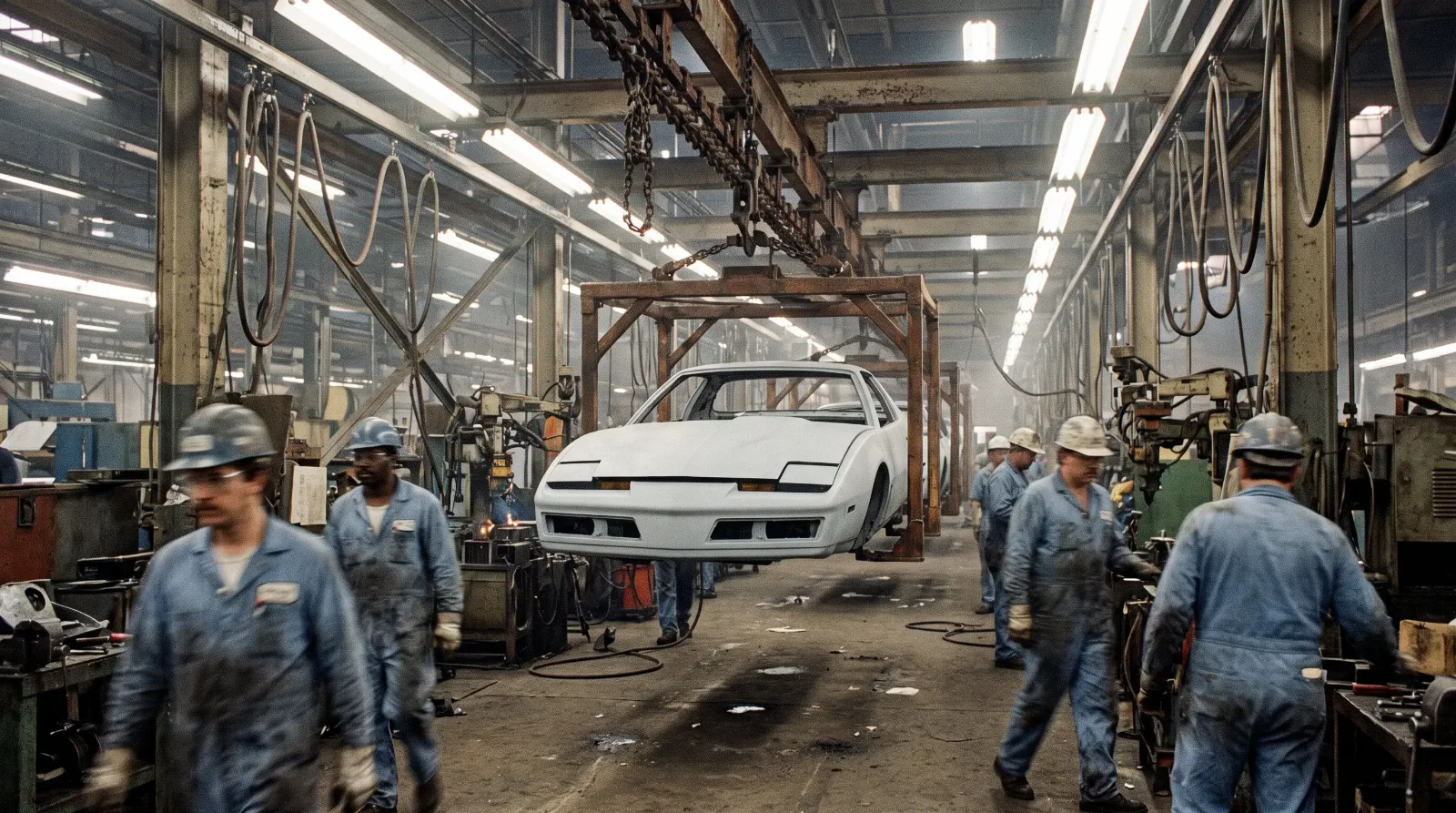
Two coasts, one car: Norwood and Van Nuys
For most of the Firebird's run, production split between two GM assembly plants: Norwood, Ohio, just outside Cincinnati, and Van Nuys, California, in the San Fernando Valley. Both plants built Firebirds and Camaros side by side on the same F-body line, which is exactly why the two cars share so much sheet metal and structure underneath their different badges. A Firebird built at Norwood and one built at Van Nuys in the same model year could differ in small trim and supplier details depending on which regional parts network fed that plant.
This dual-coast setup meant a dealer in Ohio and a dealer in California were often selling cars from different assembly runs entirely, something almost no period buyer thought to ask about. It only became a talking point decades later, once collectors started digging into build sheets and cowl tags trying to pin down exactly where their particular car came off the line.
The plant workers who built the badge
I've met retired Norwood line workers at Pontiac gatherings who talk about the F-body line the way some people talk about a hometown team. One told me his shift used to race, unofficially and against every plant rule in the book, to see who could get a Trans Am's hood decal aligned fastest without a redo. That is not the kind of thing that shows up in a GM press release, but it is exactly the kind of detail that tells you these cars were built by people who cared whether the bird on the hood sat straight.
Van Nuys had its own culture entirely, closer to the aerospace and entertainment industry that surrounded it, and workers there have described the plant's atmosphere in retrospective interviews as different in character from the Midwest operations, though that is secondhand recollection passed down through oral histories and reunion interviews rather than a documented labor survey, and it should be read as personal impression rather than settled fact.
| Plant | Location | F-body production years |
|---|---|---|
| Norwood Assembly | Norwood, Ohio | Through 1987 |
| Van Nuys Assembly | Van Nuys, California | Through 1992 |
| Ste-Therese (Boisbriand) | Quebec, Canada | 1993 through 2002 |
Norwood's closing chapter
Norwood shut its doors on August 26, 1987, the day the plant's last Camaro rolled off the line, a date Norwood workers still refer to as Black Wednesday. GM had announced the closure back on November 6, 1986, as one of eleven plants cut in a broader restructuring, citing the facility's age, cost and absentee rate, and roughly 4,200 workers lost their jobs when the line finally stopped. For a plant that had built F-body cars for decades, the closure meant Van Nuys became the sole remaining source for Firebird production going forward, at least until that plant reached the same fate a few years later.
Longtime Pontiac club members treat the Norwood closure as a genuine dividing line in Firebird history, not just a manufacturing footnote. Cars built there carry a certain weight among collectors who track this kind of thing closely, less because Norwood-built cars are mechanically different and more because the plant's closure marked the beginning of the F-body's slow consolidation toward a single remaining home.
Van Nuys carries on, then hands off to Quebec
Van Nuys kept building Firebirds into the early 1990s before it, too, closed as part of GM's continued plant rationalization. Rather than end F-body production outright, GM shifted the line to Ste-Therese in Quebec, a plant that would carry the Firebird and Camaro through their final generation until GM discontinued both nameplates in 2002.
That means the very last Firebirds built anywhere came from a plant most American enthusiasts have never set foot near, in a country plenty of them do not associate with muscle car manufacturing at all. It is one of those facts that settles an argument fast once you drop it on the table at a swap meet, precisely because almost nobody expects it.
I have watched that fact do exactly that job more than once. A guy insists his Norwood-built '86 Trans Am is somehow the "real" version because it came from American soil, and someone across the table points out politely that the fourth-generation cars everybody argues about at concours events came from Quebec entirely. The room usually goes quiet for a second, then somebody asks where the nearest cowl tag decoder is, and the conversation turns useful instead of stubborn.
"Nobody at Norwood or Van Nuys thought they were building history. They were building cars on a Tuesday shift, trying to hit quota and go home. The history part is what the rest of us added on afterward."
Wayne Coburn
Why plant history still matters to buyers
A cowl tag or trim tag can tell you which plant assembled a specific car, and that detail matters more to serious collectors than most casual buyers expect. It is not usually a value driver on its own, but paired with other documentation, it helps confirm a car's story is consistent rather than assembled from mismatched parts and a good paint job. When plant codes, build dates and options all line up, you are looking at a documented car rather than one you are asked to take on faith.
This kind of detail sits right alongside the bigger story of the F-body rivalry that shaped both cars from the same shared assembly lines. If you want to go deeper into how closely the two platforms were actually built, a related deep-dive covers that shared engineering in full. And if all this plant talk has you wanting to see a build sheet in person, browsing classic Firebirds for sale is a good place to start asking sellers the right questions.
Sources and notes
- Wikipedia: Norwood Assembly
- Wikipedia: Van Nuys Assembly
- GM Authority: Former GM Employees Discuss Norwood Assembly Plant Closure
- Hagerty: Pride of Van Nuys, GM Factory's Final Car
- Spectrum News 1: Former Employees Reflect on Shuttered GM Plant
- Zocalo Public Square: General Motors' Last Camaro From the Van Nuys Valley
Related Reading
Have a
Pontiac Firebird
for Sale?
Reach thousands of serious classic car collectors across the US.
Sell It Here →
Are You a Classic Car Dealer?
List your full inventory and connect with targeted classic car buyers.
Join as a Dealer →
#pontiac firebird
#Firebird history
#F-Body Platform
#Norwood Assembly
#Van Nuys Assembly
#Firebird production

About the author
Wayne Coburn
Longtime Corvette owner, judge and club figure who knows the cars, the records and the people behind them.
Related Listings - Pontiac Firebird




Comments
Be the first to comment on this article.