
Ask anyone who followed the NMCA and NSCA circuits in the 1990s to name the Camaro that started arguments, and a good number of them will say Pat Musi's. Not because it was the prettiest car on the property, though it usually was, but because it was the car other builders measured themselves against. Pat Musi built engines for a living before he built a reputation as a Pro Street name, and that order matters. He spent the late 1970s and 1980s establishing himself as a big-block Chevrolet engine builder in NHRA Pro Stock, then carried that reputation into Pro Street when he entered the class in 1994. The Camaro came out of a shop that already understood horsepower before it ever worried about a paint scheme.
Car Features
8 min read
The Pat Musi Pro Street Camaros
Pat Musi's Pro Street Camaro grew out of his reputation as a big-block Chevrolet engine builder, turning the car into a rolling résumé for a program that outlasted the entire Pro Street era.
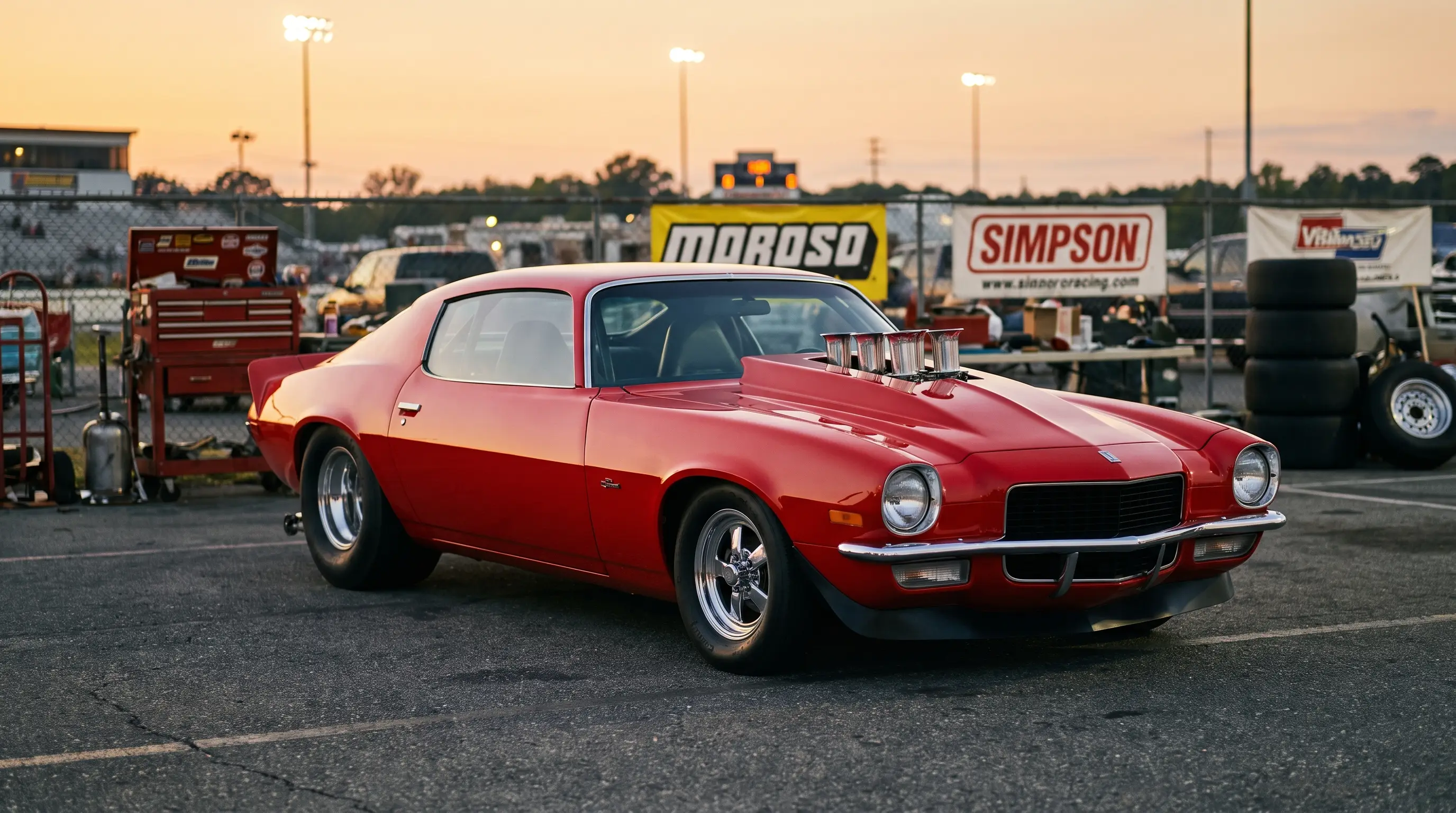
An engine builder's car, built the way an engine builder thinks
Musi's background was in big-block Chevrolet horsepower, the kind of work that gets a name known inside race shops long before the public ever sees the car it ends up in. When he built his own Pro Street Camaro, it wasn't a showcase for a body shop's metalwork with an engine dropped in as an afterthought. The car existed to prove what the engine program underneath it could do on a Saturday night, in front of people, on a strip, not on a dyno sheet nobody outside the shop would ever read.
That's a different design philosophy than most Pro Street builds followed. A lot of cars from that era were conceived as a look first, chassis and drivetrain worked out afterward to hit a target number that would satisfy a magazine feature. Musi's Camaro ran the other direction. The powertrain came first because it had to; his name was already attached to it before the bodywork ever got tubbed.
What made the car stand out on the strip
The exact quarter-mile numbers moved year to year as the combination evolved, which was typical for a serious Pro Street effort, but the trajectory was always downward, always chasing the next tenth. Musi's engine program eventually grew to displacements as large as 737 cubic inches in later Pro Street and Pro Nitrous builds. What didn't change was the presentation. The car stayed a Camaro people could recognize at fifty yards, tubbed rear end and all, not a tube-frame silhouette wearing Camaro sheet metal for the sake of a rulebook technicality.
Big-block power in a car built around a Chevrolet small-block heritage was itself part of the statement. Musi's shop had built a reputation on making serious horsepower reliable enough to run a full season, not just survive one dyno pull for a magazine spread, and the Camaro was the rolling proof of that reliability. A car that only ran fast once isn't a legend. A car that kept running fast, race after race, is.
| Detail | Specification |
|---|---|
| Body | Chevrolet Camaro, tubbed rear frame |
| Builder background | Pat Musi, big-block Chevrolet Pro Stock engine builder before entering Pro Street in 1994 |
| Class | NMCA/NSCA Pro Street, eight world championships between 1997 and 2005 |
| Reputation | Consistently referenced as a benchmark Pro Street Camaro of the 1990s and 2000s |
How the rest of the class responded
Once a car built by an established engine builder started showing up and running at the front of the pack, it changed the calculation for a lot of other Pro Street competitors. Builders who had been sourcing their combinations from whichever shop was convenient started paying closer attention to who was actually behind the engine work on the cars beating them. That shift, toward taking the powertrain program as seriously as the chassis work, is part of what pushed the whole class forward across the decade rather than letting it plateau on whatever combination had been fashionable a few years earlier.
It also raised the bar for what counted as a credible Pro Street entry in the first place. A car with flashy bodywork and a mediocre engine program stopped being enough to get taken seriously at the tracks where the Musi name carried weight. Competitors either upped their own engine programs or accepted they were racing for a different, lower tier of respect, and that pressure rippled outward well beyond whoever was actually lining up next to the Camaro on a given Saturday.
The shop behind the car outlasted the trend
The old street-freak Pro Street look was already fading by the time Musi entered the class in the 1990s, but the organized NMCA and NSCA Pro Street racing categories kept the name alive as a heads-up drag racing class, and Musi's Camaro became one of its defining cars, winning eight world championships between 1997 and 2005. His engine business didn't cool off after that either. The shop kept building serious horsepower for drag radial, Pro Nitrous, and Pro Mod competitors long after the tubbed-rear-end street look stopped being the thing to build. That continuity is part of why the Camaro still gets talked about. It wasn't a one-era name attached to a fad that ran its course and disappeared. It was an early, very public showcase for a program that went on to become one of the more respected engine-building operations in drag racing, full stop.
There's a version of this story where the car is just a cool old Camaro with a big motor, and there's a more accurate version where the car is a résumé. Everyone who watched it run understood what they were actually looking at was a business card with a paint job.
A reputation that traveled beyond one region
Drag racing in the 1980s and into the 1990s was still very much a regional culture. A car could be legendary at the tracks along the East Coast and virtually unknown two thousand miles away, since the magazine coverage that eventually connected these scenes nationally took time to catch up with what was happening at any given local strip. Musi's Camaro was one of the builds that crossed those regional boundaries faster than most, partly because his engine-building reputation had already spread through word of mouth among serious racers before the car itself ever became the story. Competitors who had never seen the Camaro run in person still knew the name attached to it, and that recognition alone was enough to draw a crowd whenever the car actually did show up at an out-of-town event.
That kind of cross-regional recognition mattered because it meant the car wasn't just a local hero story. It was part of a broader national conversation about which shops and which builders were actually pushing the performance envelope furthest, at a time when that conversation still traveled mostly through racers talking to other racers rather than through any centralized media coverage.
Why the Camaro still comes up in conversation
Talk to anyone who followed the class closely and the Musi Camaro gets mentioned in the same breath as the handful of other cars that defined what a serious Pro Street build looked like, cars covered in more depth in our famous pro street cars retrospective. The comparison that comes up most is with the cars campaigned by contemporaries working the same scene at the same tracks, a rivalry sketched out further in a related story from the same period.
What separates the cars people still remember from the ones that faded is usually consistency. A single great pass gets a photo in a magazine. A season of great passes gets a reputation that outlives the car itself, and that's what happened here. Anyone chasing a genuine piece of this era for a collection can Pro Street cars for sale now to see what period-correct builds are currently available.
The Camaro's legacy isn't really about one car anymore. It's about proving that the engine program mattered as much as the sheet metal, at a moment when a lot of the class was betting the other way.
Sources and notes
- Dragzine, A Few Words With Pro Street Legend Pat Musi
- Competition Plus, Pat Musi Reflects on Pro Stock Career and Legacy
- Engine Builder Magazine, Pat Musi's Love of Nitrous
- Edelbrock Group, Edelbrock-Musi 555 Camaro at Mecum Indy
- Wikipedia, Pro Street
"People remember the paint on a Pro Street car. What they should remember is that the fast ones were fast because somebody understood the engine before they ever worried about how the car would look sitting still."
- Patrick Walsh
Related Reading
Have a
Classic Car
for Sale?
Reach thousands of serious classic car collectors across the US.
Sell It Here →
Are You a Classic Car Dealer?
List your full inventory and connect with targeted classic car buyers.
Join as a Dealer →

About the author
Patrick Walsh
Automotive journalist covering classic car shows, events, and the enthusiast community across North America.




Comments
Be the first to comment on this article.