
I was at a Mopar show a few summers back, standing next to a fellow judging a row of Road Runners, when he pointed at a matte black hood scoop and said, loud enough for half the row to hear, "that's not a real one, the pins are wrong." Nobody argued with him. That is the world of the road runner a12 lift off hood, where four hood pins and a stamped scoop shape can settle an argument faster than any paint code or fender tag, at least among people who have spent enough weekends staring at these cars to know the difference.
Car Features
7 min read
The A12 Road Runner: The Lift-Off Hood 440-6
The road runner a12 lift off hood is the most recognizable A12 detail in the hobby, and the first place a fender tag mismatch gets exposed at a swap meet.
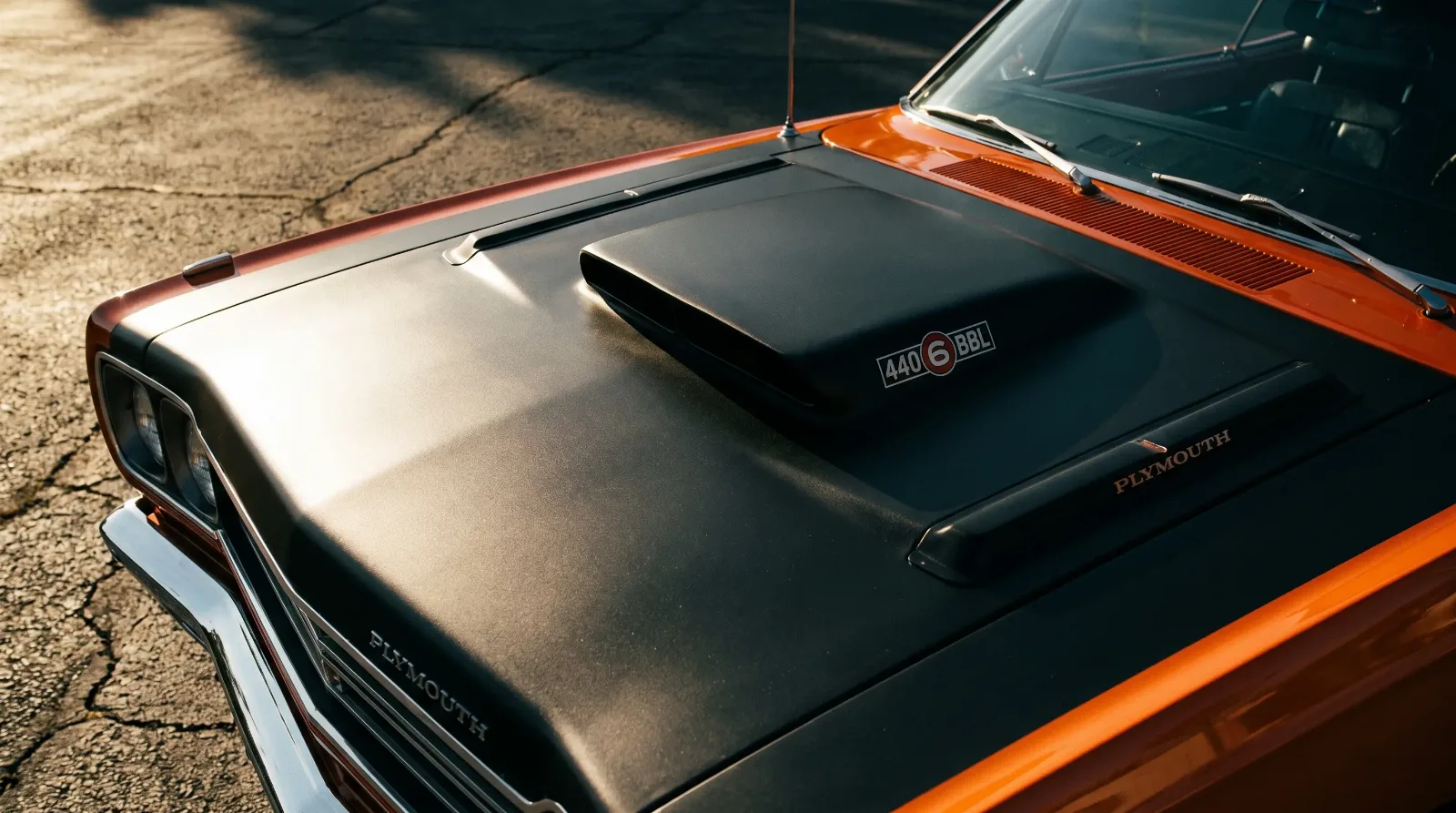
What made the A12 hood different
Plymouth built the A12 package, the 440 Six Barrel Road Runner, as a mid year 1969 addition aimed at buyers who wanted triple carburetion and a genuine factory drag package rather than a dressed up showroom car. Part of that package was a fiberglass hood that lifted completely off the car rather than hinging like a normal hood, held in place by four pins instead of a latch. Underneath sat a scoop shaped intake feeding the three Holley two barrel carburetors below. It was not there to look tough, though it certainly did. The fiberglass construction cut weight over a comparable steel hood, and the scoop shape improved the flow of cooler outside air straight to the carburetors, both details that mattered when the car left the factory built for the strip as much as the street.
Most examples wore the hood in flat matte black regardless of the body's exterior color, a contrast that became one of the most recognizable visual signatures in the entire Road Runner lineup. Painted or trimmed differently, a lesser hood simply does not read the same way from across a parking lot, and that is exactly why the detail matters so much to people restoring or shopping for one of these cars today.
The fender tag conversation nobody wants to have
Here is where the club raconteur part of this story earns its keep. I have watched more than one deal at a swap meet fall apart over a hood. A seller says the car is a real A12, the buyer asks for the fender tag, and suddenly the conversation gets quiet. The fender tag carries a build code that should match the drivetrain, the trim, and yes, the hood option, and a mismatch there is the first sign that a Six Barrel hood got swapped onto a standard 440 or 383 car somewhere along the way, usually by an owner decades ago who just liked the look and had no idea he was creating a headache for whoever bought the car later.
Because the hood is such a visually distinct and desirable piece, it has been reproduced for years, which is good news for restorers with a documented A12 and bad news for buyers trying to sort a genuine car from one dressed up to look like it. A reproduction hood on a real A12 car being restored is completely normal and even expected, since original fiberglass from 1969 does not always survive the decades intact. A reproduction hood on a car with no other A12 documentation is a different story entirely, and that is where a broadcast sheet or period paperwork earns its keep.
| Detail | A12 hood specification |
|---|---|
| Material | Fiberglass, full lift off design |
| Mounting | Four hood pins |
| Finish | Matte black, most examples |
| Function | Reduced weight, cold air path to triple carbs |
| Verification | Fender tag and broadcast sheet cross reference recommended |
Living with one at a club meet
I have had club members tell me the hood pins themselves become a small ritual. You get a feel for the order, front pins first or back, depending on how the car sits, and after a while it is second nature the same way locking up a garage door is second nature. New owners coming from cars with conventional hinged hoods usually ask about it within the first ten minutes of ownership, and every long time A12 owner I know has a story about the first time they set the hood down somewhere it should not have gone and picked up a scratch for their trouble. It is a small thing, but it is the kind of small thing that makes these cars feel different to drive and own than a standard Road Runner, and that difference is part of the appeal for people who chase this specific package rather than settling for a regular 440 car.
"Every swap meet has a guy who can spot a repop hood from thirty feet away, and every one of those guys learned the hard way, usually by nearly buying a car that was not what the seller said it was."
- Wayne Coburn
What to check before you buy
Anyone shopping seriously for a car wearing this hood should treat the search the way I treat it at a swap meet. Start with the fender tag and compare the drivetrain broadcast code against what sits under the hood right now. Look at the pin mounting points for evidence of prior drilling or filler work, since a car that has had the hood swapped more than once often shows small telltale marks around the latch or pin area even under fresh paint. Ask whether the fiberglass itself is original or a documented reproduction installed during a restoration, and get that answer in writing if you can, because a verbal assurance at a car show tends to evaporate the moment money changes hands. None of this is meant to scare a buyer away from a genuine car. It is meant to make sure the premium you pay for an A12 example actually buys you an A12 example, and not just a good looking hood bolted onto a lesser car.
Why the hood still matters to the hobby
Fifty plus years after the A12 left the factory, the lift off hood remains one of the clearest, fastest ways to spot a Six Barrel Road Runner in a crowd, and one of the clearest ways to get burned if you take it at face value without the paperwork behind it. That tension between instant visual identity and the need for real documentation is a pattern that runs through the whole 1969 Road Runner story, not just this one option. Anyone digging into where the A12 and the rest of that model year fit into the bigger picture should where this started for the fuller context on how 1969 became the high water mark for the nameplate.
For club members and newcomers alike, the hood is a conversation starter every single time, whether it is parked at a local cruise night or sitting in a garage getting freshened up for the next show season. Anyone hoping to find a documented example, hood pins and all, can browse a classic Runner for sale and see what is currently on the market, though I would tell any friend the same thing I tell strangers at a swap meet: ask for the fender tag before you ask about the price.
Sources and notes
Related Reading
Have a
Plymouth Road Runner
for Sale?
Reach thousands of serious classic car collectors across the US.
Sell It Here →
Are You a Classic Car Dealer?
List your full inventory and connect with targeted classic car buyers.
Join as a Dealer →
#Plymouth Road Runner
#muscle car documentation
#mopar restoration
#440 Six Barrel
#1969 Road Runner
#A12 hood

About the author
Wayne Coburn
Longtime Corvette owner, judge and club figure who knows the cars, the records and the people behind them.
Related Listings - Plymouth Road Runner




Comments
Be the first to comment on this article.