
In early February 1968, at the Daytona 24 Hours, a Camaro wearing the number 13 ran faster in practice than any other Trans-Am car in the field, at better than 101 mph. Then the inspectors got their hands on it. They came back with a list of 27 irregularities, and the car never turned a wheel in the race. That weekend tells you most of what you need to know about the smokey yunick camaro: it was quick, it was clever, and it was built by a man who read a rulebook the way a locksmith reads a lock.
Car Features
7 min read
Smokey Yunick's 'Mysterious No. 13' Trans-Am Camaro
Fastest Trans-Am car at Daytona in 1968, then disqualified for 27 irregularities: the story and the paper trail of Smokey Yunick's No. 13 Camaro.
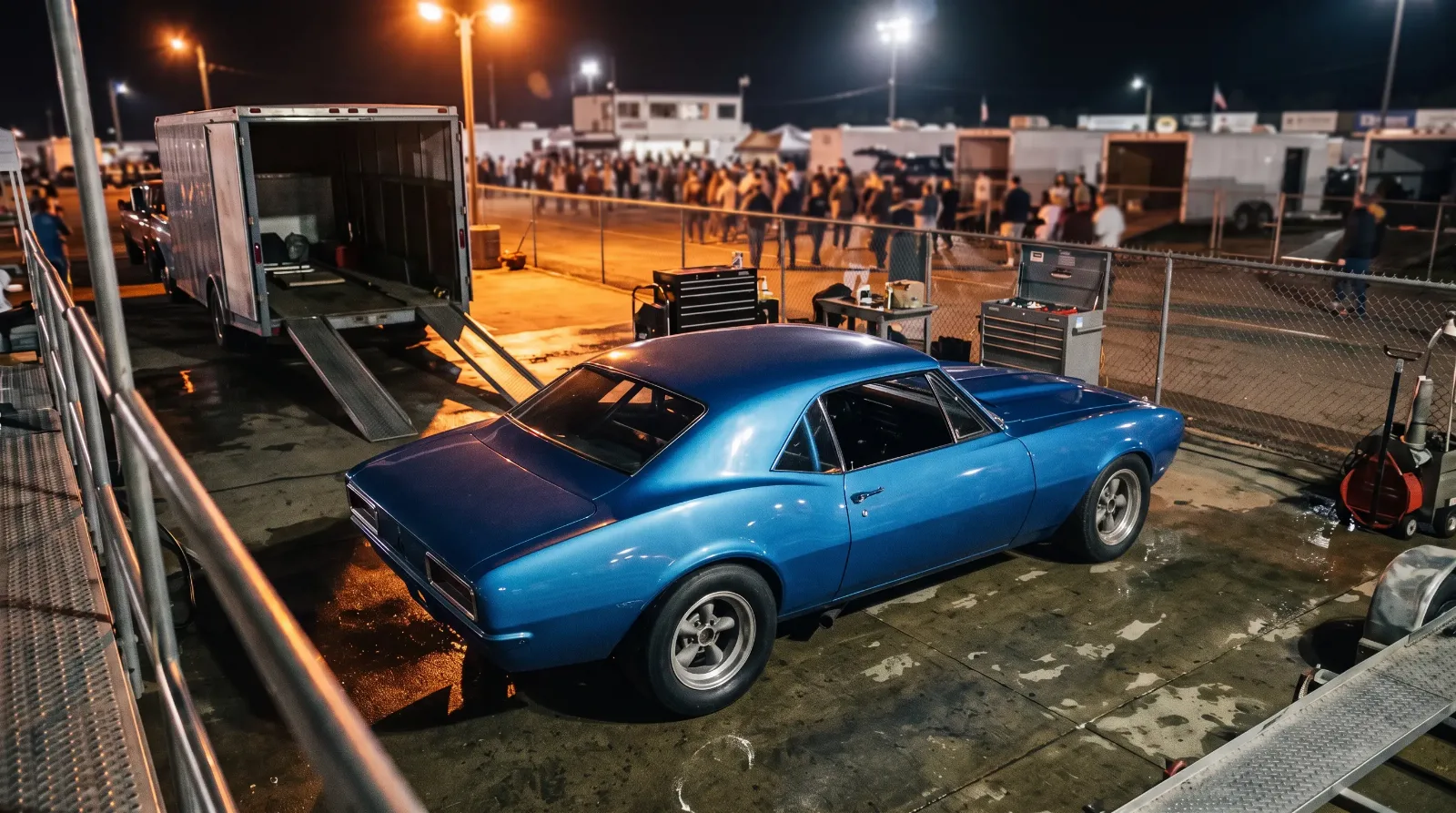
The car has carried the nickname "Mysterious No. 13" ever since, and it earned it. It sits a little apart from the factory-backed Trans-Am effort covered in our Camaro racing guide, because it was never really about winning races. It was about seeing how far one Chevrolet could be pushed before someone in a white shirt said stop.
The man on North Beach Street
Henry "Smokey" Yunick was born on 25 May 1923 in Neshaminy Falls, Pennsylvania, and spent his working life in Daytona Beach, Florida, where he died of leukemia on 9 May 2001. His shop sat at 957 North Beach Street, and he ran it from 1947 to 1987 under a sign that said exactly what he thought of the competition.
By the late 1960s Yunick had a reputation in stock car circles as the builder whose cars always seemed to fit the rules on paper and not quite anywhere else. When the SCCA's Trans-Am series opened the door to small pony cars running engines up to five liters, a man like that was always going to show up with something interesting.
How the Smokey Yunick Camaro was built
The No. 13 did not start as a showroom car with the hubcaps taken off. It was built from bare GM bodies, and the list of what happened next reads like a confession. The body panels were acid-dipped to shed weight. The glass was thinner than stock. The front subframe was lowered, "Z'ed" in the trade, and the floorpan was raised to drop the car closer to the track. The fenders were widened and the windshield was laid back for less drag. On the front fenders, with a straight face, sat a pair of Z/28 badges.
Every one of those changes made the car better. Most of them also made it something other than the production Camaro the rules had in mind. That gap is the whole story of the car.
There is a first-hand account from Richard Parcells, a former SCCA technical inspector, that the car was turned away at Riverside in September 1967 over a belly pan that could not be removed and the acid-dipped body, with the verdict that it could never be made legal. The Bonhams catalogue agrees that the car was thrown out at Riverside, and forum posts with period photos place it there in September 1967, as the Trans-Am field gathered for the Mission Bell 250. So Daytona in 1968 was the second time officials had looked under the No. 13 and not liked what they found.
That date also explains the argument over the car's model year. Bonhams, Octane and Wikipedia describe it as a 1968 Camaro. The inspector remembers it at Riverside in September 1967, and Hot Rod photographs from the period show a 1967 body. A car assembled from bare bodies does not really have a model year in the ordinary sense, so the honest description is a 1967 to 1968 Trans-Am Camaro, and anyone who tells you otherwise with great confidence is selling something.
"Every club has a member who swears he knows which year the No. 13 really is. I let him talk, then I ask to see the build sheet. There isn't one. Smokey started with bare bodies, so the paperwork ends right where the argument begins."
Wayne Coburn
Records at Bonneville, and no wins
If the circuits would not have it, the salt flats would. The No. 13 went to Bonneville and set speed and endurance records there, running both 302 and 396 engines. The Bonhams catalogue calls it dozens of speed and endurance records, and Chevy Hardcore puts the 1967 tally for Yunick's Camaros at more than 30. Nobody has published the full list, so treat the exact count as a good story rather than settled fact.
On the racing side, the ledger is short. The car never won a race while Yunick owned it. The Bonhams sale material names Mark Donohue, Bruce McLaren, Lloyd Ruby, and Al and Bobby Unser among the drivers connected with it, but auction copy is not a results sheet, and no race-by-race record of those drives turned up in anything we checked. At Daytona in 1968 the plan had been to run McLaren and Jim Hall. The Trans-Am class that weekend went to Jerry Titus and Ronnie Bucknum instead, in a car the inspectors were happy with.
The paper trail: Yenko, Edelbrock and Bonhams
Here is where the No. 13 gets more interesting rather than less. In 1969 Don Yenko, the Pennsylvania dealer better known for his own Camaros, bought it and won with it in NASCAR Grand Touring competition: according to the Bonhams catalogue, he took the 1969 Citrus 250 at Daytona International Speedway from pole. Yunick's car finally won, in other words, only after Yunick sold it.
| When | What happened | Owner |
|---|---|---|
| September 1967 | Reportedly rejected by tech at Riverside | Smokey Yunick |
| 1967 | Speed and endurance records at Bonneville, 302 and 396 engines | Smokey Yunick |
| 3 to 4 February 1968 | Fastest Trans-Am car in Daytona 24 Hours practice, then disqualified | Smokey Yunick |
| 1969 | Bought by Don Yenko, wins the NASCAR Citrus 250 at Daytona from pole | Don Yenko |
| 1993 | Bought and restored | Vic Edelbrock Jr. |
| 15 August 2025 | Bonhams Quail Auction, Monterey, no reserve, sold for $268,800 | Sold at auction |
Vic Edelbrock Jr. bought the car in 1993 and restored it, which put it in the hands of a family whose name was already cast into a great many intake manifolds. Then, on 15 August 2025, it crossed the block at the Bonhams Quail Auction in Monterey with no reserve and an estimate of $500,000 to $700,000. It sold for $268,800 including the buyer's premium, well under the estimate. The chassis is documented as TA/13. The catalogue listed a 396 engine, but a saleroom notice corrected that to 305 cubic inches, a fitting last twist for a car that never sat still on paper.
A car that famous selling below its estimate is not a scandal. It is a reminder that a legend and a value are two separate things. Bidders pay for documentation, and a car built to dodge inspectors leaves a thinner trail than most.
Why the No. 13 still matters
The No. 13 sits at the edge of the Camaro's racing story, but it touches the middle of it. When Roger Penske left Chevrolet for AMC after 1969 and took Mark Donohue with him, Chevrolet needed a new Trans-Am partner. It chose Jim Hall's Chaparral operation in Midland, Texas, over Smokey Yunick, about six months before the 1970 opener. Whether a few disqualifications weighed in that decision is not on any record we have seen, and it would be unfair to guess.
Yunick was not the only Chevrolet specialist of the period working around what the factory would sell. Out on the drag strips, Dick Harrell's cars were stuffing big-block power into Camaros through the dealer back door. The difference is that Harrell's cars were meant to be sold and raced by customers. The No. 13 was meant to make a point.
For the owner of a period Camaro, the lesson is the same one Yunick taught the inspectors. Know what your car actually is, and keep the papers that prove it. For how the Camaro got from the 1967 launch to the Trans-Am wars and beyond, there is the wider story. The No. 13 is just the chapter where somebody tried to cheat the rulebook and ended up in the history books anyway.
Sources and notes
- Bonhams: 1968 Chevrolet Camaro Trans-Am, the "Mysterious No. 13", lot 140, The Quail 2025
- Trans-Am Series: On this day in Trans-Am history, 3 to 4 February
- Camaro Research Group forum: Richard Parcells on the Yunick Camaro at Riverside
- Chevy Hardcore: Looking back at Smokey Yunick's hemi-head Camaro
- Octane: Vic Edelbrock Jr.'s personal collection at The Quail
- Wikipedia: Smokey Yunick
Related Reading

Have a
Chevrolet Camaro
for Sale?
Reach thousands of serious classic car collectors across the US.
Sell It Here →
Are You a Classic Car Dealer?
List your full inventory and connect with targeted classic car buyers.
Join as a Dealer →
#1968 camaro
#trans-am racing
#camaro racing
#don yenko
#Smokey Yunick
#Mysterious No. 13
#Daytona 24 Hours

About the author
Wayne Coburn
Longtime Corvette owner, judge and club figure who knows the cars, the records and the people behind them.
Related Listings - Chevrolet Camaro
Comments
Be the first to comment on this article.