
The 1958 Thunderbird unibody construction is one of those engineering decisions that gets a single sentence in most Thunderbird overviews and deserves an entire chapter. Ford was not just redesigning a car in 1958, it was changing the fundamental way that car was built, and the production paperwork from Dearborn shows exactly how much was riding on getting it right the first time.
Car Features
6 min read
The First Unibody Thunderbird
Why the 1958 Thunderbird unibody shift was a bigger engineering risk than the styling change it is usually remembered for.
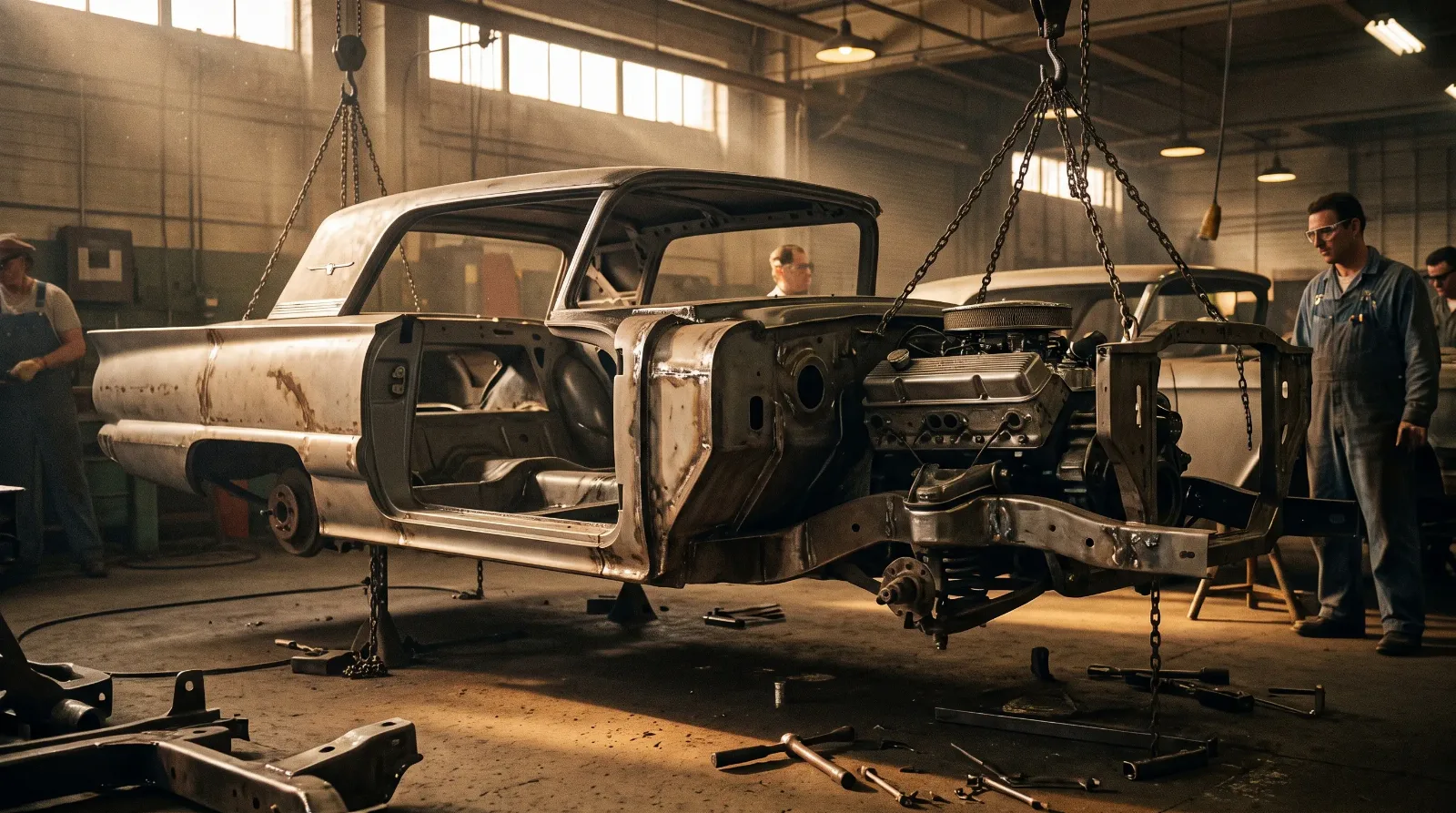
What unibody actually meant for Ford in 1958
Every prior Thunderbird, the two-seat cars built from 1955 through 1957, used traditional body-on-frame construction, a separate steel frame with the body bolted on top. It was the standard approach across the American industry and Ford had decades of manufacturing experience building cars this way. Unibody construction throws that separation out. The body panels themselves, stamped and welded together, carry the structural load that a frame used to handle. Done correctly, it produces a lighter, stiffer, quieter car. Done incorrectly, it produces a car that creaks, rattles, and eventually cracks at stress points that a traditional frame would have absorbed.
Ford's decision to commit the redesigned four-seat Thunderbird to unibody construction, rather than easing into it with a smaller or lower-volume model first, was a bet that its stamping and welding processes were mature enough to handle a structural role they had never played before at this production scale. The 1958 Thunderbird was not a low-volume halo car anymore either. Ford needed to build tens of thousands of these a year, which meant the unibody approach had to work reliably on a full production line, not just on hand-built prototypes.
Why Ford took the risk instead of waiting
The timing lines up with the broader redesign that gave the 1958 Thunderbird its four-seat layout and 113 inch wheelbase, a project already documented in detail in a related story on how Ford doubled the Thunderbird's seating. Unibody construction and the longer wheelbase were connected engineering decisions, not separate ones. A body-on-frame approach at the new car's size and weight would have added even more mass, working against Ford's need to keep the bigger four-seat Thunderbird from feeling sluggish compared to the two-seater it replaced.
Ford's engineers also had a genuine efficiency argument on their side. Unibody construction, once mastered, can reduce material use and assembly steps compared to building and mating a separate frame and body. For a company betting heavily on the commercial success of this redesign, any manufacturing efficiency that helped protect margins on a bigger, more expensive car was worth pursuing, provided the quality held up.
| Trait | Body-on-frame (pre-1958) | Unibody (1958+) |
|---|---|---|
| Structural load | Carried by separate frame | Carried by body panels |
| Weight | Generally heavier | Generally lighter for equivalent size |
| Repair after collision | Frame often salvageable | Structural repair more involved |
| NVH (noise/vibration) | Depends on mounting | Can be tighter if executed well |
There was also a supplier and tooling dimension to this decision that rarely makes it into casual retellings. Unibody construction demands more precise stamping dies and more consistent welding across a much larger number of joints than a body-on-frame car requires, since so many of those welds are now load bearing rather than purely cosmetic. Ford had to requalify its stamping plants and retrain welding crews to hold tolerances that a frame car simply did not demand. Any inconsistency in that process would have shown up as squeaks, misaligned panel gaps, or worse, cracked structural welds within a few years of a car leaving the factory. The fact that this did not become a widespread pattern on 1958 Thunderbirds says something about how seriously Ford treated the retooling effort.
Did it actually work
By most measures, yes. The 1958 Thunderbird did not suffer the reliability black eye that a botched unibody launch could easily have produced, and Motor Trend's staff cited the car's engineering execution directly when awarding it Car of the Year for the model cycle. Owners over the following decades have reported the usual mid-century rust concerns common to any unibody car of the era, since unibody structures are less forgiving of corrosion than a separate frame, but nothing that pointed to a fundamentally flawed launch.
Rust remains the single biggest structural concern for anyone shopping a 1958 through 1960 Thunderbird today, precisely because of the unibody design. A frame car with severe rust can sometimes be saved by frame replacement. A unibody car with severe structural rust is a much harder, much more expensive repair, since the rusted section is doing real structural work rather than just holding the body up.
The ride and handling case for unibody construction also held up under scrutiny. Contemporary road tests noted the 1958 Thunderbird felt noticeably tighter and quieter over rough pavement than comparable body-on-frame personal cars from the same period, a direct result of the stiffer unibody structure resisting flex better than a separate frame and body combination typically manages. That improved rigidity also helped the suspension engineers dial in sharper handling than the car's size and weight would otherwise suggest, another detail Motor Trend's judges weighed favorably when the car took the Car of the Year award.
What it means for buyers and restorers now
Anyone evaluating a 1958 through 1960 Thunderbird for purchase should prioritize a thorough inspection of the structural areas specific to unibody construction, particularly the torque boxes, floor pans, and rocker areas, over the cosmetic condition of paint or trim. A car with rough paint and a solid structure is a far better restoration candidate than a glossy car hiding structural rust, and that priority matters more on these cars than it would on a body-on-frame classic from the same period.
For the fuller context of why Ford took this redesign on in the first place, read the background on the 1958 model's complete story, and if the following model year interests you as well, the 1959 Thunderbird is worth a look too for how Ford refined the formula in its second unibody season.
"People assume the styling change is what made the 1958 car a big deal. The styling is the part you can see. The unibody decision is the part that actually took nerve, because if it had gone wrong, it would have gone wrong on every single car Ford built that year, not just a few."
- Tom Ramirez
The 1958 Thunderbird unibody program remains one of the more underappreciated engineering stories in Ford's postwar history. It reshaped how the company approached structural design well beyond this one model, and it did so under the kind of production pressure that leaves little room for a second attempt. Buyers interested in a car from this era can shop classic Thunderbird listings and see how well individual examples have held up structurally since 1958.
Sources and notes
- Ford Thunderbird (second generation) - Wikipedia
- Curbside Classic - Ford Falcon, Comet, and Fairlane Unit-Body Fords
- Ford Falcon (North America) - Wikipedia
- Old Cars Weekly - Car of the Week: 1958-1960 Ford Thunderbirds
- Squarebirds.org - 1958 Ford Thunderbird Specifications
- Hagerty - Thunderbird Buyer's Guide
Related Reading
Have a
Ford Thunderbird
for Sale?
Reach thousands of serious classic car collectors across the US.
Sell It Here →
Are You a Classic Car Dealer?
List your full inventory and connect with targeted classic car buyers.
Join as a Dealer →
#classic ford
#square bird
#1958 thunderbird
#Thunderbird restoration
#Thunderbird unibody
#Ford engineering history

About the author
Tom Ramirez
Corvette researcher and historian based in Bowling Green, Kentucky. Two decades documenting Corvette production history from original factory records.
Related Listings - Ford Thunderbird




Comments
Be the first to comment on this article.