
Every artifact tells you something if you look closely enough, and the paperwork behind the Thunderbird four seats 1958 decision is one of the clearer examples I have handled in twenty years of cataloging this marque. The documents show a company willing to abandon a working formula, retool an entire factory, and bet the model's future on a car that had never been built before. That is a bigger risk than most retellings of Thunderbird history give it credit for.
Car Features
6 min read
Four Seats and a Gamble: Why Ford Doubled the Thunderbird
The archival record behind Ford's decision to add Thunderbird four seats in 1958, and why it was a bigger risk than history remembers.
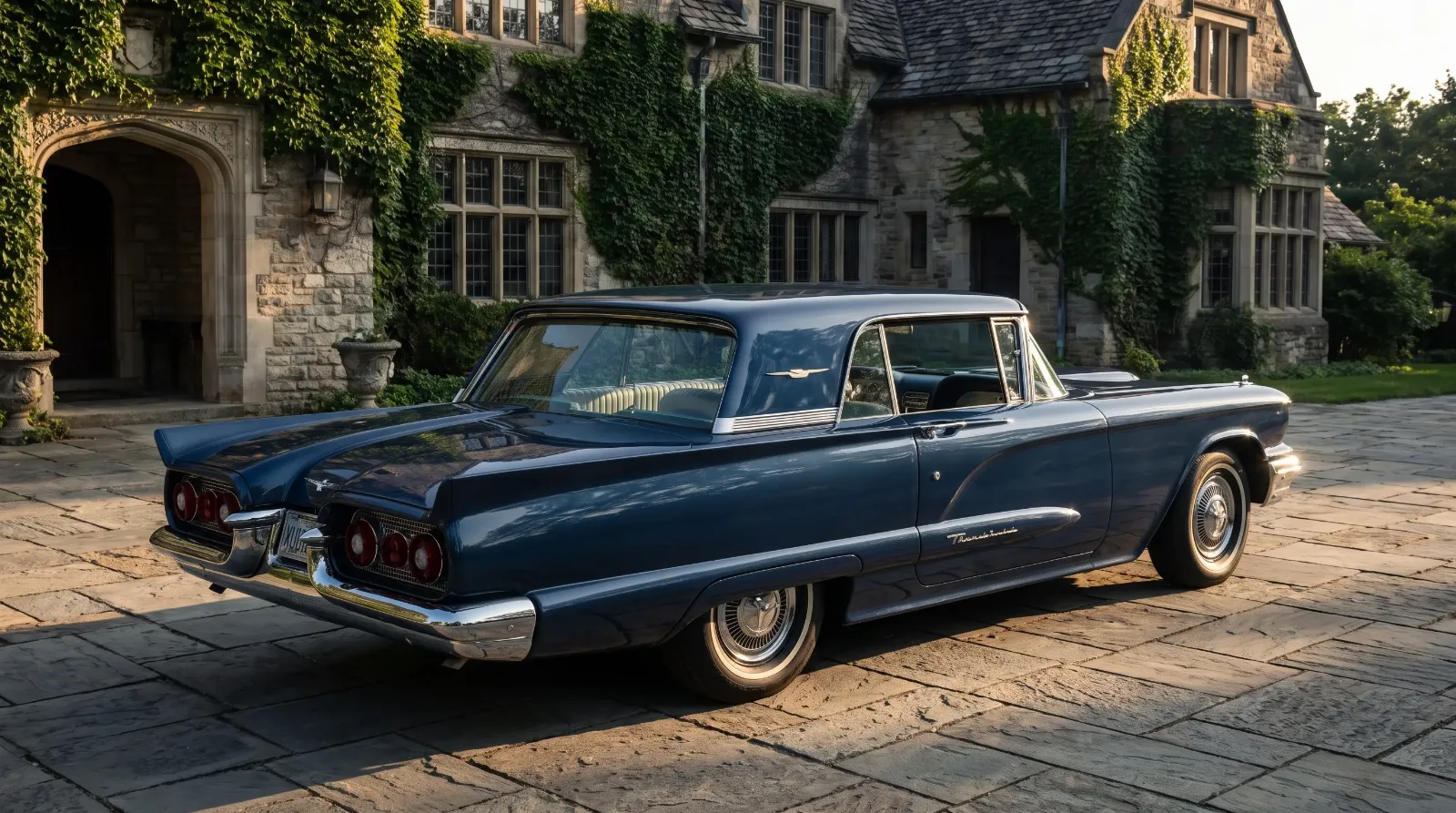
The two-seat car Ford was walking away from
The original Thunderbird, sold from 1955 through 1957, was a tight, two-seat personal car built to compete loosely with the Corvette while offering considerably more comfort. It sold reasonably well for what it was, moving between roughly 16,000 and 21,000 units a year, numbers that looked healthy next to the Corvette's early struggles but modest compared to what Ford's mainstream products achieved. The two-seat format had an obvious structural limit: it could only ever appeal to buyers who did not need to carry passengers, a narrower audience than Ford's leadership believed the Thunderbird name could reach.
The full account of how that original car came to be, and the years it spent as a pure two-seater before the redesign, is documented in our complete history of the model, which fills in the earlier chapters this article assumes as background.
Committing to a longer wheelbase
Stretching the Thunderbird to seat four was not a trim-level adjustment. It required an entirely new chassis architecture, growing the wheelbase from 102 inches to 113 inches, a change of more than ten percent that touched nearly every structural dimension of the car. Ford's engineering staff also moved the 1958 model to unibody construction, integrating the frame and body into a single stamped structure rather than the traditional separate frame the two-seater used. Combining a completely new dimensional package with a completely new construction method in a single model cycle was an aggressive schedule by any era's standards, let alone the late 1950s.
Archival production planning documents from this period show Ford's tooling investment for the 1958 redesign significantly exceeded what a normal model refresh would have required. This was not a facelift dressed up as news. It was closer to launching an entirely new nameplate that happened to keep an existing name.
| Dimension | 1957 (two-seat) | 1958 (four-seat) |
|---|---|---|
| Wheelbase | 102 in | 113 in |
| Overall length | 181.4 in | 205.4 in |
| Curb weight | ~3,145 lb | ~3,708 lb |
| Seating capacity | 2 | 4 |
Why leadership took the risk
Robert McNamara's read of the market, formed while he ran the Ford Division, held that the Thunderbird's real appeal was never about sports car credentials. Buyers wanted style, comfort, and a badge that signaled taste more than a stopwatch time around a track. A two-seat car structurally excluded a huge share of that audience, families and couples who needed room for at least one more passenger. Widening the car to four seats was, in this reading, not a departure from the Thunderbird's identity but a correction of a limitation that had been holding the identity back the whole time.
That is a defensible argument in hindsight, but it required Ford's leadership to trust a theory over hard sales data, since the two-seater's numbers had actually been trending upward through 1957, not down. Betting against your own improving sales chart takes a particular kind of institutional confidence, and it is worth remembering that not every executive at Ford was convinced this was the right move at the time.
Internal correspondence surviving from the period also shows engineering concerns that had nothing to do with sales projections. A unibody structure carrying more weight over a longer wheelbase needed to pass the same durability and safety expectations Ford applied to its full-size cars, and the Thunderbird had never been tested at that scale before. Suspension geometry, frame rigidity, and noise isolation all had to be reworked essentially from scratch rather than adapted from the two-seat car's proven setup. None of that engineering risk shows up in a sales brochure, but it is right there in the archived test reports, and it is part of why this redesign deserves more credit than a simple styling refresh would.
The verdict, recorded in the sales ledgers
The 1958 model year closed with 37,892 Thunderbirds sold, nearly double the strongest two-seat year, and it did so during a recession that depressed sales across the American auto industry. Ford had projected a market for a bigger, more comfortable personal car and the ledgers confirmed it almost immediately. Contemporary trade press coverage treated the sales result as validation not just of the Thunderbird specifically but of an entire new category of car, one built around personal style and comfort rather than outright performance.
Dealer reaction at the time is another piece of the record worth noting. Some Ford dealers who had built loyal two-seat Thunderbird customers privately worried the redesign would alienate the very buyers who made the nameplate a success in the first place. Trade correspondence shows a handful of dealers requesting Ford continue offering some two-seat variant alongside the new four-seat car, a request the factory declined outright. Ford's leadership treated the transition as complete rather than gradual, discontinuing the two-seat body entirely rather than running it in parallel, which is itself a telling detail about how confident the company had become in its own research by the time production began.
What the artifacts tell restorers today
For anyone researching or restoring a 1958 Thunderbird, the documentation trail from this redesign is unusually rich compared to many mid-century American cars, because Ford treated the launch as a major event and archived accordingly. Build sheets, dealer bulletins, and factory service documentation from the 1958 introduction survive in reasonable numbers, giving today's owners more to work with than they might expect for a car this old. That documentation also matters for value, since a well-papered example commands a real premium over an undocumented one in the current market.
"What strikes me looking at the original tooling records is how little hedging there is. Ford did not build a modest transitional model between the two-seater and the four-seat car. It jumped straight to the finished idea and staked real money on getting it right the first time."
- Sarah Whitfield
The Thunderbird four seats 1958 decision reads today as an obvious success, but the records make clear it was a genuine gamble at the time, made against improving sales data on the car it replaced. Ford won that bet decisively, and the personal luxury category it created still shapes how collectors think about the marque. Anyone drawn to this chapter of the story can find a classic Thunderbird from the era that follows directly from this redesign.
Sources and notes
- Ford Thunderbird (second generation) - Wikipedia
- Conceptcarz - 1957 Ford Thunderbird Specifications and Dimensions
- Conceptcarz - 1958 Ford Thunderbird Specifications and Dimensions
- Automotive Mileposts - 1957 Ford Thunderbird Production Numbers
- Hagerty Valuation Tools - 1958 Ford Thunderbird
- Old Cars Weekly - Car of the Week: 1958-1960 Ford Thunderbirds
Related Reading
Have a
Ford Thunderbird
for Sale?
Reach thousands of serious classic car collectors across the US.
Sell It Here →
Are You a Classic Car Dealer?
List your full inventory and connect with targeted classic car buyers.
Join as a Dealer →
#personal luxury car
#square bird
#1958 thunderbird
#Thunderbird four seats
#Ford Thunderbird history
#unibody Thunderbird

About the author
Sarah Whitfield
Third-generation classic car collector specializing in pre-war American and European coachbuilt automobiles. Researcher and concours enthusiast.
Related Listings - Ford Thunderbird
Comments (1)
L
Lorraine
3 days ago
My Eddie always said the Squarebird saved the Thunderbird, bless him.
T
Tammy R.
2 days ago
Your Eddie had it right, plain and simple.