A Racing Program Born Against the Clock
In the winter of 1962, Zora Arkus-Duntov was doing what he always did — pushing General Motors further than its corporate leadership wanted to go. The chief engineer of the Chevrolet Corvette had spent the better part of a decade turning America's sports car into something that could hold its head up against European machinery, and by late 1962 he had an idea that went further than anything Chevrolet had attempted before. He called it the Grand Sport.
The plan was audacious. Duntov intended to build 125 examples of a radically lightened, purpose-built racing Corvette, enough to meet FIA homologation requirements for GT competition. If the numbers came through and the program ran its course, the Grand Sport would go to Le Mans, to Sebring, to the Nürburgring — and it would take on Ferrari on equal terms. For a brief window in early 1963, it looked like it might actually happen.
It did not. But five cars were built, and those five cars became one of the most storied chapters in Duntov's long relationship with the Corvette — not because they won races in the factory program he'd envisioned, but because they survived, raced hard under private ownership, and refused to be forgotten.
Engineering the Grand Sport: Radical for Its Era
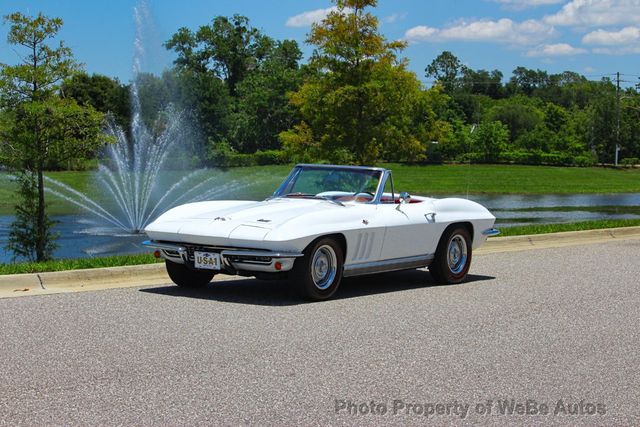
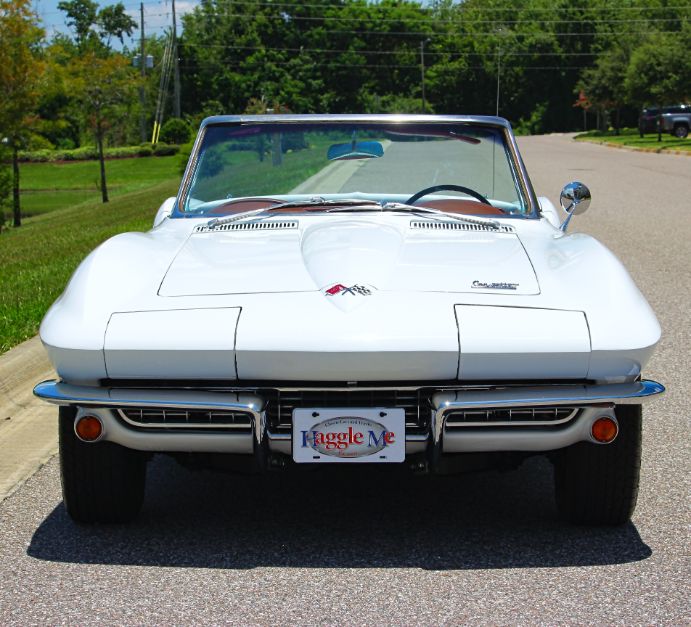
The Grand Sport was not a modified production Corvette. It was a clean-sheet racing car that happened to wear Corvette body panels — and even those weren't standard. The fiberglass bodywork was reportedly laid up thinner than production spec, shaving significant weight from the shell. Period accounts suggest the completed car weighed somewhere in the neighborhood of 1,900 to 2,000 pounds depending on configuration — roughly half the mass of the production C2 that would reach showrooms later that year.
Beneath that lightweight skin, Duntov's engineers specified an aluminum-tube space frame in place of the production ladder chassis. The suspension was fully independent front and rear — not the production rear axle arrangement — and the brakes were large inboard units at the rear, a configuration borrowed from European racing practice. Fuel was delivered through mechanical fuel injection, the system Duntov had championed for the production Corvette since 1957.
The engine intended for the Grand Sport was an aluminum-block 377-cubic-inch V8, reportedly targeting outputs in the range of 550 horsepower, though figures in period accounts vary by source and configuration. Some references suggest the engine was still in development when the program was cancelled. What is not disputed is that the drivetrain was designed from the outset to run at sustained racing speeds for hours at a time — not to satisfy a showroom customer, but to last through the long circuits of endurance racing.
The aerodynamics were functional rather than dramatic — the body retained recognizable Corvette proportions, but the nose was lower, the wheel arches were widened to accommodate racing rubber, and the overall package was designed around downforce and cooling rather than showroom appeal. For those who saw the cars at Nassau or Daytona in late 1963, they looked like nothing else on the grid.
The AMA Ban and the Program's End
The Automobile Manufacturers Association racing ban of 1957 had never been uniformly observed. Ford, Chrysler, and General Motors all found ways to support racing programs through various degrees of indirection, and by the early 1960s the arrangement had become something of an open secret. But GM's board remained officially committed to the ban's principles, and in early 1963 — with the Grand Sport program underway and five cars completed — corporate management pulled the plug.
The decision reportedly came down in the spring of 1963. The 125-car homologation run was scrapped. The factory racing effort was officially ended. Duntov, by most accounts, was furious. The Grand Sport represented the most sophisticated piece of engineering his team had produced — a genuine attempt to build an American car capable of beating Ferrari at its own game — and it had been stopped not by technical failure but by boardroom politics.
"The five Grand Sports that existed when GM cancelled the program were not destroyed — they were dispersed. That decision, however reluctant it may have been, is the reason they exist today."
— Period motorsport accounts
What happened next saved the cars. Rather than being destroyed or locked in a warehouse indefinitely, the five completed Grand Sports were sold off to private customers. GM's official position was that it was no longer in the racing business. What its engineers and a handful of connected privateer teams did with their own equipment was, technically, not GM's concern.
Duntov reportedly never fully forgave management for the cancellation. The Grand Sport was, by most accounts of those who knew him, the racing program he wanted most. He continued to develop the production Corvette, continued to push for performance improvements through legitimate channels, and eventually saw the Corvette become a serious racing platform in the 1980s and 1990s — but the factory Le Mans program died in 1963 and was not resurrected in his lifetime.
Five Cars, Five Histories: The Privateer Campaign
The five Grand Sports that survived the cancellation did not sit idle. Through 1963 and into 1964 they appeared at some of the most important race venues in North America, in the hands of drivers and teams that understood what they had.
Dick Doane acquired one of the cars and raced it in SCCA competition. John Mecom's team, which ran out of Houston and had the resources to prepare cars properly, campaigned multiple Grand Sports. Roger Penske — already emerging as one of the most capable privateer operators in American racing — drove and managed Grand Sport entries during this period. The cars showed up at Nassau Speed Week, where the Bahamas venue's relative freedom from AMA oversight made it a natural gathering point for factory-backed hardware running under private flags. They ran at Daytona. They ran at Sebring.
- Nassau Speed Week 1963 — multiple Grand Sports entered; competitive against the best road racing machinery available in North America
- Daytona Continental 1964 — Grand Sports demonstrated the car's durability potential on the high-speed oval-road course combination
- Sebring 1964 — the 12-hour event provided the most direct comparison to the endurance racing the cars had been built for
Results were mixed but genuinely competitive in context. The campaign was unofficial, underfunded compared to what a factory effort would have been, and hamstrung by the lack of development support that a GM-backed program would have provided. The aluminum racing V8 that Duntov had envisioned for the cars was not always available; some ran with modified production engines. The cars were fast but fragile in ways that a proper factory development program might have resolved.
What the privateer campaign demonstrated, however, was that the basic architecture of the Grand Sport was sound. The car was quick. It handled. Against Cobras and early GT40 prototypes, it was not embarrassed. In a world where GM had been allowed to race it properly, period accounts suggest it might have been a genuine Le Mans contender.
Why Five Is the Number That Matters
There is something almost mythological about the number five in the Grand Sport story. The program was supposed to produce 125 cars. Five were built. Five were sold to privateers. Five raced. Five survived intact.
That survival is not accidental — these were not the kind of cars that got rebodied, crashed into obscurity, or parted out when they became uncompetitive. They were recognized as significant almost from the moment the factory program ended, and the people who owned and raced them treated them accordingly. Each of the five has a documented ownership chain and racing history that historians and auction houses have spent decades reconstructing in detail. When one appears for sale — as several have over the decades — it does so with full provenance, and the prices reflect it.
The fact that only five exist is central to what makes them significant. Had GM built the 125 cars Duntov wanted, the Grand Sport would be a historical footnote — a successful homologation series car, perhaps, or a footnote in the C2 Corvette's story. Because only five exist, each one is irreplaceable. The scarcity created by GM's cancellation is part of what made the cars legendary.
For Duntov himself, the Grand Sport remained a symbol of what might have been. His biography is rich with achievements — the high-lift camshaft that bore his name, the fuel-injected small-block, the independent rear suspension that finally arrived on the C2 — but in interview after interview in his later years, period accounts suggest he returned to the Grand Sport program with a particular kind of frustration. He was a man who had fled Europe to escape totalitarian authority, and finding the same kind of arbitrary institutional resistance inside a Detroit corporation appears to have stung in a way that straightforward technical failure would not have.
The legacy Duntov left is inseparable from the cars that were built under his direction, and no car he touched carries more concentrated legend per unit than the Grand Sport. Five cars. Five histories. One program that was supposed to be so much larger, stopped before it could fully begin, and somehow more enduring for it.
Sources and notes
- National Corvette Museum — archives on Grand Sport production records and history
- Road & Track — period road test coverage and retrospective features on the Grand Sport program
- Motorsport Magazine — historical accounts of Nassau Speed Week and Sebring 1964 race coverage
- Car and Driver — retrospective analysis of Duntov's engineering legacy and the AMA ban's effects
- RM Sotheby's — auction catalog documentation for individual Grand Sport provenance and history