
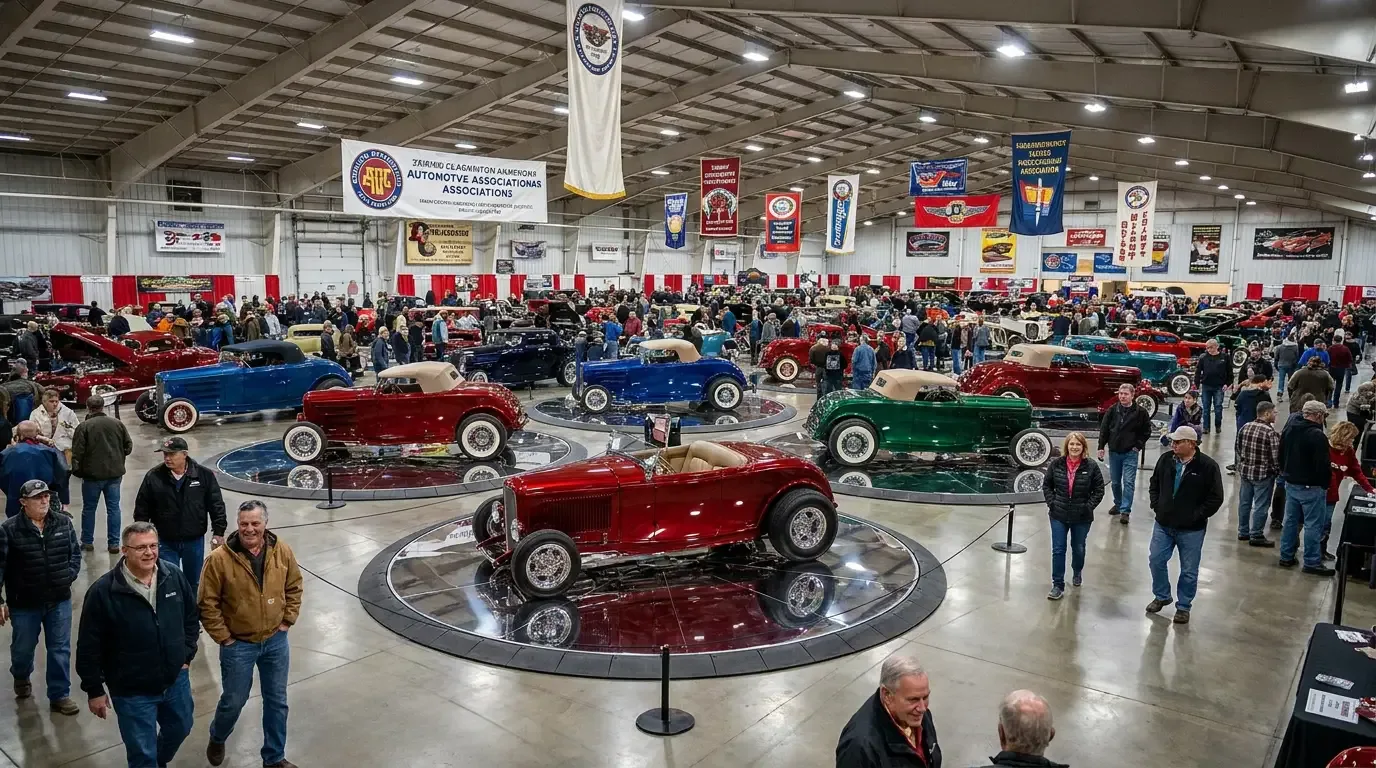
Walk any big indoor show floor long enough, and it does not matter if it is out in California or right here in a Midwest fieldhouse in February, you will hear the same four names traded back and forth like currency: Roth, Von Dutch, Barris, Williams. Guys who never turned a wrench on the car in front of them still argue about them. That is the tell. These were not just builders and painters. They were the ones who decided what a customized car was allowed to look like, and the rest of us have been working inside the lines they drew ever since. You cannot walk the aisles of the grand national roadster show without seeing their fingerprints on half the cars there.
Ownership & Lifestyle
7 min read
Ed Roth, Von Dutch and the Kustom Kulture Icons
Roth, Von Dutch, the Barris brothers and Robert Williams: the four kustom kulture icons whose fingerprints are on half the cars at any show.
I came up respecting these men clear back in my swap-meet days, and I still do. Not because everything they made was tasteful. Some of it was flat-out ugly on purpose. But they had nerve, and nerve is not a thing you can buy at the parts counter, not in Milwaukee or anywhere else.
Ed "Big Daddy" Roth and the monster in the fiberglass
Ed Roth is the one everybody knows, even people who could not tell you a coupe from a roadster. He started out airbrushing wild shirts at car shows, selling them right off the table while a crowd watched him work. That hustle funded the cars. Roth understood something most builders miss: the merch and the myth sell the metal.
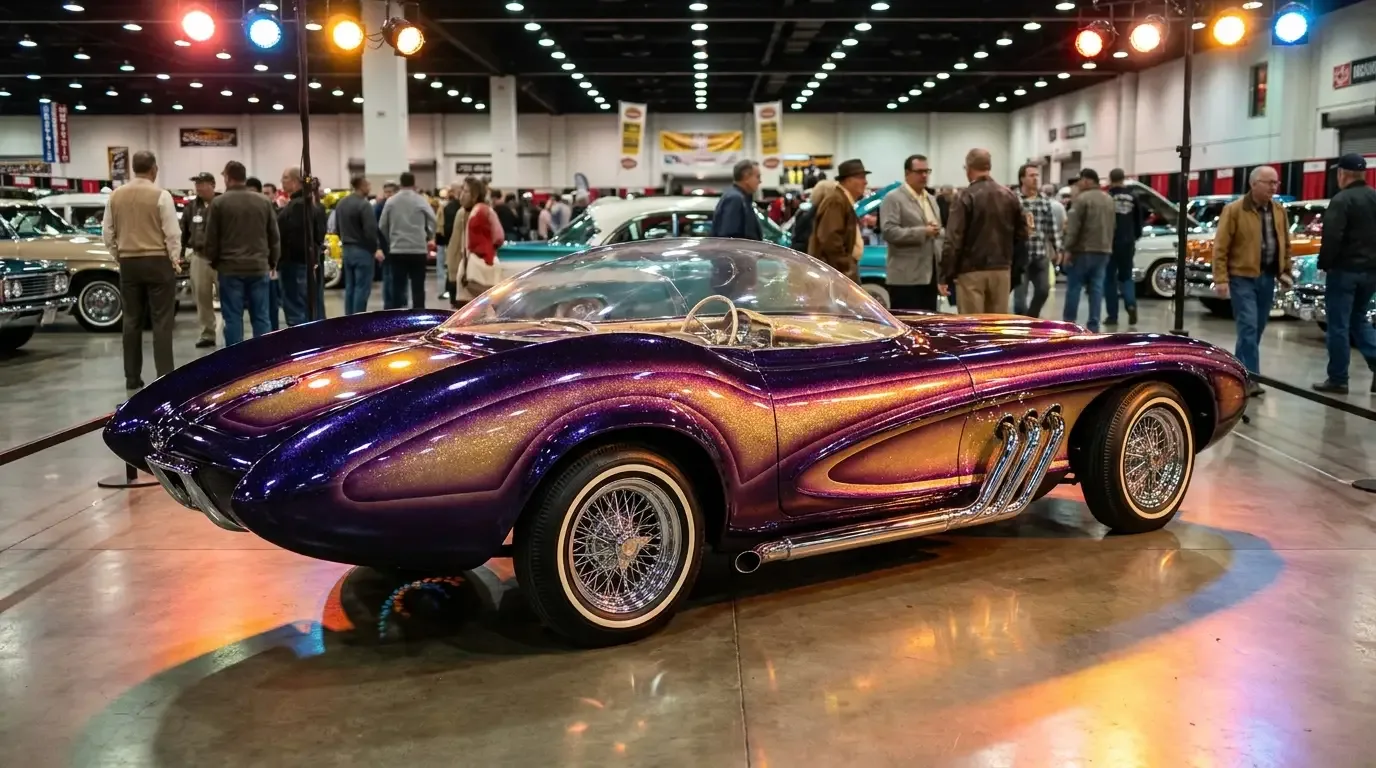
His signature creation was Rat Fink, a green, drooling, bug-eyed rodent he cooked up as the anti-Mickey Mouse. It became the mascot of the whole scene. Then came the show rods, one-off fiberglass fantasy cars that owed nothing to Detroit. The Beatnik Bandit, built around 1961, had a clear bubble top and a single joystick instead of a wheel and pedals. It looked like it drove off a comic book page. The Outlaw came before it, and a string of others followed, each weirder than the last.
Here is the part younger guys forget. Roth built these to be photographed and modeled, not driven. Revell turned his cars into plastic model kits that sold in the millions, and that is how a kid in Ohio who never saw a real hot rod learned what one was supposed to feel like. That reach is why he matters to the whole story of the hot rod, not just the custom corner of it. If you want the wider arc, read the hot rod story and watch how Roth's stuff sits right in the middle of it.
Von Dutch and the brush that started a trade
Kenny Howard, who everybody called Von Dutch, is the reason pinstriping exists as its own craft in this world. Before him, striping was a factory pinline, a straight accent laid down by a guy on an assembly line. Von Dutch made it art. He would freehand a flying eyeball, a set of nervous lines crawling across a dash or a tank, no tape, no plan you could see, just a long striping brush loaded with One Shot and a steady hand.
He worked out of Barris's shop for a stretch in the early 1950s, and that is part of how the styles cross-pollinated. Von Dutch was a genuine eccentric, difficult, allergic to steady work, and he priced jobs to keep customers away when he did not feel like painting. But every striper alive is copying a man who copied him. The flying eyeball is his. When you see it on a helmet or a tank today, that is Von Dutch reaching across seventy years.
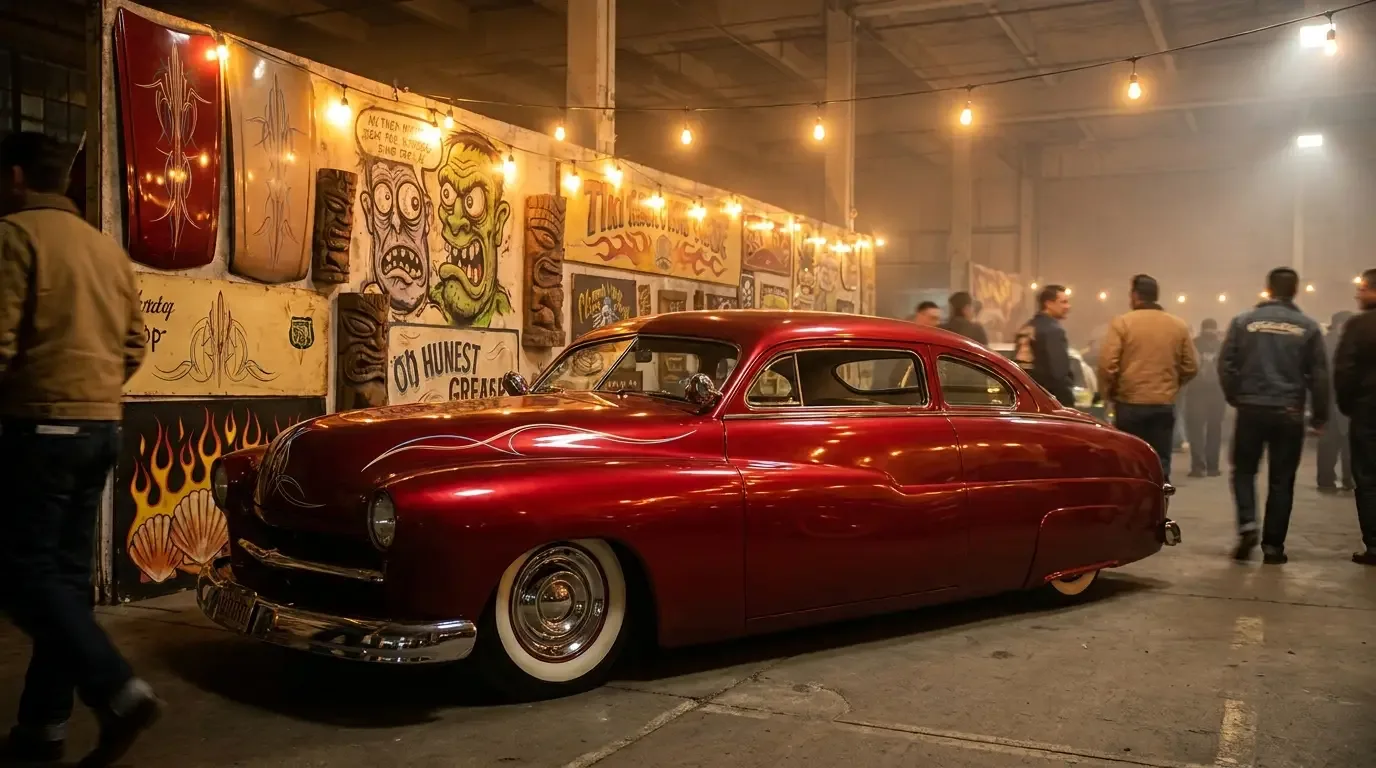
The line work he pioneered is a whole discipline now, tangled up with the flames, scallops, and lettering that define What Kustom Kulture Is to anyone looking in from outside.
The Barris brothers and the kustom, spelled with a K
George and Sam Barris are the reason we spell it "kustom" with a K. That K on the shop sign was a marketing move, and it stuck so hard it named a whole culture. Sam was the quieter craftsman, and a lot of the early bodywork genius was his. George was the promoter, the one who got the cars into magazines and later onto television.
What the Barris shop did was define the kustom as a style separate from the hot rod. A hot rod was about speed and a stripped-down look. A Barris kustom was about flow. They chopped tops low, molded away the seams, frenched the headlights, shaved the door handles, and dropped the whole car until it looked poured onto the ground. The Hirohata Merc, a 1951 Mercury they built in the early 1950s, is still the car every kustom guy measures against.
George later built the 1966 Batmobile and other TV cars, which brought the Barris name to people who had no idea what frenching a headlight meant. Purists grumble about that. I never have. Getting normal people to care about custom cars was always the hard part.
Robert Williams and the culture that grew up
Robert Williams is the bridge from the shop floor to the gallery wall. He worked for Roth Studios in the 1960s, soaking up the show-rod and monster-art world firsthand, then took that sensibility into fine art. His paintings are dense, violent, funny, and technically serious, and he refused to let the art world dismiss them as kitsch.
Williams cofounded Juxtapoz magazine in 1994, and that publication did for lowbrow art what the model kits did for show rods. It gave the whole underground a name, a home, and a sense that it counted. The term "kustom kulture" as a gallery movement owes a lot to a 1993 show that put Roth, Von Dutch, and Williams under one roof and told the art establishment to take a hard look.
That is the throughline. Roth sold the fantasy, Von Dutch drew the line, the Barris brothers built the shape, and Williams hung it on a wall and made critics argue about it. Four different jobs, one culture.
Why these four still run the room
The reason these names hold up is that each of them owned a piece of the whole thing, and together they cover it end to end. Show up at any serious event and the influence is not subtle.
- Roth gave the scene its mascot, its show-rod imagination, and its merchandising playbook.
- Von Dutch made pinstriping a craft with a name and a founder.
- The Barris brothers defined the kustom as its own art and dragged it into pop culture.
- Robert Williams carried it into fine art and gave the underground a magazine and a movement.
None of them built for the appraisal or the auction number. They built because they could not help it, and because they wanted to make you look twice. Every chopped roof, every flying eyeball, every candy-flake fantasy car you see rolling across a modern show floor is a note in a song these four started writing seventy-odd years ago. Learn who they were, and the whole custom world stops looking random and starts looking like a tradition.
Sources and notes
- Period hot-rod and custom-car press coverage of Roth, Von Dutch, and the Barris shops.
- Kustom kulture and show-rod reference histories, including gallery-exhibition records.
- Museum and show records for signature cars such as the Beatnik Bandit and the Hirohata Merc.
- Published interviews and biographical accounts of the builders and artists named here.
Related Reading
Have a
Classic Car
for Sale?
Reach thousands of serious classic car collectors across the US.
Sell It Here →
Are You a Classic Car Dealer?
List your full inventory and connect with targeted classic car buyers.
Join as a Dealer →
About the author
Gary Nowak
Lifelong Midwest rodder who has been building and driving traditional pre-war hot rods since the 1970s.
More in Ownership & Lifestyle
Comments
Be the first to comment on this article.