
Classic car selling fees come in two shapes, and the shape matters more than the headline number. A flat fee is a fixed charge that stays the same whether the car brings $9,000 or $90,000. A commission is a percentage of the sale price, so it grows with the car. At low values the two can look similar. At $50,000 and up they stop being in the same conversation, and a seller who compares them by the sticker alone can misread the cost by thousands of dollars.
Market & Values
7 min read
Flat Fee vs Commission: What Selling a Classic Really Costs
Flat fees shrink as the car gets pricier; commissions don't. Worked math at $10k to $100k, plus what a buyer's premium costs you.
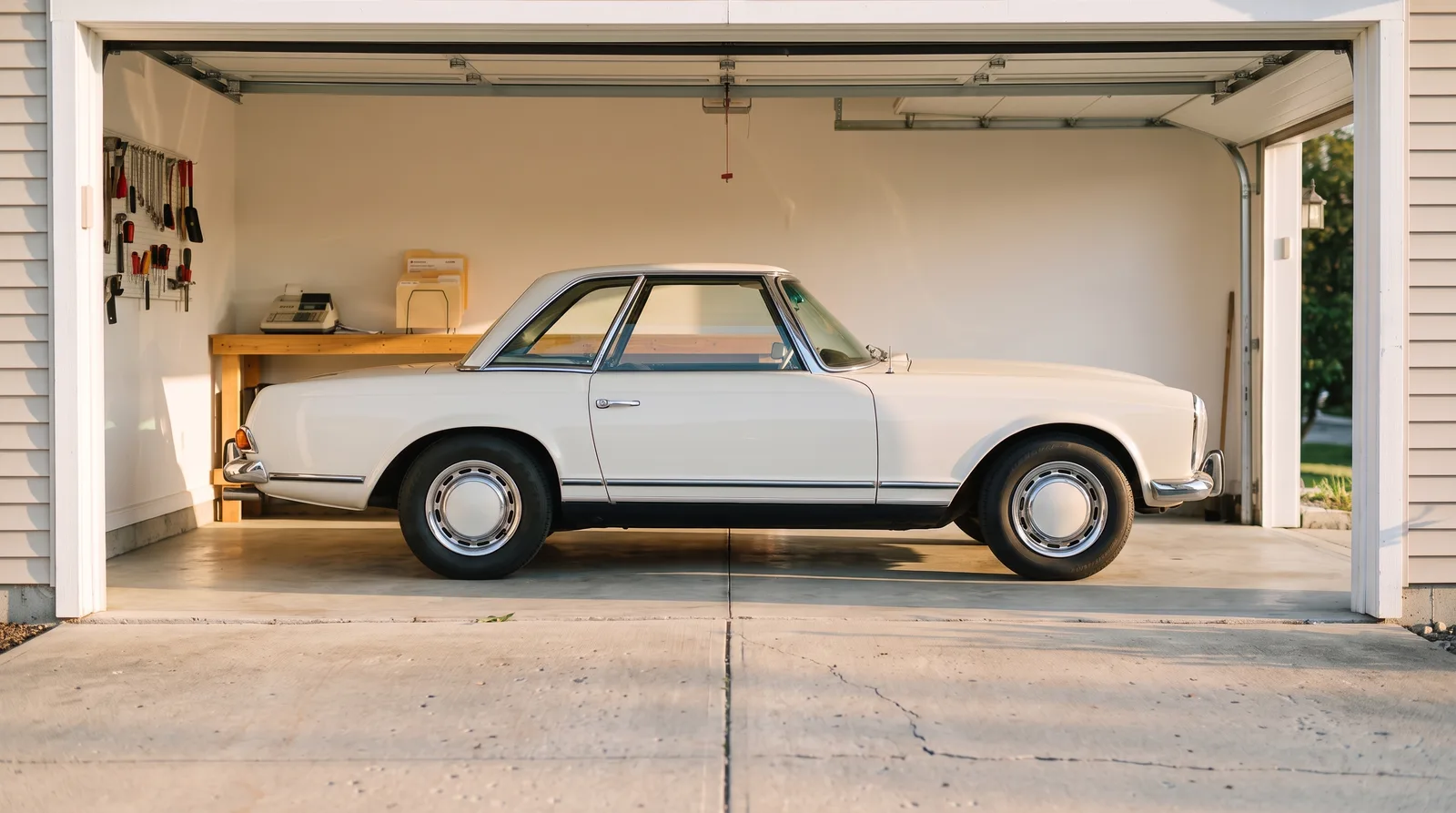
This piece runs that arithmetic at four car values, then looks at what a commission has to earn back to justify itself, and at the buyer's premium, the fee that is charged to the buyer but still lands in the seller's result. It is narrower than the platform-by-platform comparison; for audience, photo limits and listing duration on each site, see the full guide.
Two ways to pay for a sale
Flat-fee selling is what most listing sites use. Current examples: a listing here costs $49, $99 or $179 one time, with no commission. ClassicCars.com private seller packages run $149.99, $209.99 or $349.99. eBay Motors charges a single insertion fee of $34 for vehicles at $15,000 or less and $79 above, with no final value fee, though eBay keeps 2.8% of any deposit paid through its checkout. Hemmings sells flat-fee listings too. In every case the seller knows the cost before the car is photographed.
Commission selling is how consignment dealers and live auction houses get paid. Consignment commissions usually fall somewhere around 5 to 15% of the sale price, sometimes replaced by a flat fee, on agreements that commonly run 60 to 90 days. At the big live auctions the seller pays an entry fee plus a commission on the hammer price. Mecum's entry fee runs $350 to $1,000, with a seller commission of 10% on a reserve car and 6% at no reserve. Barrett-Jackson's seller commission is 8%. On top of that, the auction house charges the buyer a premium, which we will come back to, because it is not as irrelevant to the seller as it looks.
The fee math at four car values
The table below holds every variable constant except the fee model. Same car, same sale price, five ways to pay. The consignment column uses 10% as a midpoint of the usual range, and the live auction column uses a 10% reserve commission plus a $500 entry fee, inside Mecum's published range. These are illustrative figures. Your actual contract terms will differ, and they leave out prep, transport and holding cost entirely.
| Sale price | Flat fee $99 (our Featured) | Flat fee $149.99 (ClassicCars.com Regular) | eBay Motors insertion fee | Consignment at 10% | Live auction, 10% + $500 entry |
|---|---|---|---|---|---|
| $10,000 | $99 fee, net $9,901 | $149.99 fee, net $9,850.01 | $34 fee, net $9,966 | $1,000 fee, net $9,000 | $1,500 fee, net $8,500 |
| $25,000 | $99 fee, net $24,901 | $149.99 fee, net $24,850.01 | $79 fee, net $24,921 | $2,500 fee, net $22,500 | $3,000 fee, net $22,000 |
| $50,000 | $99 fee, net $49,901 | $149.99 fee, net $49,850.01 | $79 fee, net $49,921 | $5,000 fee, net $45,000 | $5,500 fee, net $44,500 |
| $100,000 | $99 fee, net $99,901 | $149.99 fee, net $99,850.01 | $79 fee, net $99,921 | $10,000 fee, net $90,000 | $10,500 fee, net $89,500 |
Expressed as a share of the price, the flat fees shrink as the car gets more valuable. The $99 fee is 0.99% of a $10,000 car and 0.10% of a $100,000 car. The commission columns barely move: the consignment fee is 10% at every value, and the auction column falls only from 15% to 10.5% as the fixed entry fee becomes a smaller slice. The gap between the cheapest and most expensive option is $1,466 on the $10,000 car and $10,421 on the $100,000 car.
Two adjustments worth knowing. A no-reserve live auction is cheaper on paper: at a 6% commission with the entry fee halved to $250, the $50,000 car costs $3,250 to sell and nets $46,750. And a fixed-fee online auction sits closer to the flat-fee columns than the commission ones. Hemmings Auctions, for example, charges the seller $99.95 and puts a 5% fee, with a floor and a cap, on the buyer.
What a commission has to earn back
None of this means commission selling is a bad deal. It means the commission has to pay for itself through a higher price, a faster sale, or work the seller would otherwise do. The useful question is how much higher the price has to be.
Take the $50,000 car again. Listed with a $99 flat fee, the seller nets $49,901. To net the same amount through 10% consignment, the car has to sell for about $55,446, roughly 11% more. Through a live auction at 10% plus a $500 entry, the hammer has to reach about $56,001, roughly 12% more. Those are the break-even prices, before transport and prep, which usually cost more for the auction route.
Can a good consignment dealer or a strong auction slot add 11 or 12% to the price? For some cars, yes. A dealer with a showroom, financing for buyers and a client list can get a premium for a car that private buyers find intimidating. A sought-after car in front of a competitive room can run well past its private-sale value. For the average driver-quality car, I would not count on it. Plenty of ordinary cars hammer at or below what a patient private seller would have accepted.
The buyer's premium is not free money
Sellers often treat the buyer's premium as someone else's problem. It is not, because serious bidders bid against their total budget. At Mecum the premium is 10% in person and 12% for phone and online bidders, with a $1,000 minimum. Barrett-Jackson charges 10% on site, and RM Sotheby's 12% up to $250,000 and 10% above.
Here is an illustrative case. A buyer has $55,000 to spend, all in, on your car.
- Live auction, 10% buyer's premium. The buyer can bid up to $50,000. After a 10% seller commission and a $500 entry fee, the seller nets $44,500.
- Online auction, 5% buyer's fee. The buyer can bid up to about $52,381. After a $99.95 seller fee, the seller nets about $52,281.
- Private sale through a flat-fee listing. The buyer pays $55,000 directly. After a $99 fee, the seller nets $54,901.
Real bidding is not that tidy. Two determined bidders can push a hammer price past anyone's spreadsheet, and that upside is the real argument for an auction. But the premium sets a ceiling on what a disciplined buyer will bid, and the seller lives under that ceiling.
Cross-border sales add a layer that no fee schedule shows. If you or your buyer are in Canada, currency conversion, import paperwork and any duties and taxes enter the buyer's math and therefore the offer; read more on that before you price a car for buyers on both sides of the border.
"A commission is a bet that someone else can get you a better price than you can get yourself. Sometimes that bet pays. Run the break-even number first, and be honest about whether your car is the kind that makes a room go to war."
David Mercer
When each model makes sense
My read of the numbers is simple. Below about $15,000, the fee model matters less than the audience, and a flat-fee or free listing almost always nets more. Between $15,000 and $75,000, flat fee wins unless the car has a specific reason to draw competitive bidding or the seller cannot handle showings and paperwork. Above that, the percentage cost gets large enough that the commission has to be justified car by car, with the break-even price written down before you sign.
Commission channels earn their fee when the seller is buying time and labor: an estate that needs a clean exit, an owner who lives far from the car, or a car whose story is best told under a spotlight on a fixed date. Flat fee earns its place when the seller can answer emails, run a test drive and take payment safely, and wants the whole sale price at the end.
If your car falls in that second group, you can list it here for a one-time fee, keep it up until it sells, and receive payment from the buyer directly with no commission taken. Whichever route you choose, put the fee in the same column as the price you expect. A fee only means something next to the number you walk away with.
Sources and notes
Related Reading



#buyer's premium
#sell classic car
#flat-fee listing
#auction fees
#consignment commission
#Sell Your Classic Car
#classic car selling fees

About the author
David Mercer
Classic car market analyst with two decades of experience tracking collector car valuations, auction results, and investment trends.

Comments
Be the first to comment on this article.