
A classic that doesn't run still sells. It just sells to a different buyer, for a different number, and the whole deal hangs on one thing: how honestly you can tell a stranger what's wrong with it. When you sell a non running classic car, most of the work is in the telling, not the fixing.
Market & Values
8 min read
Selling a Non-Running Classic Car
How to sell a classic that doesn't run: diagnose what kind of dead it is, decide what to fix, price the risk and list it honestly.
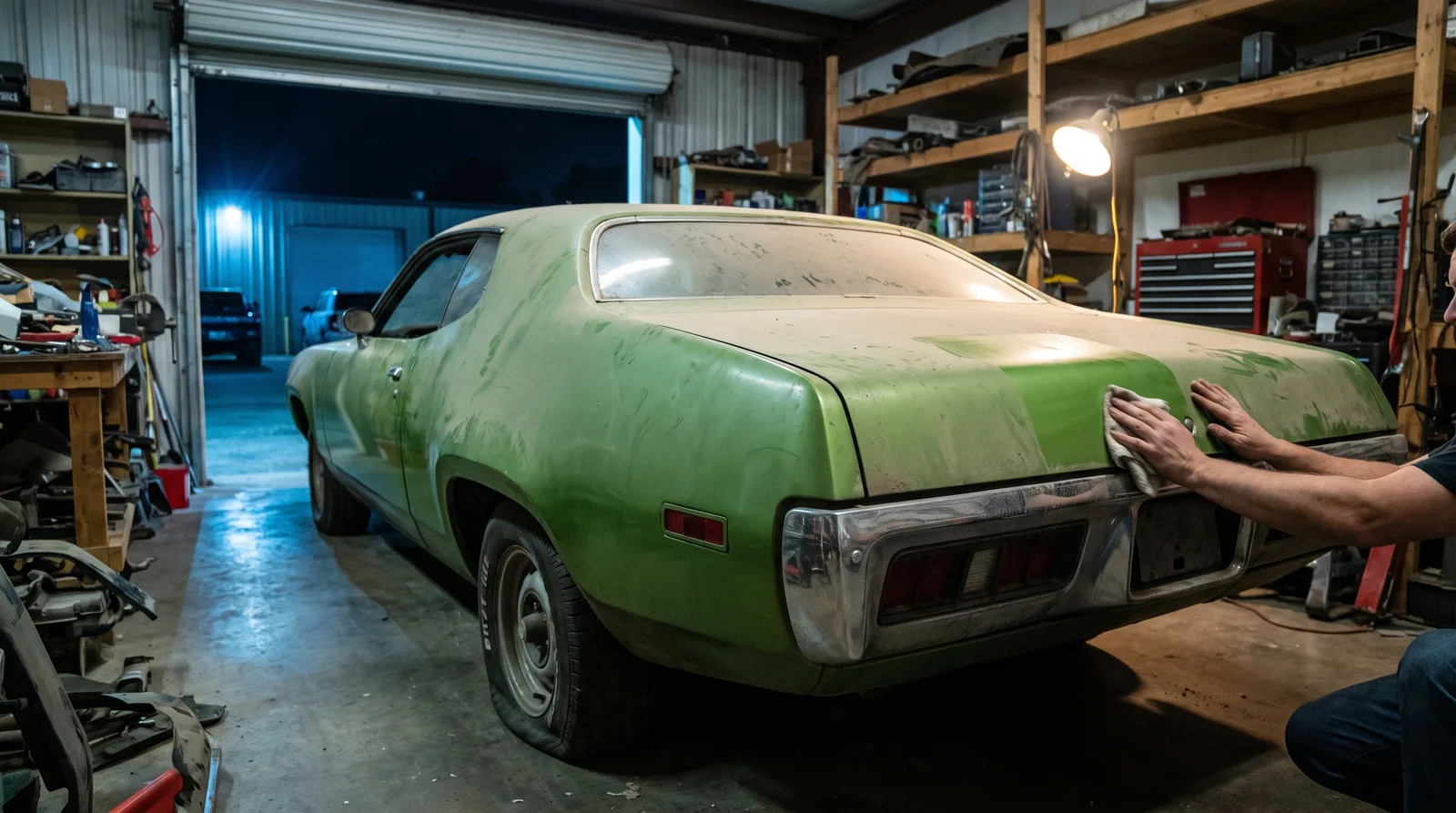
The usual steps still apply. Title, records, pricing from real sales, safe payment, the handover. Those are covered in how to sell a classic car, so I won't walk through them again. This is about what changes when the car can't move under its own power.
Figure out what kind of dead it is
"Doesn't run" covers a lot of ground. A buyer hears those two words and assumes the worst, which is a locked-up engine and rot everywhere else. Your job is to narrow it down before you list, because every fact you can prove takes a piece of the unknown off the price.
Non-running cars come in roughly four flavors, and they're worth very different money:
- Cranks but won't fire. The engine spins on the starter and never catches. Usually fuel, spark or both. Often the cheapest fix of the bunch.
- Won't crank, engine free. Dead battery, tired starter, bad ground, a neutral safety switch. You can prove the engine is free with a breaker bar on the crank bolt.
- Seized. The crank won't budge by hand. Might be surface rust in a cylinder from sitting, might be something a lot worse. Buyers price this as an engine job, period.
- Runs, but doesn't drive. It starts, but the brakes are gone, the tank is full of varnish or the transmission won't pull. It runs on paper. Nobody's taking it on the road.
Spend an afternoon finding out which one you have. Put a good battery on it. Oil the cylinders, let them soak, try to turn the engine by hand and check for spark. If it turns freely and has compression, say so, and say how you know. "Engine turns by hand, compression tested on all eight, gauge readings in the photos" is worth real money in a listing. "Ran when parked" is worth nothing. Every buyer has heard it, and plenty of them have been burned by it.
Should you get it running before you sell?
Sometimes. The math is what the fix costs you against what the buyer knocks off for the unknown.
Buyers discount a dead car twice. Once for the repair they can see, and once more for the risk they can't. A car that cranks and needs a fuel system gets marked down for the fuel system plus a chunk for "what else is wrong with it." Get that same car started and idling and most of that second number goes away. That's where the cheap money is.
A big engine or transmission job right before a sale almost never pays back. The buyer doesn't fully trust a fresh rebuild he didn't watch happen.
| What's wrong | Fix it first? | Why |
|---|---|---|
| Dead battery, starter or bad ground | Yes | Cheap parts, and a car that cranks shows better than one that clicks |
| Stale fuel, gummed carb, dead fuel pump | Usually | Turning "non-runner" into "runs and idles" removes most of the risk discount |
| No spark (points, coil, wiring) | Usually | Inexpensive, and the fix is easy to show on video |
| No brakes, engine runs | Depends | Fix them if you want test drives; otherwise sell it as "runs, does not stop" and say so |
| Bad transmission or rear end | Rarely | Expensive, and the buyer may have his own plans for the drivetrain |
| Seized engine | No | Buyers price it as a rebuild either way; sell it as-is and be plain about it |
One rule I'd hold to. If you get it running, don't take it around the block on forty-year-old brake hoses to make a point. A video of it starting, idling and shutting off does the job without anybody ending up in a ditch.
Pricing a car that won't move
Start from what the same car brings in running, driver condition, using completed sales and not asking prices. Then work down. Subtract what a buyer will realistically spend to get it on the road, and subtract again for risk.
How big the risk discount gets depends on what you've proven. A car with a known, documented problem, say a bad fuel pump with compression numbers posted, needs a smaller discount than one where nobody knows anything. A seized engine sitting in a car with soft floors is a parts car, and it should be priced like one.
What moves the number most is rust, completeness and paper. A dead car with solid floors, all its trim and a clean title is a project somebody can finish. A dead car missing its grille, the back seat and the title is a pile of parts with a VIN on it.
If your car is closer to half-built than dead, with the body in primer or a fresh engine on a stand, the pricing works differently. The approach changes when you sell project car builds like that, because the buyer is paying for finished work as well as the car.
"A dead car sells on what you can prove. Every question you answer before the buyer asks it is money that stays in your pocket."
Mike Sullivan
Listing it and showing it honestly
Put "does not run" in the title of the ad. The people who want a non-runner are searching for one, and the people who don't will waste your Saturday if you bury it.
Then tell the whole story: when it last ran, why it stopped, what you've checked and what you found. Shoot the photos the way a buyer would inspect it: floors from underneath, trunk pan, frame rails, the engine bay, the VIN plate next to the title. Shoot a video of what happens when you turn the key, even if all that happens is a click. Buyers trust a video of a car not starting more than a seller swearing it "just needs a tune-up."
Where you list matters less than how. Facebook Marketplace is free for local vehicle sales and Craigslist charges $5 for a car ad by owner, and both pull in local project hunters who already own a trailer. A national listing reaches the guy three states over who's been hunting for your exact car to finish his. eBay Motors charges one insertion fee, $34 for a vehicle at $15,000 or under, but vehicle bids there are non-binding, so expect the occasional winner who never shows up.
Then make the car reachable. Drag it out of the back of the barn before anybody comes. Make sure a trailer or a rollback can actually get to it. Tell buyers up front that they bring the trailer and the winch, and that loading is on them. Nothing kills a sale faster than a man who drove two hours and can't get the car out of your yard.
Who buys them and how they leave
Three kinds of buyer show up for a dead classic. The finisher wants your car to restore and pays the most, as long as it's solid and complete. The parts buyer wants your glass, trim or engine for a car he already owns, and pays less but decides fast. The flipper or dealer buys to resell. Our own working estimate puts a dealer's cash offer on a running classic about 20 to 30 percent under a private sale, once reconditioning, holding cost and margin come out. On a non-runner, expect the gap to be wider, because the reconditioning bill is bigger.
The paperwork doesn't change because the engine doesn't turn. You still need a clean title in your name, a bill of sale that says "sold as-is, does not run" in plain words, and whatever release-of-liability step your state asks for. Get paid in full before the car is loaded. Cash counted at a bank or a wire that has actually cleared.
Towing is the buyer's job and the buyer's cost, and the ad should say so. If you want to widen the pool, get a transport quote ahead of time so you can answer the out-of-state guy who asks what it'll cost to ship.
Rust doesn't take the winter off. Once you've decided it's going, write it up honestly, price it from real numbers, and create your listing while it's still a car and not a parts pile. Here the fee is flat and paid once, starting at $49, with no commission, and the ad stays up until the car sells.
Sources and notes
- Hagerty: what does a car's condition really look like (#1 to #6 scale)
- eBay Motors: vehicle selling fees
- The Drive: Craigslist charges $5 for car and truck ads by owner
- Jalopnik: selling a car on Facebook Marketplace (free to list)
- California DMV: Notice of Transfer and Release of Liability
- FTC: how to spot, avoid and report fake check scams
Related Reading
#project car
#parts car
#sell classic car
#classic car pricing
#sell non running classic car
#non running classic

About the author
Mike Sullivan
Detroit-area muscle car enthusiast and restoration specialist with three decades of hands-on experience working on American iron.


Comments
Be the first to comment on this article.