
A classic car sale carries most of its risk in the last hour. The negotiation is done, the buyer is pleasant, the trailer is in the driveway. Then the payment arrives in a form you have not verified, and the title goes with the car. If the money turns out to be bad, you no longer hold the asset and you hold no recourse worth the name. The safest way to get paid selling car deals of any size comes down to one rule: the funds must be final and confirmed in your own account before the title, keys or car leave your control.
Market & Values
8 min read
Getting Paid Safely: Wire, Cashier's Check or Escrow
The safest way to get paid selling a classic car: how wires, cashier's checks and escrow work, what they cost, and how each one fails.
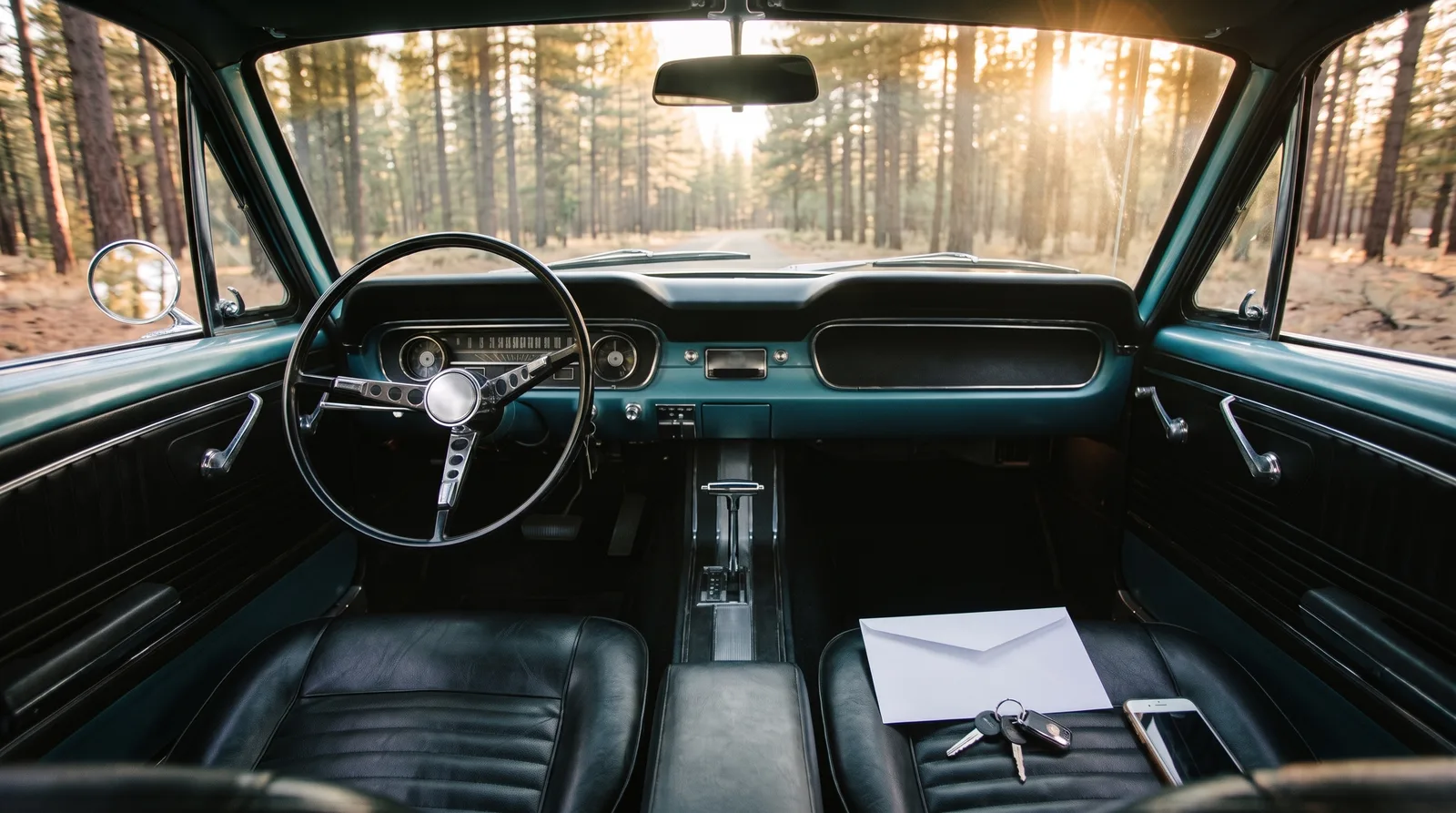
This article covers that one step in detail. For prep, pricing and the rest of the process, see the full guide. Here the subject is narrower: which payment methods hold up, what each one costs, and how each one fails.
Why the payment step concentrates the risk
A car is a high-value, portable asset with a transferable title. Once both leave, recovering either is slow and uncertain. That asymmetry is why fraud clusters at the payment step. The fraudster does not need to fool you about the car. He only needs you to believe the money is good for a few days.
The common failure is a confusion between funds that are available and funds that are final. The Federal Trade Commission is direct about this: the fact that a bank makes deposited funds available does not mean the check is good, and a fake check can take weeks to surface. By then you have spent the money, the car is in another state, and the bank reverses the deposit against you.
The second failure is a payment channel that offers you no protection at all. PayPal and Venmo purchase protection both exclude motor vehicles, and Zelle has no purchase protection. Those apps are built for small transfers between people who know each other. A five-figure car sale to a stranger is outside that design, and the seller absorbs the downside.
Bank wire: fast and final, if you confirm it yourself
A domestic wire is the cleanest method for most private classic sales. Once the money is credited to your account, it is generally final in a way a check is not. The buyer's bank typically charges the sender a fee, usually somewhere around $25 to $35 for a domestic outgoing wire, and some banks charge the recipient a smaller incoming fee, often around $15. A few banks charge nothing either way. On a car worth tens of thousands, that is a rounding error.
The verification step is what makes a wire safe. Log in to your own banking app, or call your bank at the number on your card, and confirm the credit has posted. Do not accept a screenshot, a wire confirmation number or an email "receipt" from the buyer as proof. Those are trivially faked, and a fraudster's best tool is a convincing document that arrives before the money does.
Give your account details by phone or in person rather than by email, and confirm any change to them the same way. Payment-redirection schemes work by intercepting or imitating email, so a channel the fraudster cannot read is part of the control. Wires sent on a Friday afternoon can land on Monday, so plan the handover around posted funds, not around the buyer's schedule.
Cashier's check: verify the bank, not the paper
A cashier's check is drawn on the bank's own funds, which is why sellers trust it. That trust is exactly what counterfeiters exploit. A fake cashier's check looks right, carries a real bank's name and often a phone number that rings through to an accomplice who "confirms" it.
Verification has to be independent. Look up the issuing bank's phone number yourself, from the bank's official website or a branch directory, and call to confirm the check number, amount and payee. Better still, meet the buyer at a branch of the issuing bank and watch the check being issued, or deposit it and wait until your own bank confirms it has been paid, not merely made available. That takes longer. It is the point.
A cashier's check for more than the agreed price, with a request to refund the difference or pay a "shipper," is a scam in every case I have seen. Decline it outright. No legitimate buyer overpays for a car.
Escrow: what you are paying for and when it earns its fee
Escrow solves a specific problem: a long-distance deal where the buyer will not send money before seeing the car and the seller will not release the car before seeing the money. A licensed escrow company holds the buyer's payment, the buyer receives and inspects the car within an agreed window, and the funds are released to the seller once the buyer accepts or the window closes.
The cost is a percentage of the price on a sliding scale. On Escrow.com's standard schedule at the time of writing, that is 2.4 percent between $5,000 and $50,000 and 1.9 percent from $50,000 to $200,000, so roughly $960 on a $40,000 car and about $1,700 on a $90,000 one. Buyer and seller can agree who pays or split it. For a $15,000 driver sold locally, that fee buys little. For a $90,000 car going across the country to a buyer you have never met, it buys a lot.
The risk in escrow is a fake escrow service. Fraudulent "escrow" websites are built specifically to steal cars, and the buyer always suggests them. Choose the escrow company yourself, confirm it is licensed in the state it claims (Escrow.com, for example, operates under a California escrow license from the Department of Financial Protection and Innovation), type its web address directly rather than following a link, and verify the funded transaction by logging in to your own account on that site.
| Method | Finality once confirmed | Typical cost | Seller's verification step | Best fit |
|---|---|---|---|---|
| Bank wire | High | Sender fee, roughly $25 to $35 domestic | Confirm the credit in your own account | Most private sales, local or remote |
| Cashier's check | High if genuine, zero if fake | Small issuing fee to buyer, often about $5 to $15 | Call the issuing bank on a number you looked up, or watch it issued | Local sales with a branch visit |
| Escrow | High, on release | Percentage of price, sliding scale (about 1.9 to 2.4 percent for most classics) | Log in to the escrow account you opened yourself | Long-distance, higher-value cars |
| Cash | High once counted and deposited | None | Count and deposit at your bank with the buyer present | Lower-value local sales |
| Personal check, PayPal, Venmo, Zelle | Low or no protection | Varies | None adequate | Small deposits only, if at all |
What to refuse, and how to sequence the handover
Cash works for lower-value local sales if you handle it at your bank: meet there, have the teller count and check the bills, deposit them on the spot. Banks file a currency transaction report with FinCEN on cash transactions over $10,000, which is routine and not a problem for a legitimate sale, though some buyers will balk. Above that range most sellers prefer a wire anyway.
Refuse personal checks for the purchase price, refuse payment apps for anything beyond a small deposit, refuse overpayments, and refuse any arrangement where a third party you have never spoken to is "handling the money." Those four patterns account for most of the losses in private car sales.
"A price is a claim. Cleared funds are a fact. I have reviewed sales where the seller did everything right on condition and documentation, then released the title against a payment he had only been told about. The car was gone, and so was the value."
Marcus Feld
Sequence matters as much as method. Agree on the payment method in writing when you agree on price. Receive and confirm the funds. Only then sign the title, hand over the keys and release the car. Write "sold as is" on a dated bill of sale with the VIN, price and both signatures, and keep a copy. If a transporter is collecting the car, the same rule applies: the truck does not load until the money has posted, and there is more on shipping a classic car after the sale logistics in our companion piece.
None of these controls is complicated. They require patience at the moment the buyer is least patient. A legitimate buyer will wait a business day for a wire to post. A fraudster will not, and that difference is the most reliable signal you will get.
Sources and notes
- FTC: How to spot, avoid and report fake check scams
- Federal Reserve: Regulation CC compliance guide (next-day availability for cashier's checks, exceptions)
- Escrow.com fee calculator (standard fee tiers, checked October 2026)
- Escrow.com: Escrow licenses (California DFPI license)
- Bankrate: Wire transfer fees
- CFTC: Currency transaction reporting (the $10,000 CTR threshold under FinCEN rules)
Related Reading
#private sale
#sell classic car
#safest way to get paid selling car
#car sale payment
#escrow
#cashier's check scam
#wire transfer

About the author
Marcus Feld
Accredited collector-car appraiser who reads the market through hammer prices, condition tiers and risk.
More in Market & Values

Comments (1)
M
Marty Haggerty
2 days ago
Gotta push back on cash bein' only for small sales. Sold a roadster after the Pittsburgh World of Wheels for cash n we did it at his bank, teller counted every bill. Clean as can be.
Cash held up there because the teller verified it, Marty, not because it was cash. At a bank counter the risk on a large cash sale is mostly logistics: the bank files a currency transaction report over $10,000, and the buyer has to be comfortable with that. A buyer who balks at going to the bank is the signal.
D
datsun_dee
1 day ago
Marty, the bank part is what saved you. Those counterfeit pens people wave around are just iodine reacting with the starch in ordinary paper, and a bleached real bill passes them. Teller or nothing.