
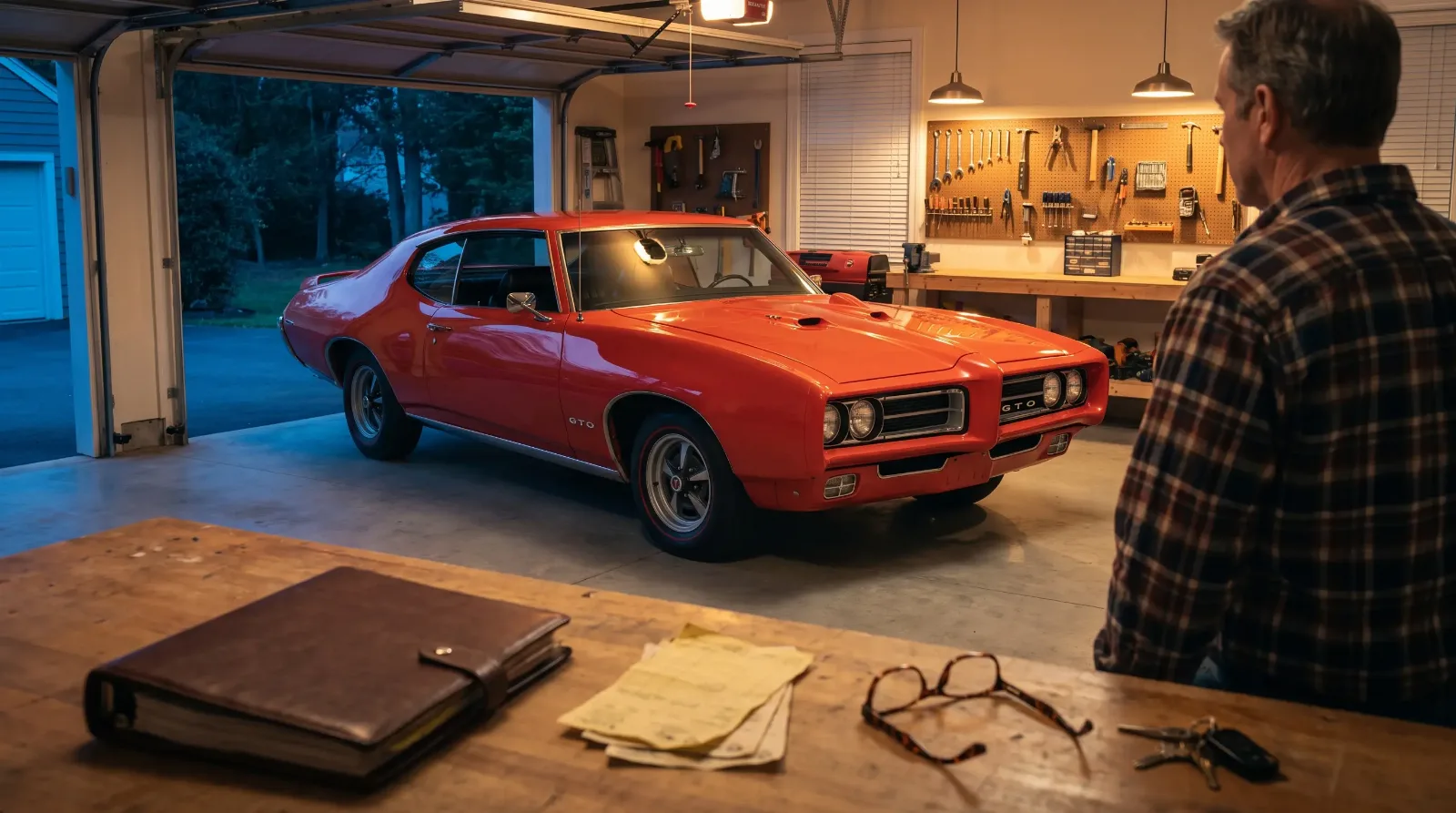
Put a muscle car up for sale and count how long it takes before somebody asks the question. Not about rust. Not about the title. "Is it numbers matching?" Usually it's the first call, sometimes the first line of the first email. That question carries real money, and matching numbers value cuts both ways: it can hold a car's price up, and a wrong answer found late can knock it down harder than the missing engine ever would.
Market & Values
8 min read
Matching Numbers and What They Do to the Price
What numbers matching really means, where it moves a classic's price, how to prove it, and how to sell a car whose numbers don't match.

This piece is about one thing. What the phrase means, what it does to the number on your car, and how to prove it or price around it. The wider job of setting a price, comps and condition tiers and the rest, lives in our guide to what your classic car is worth. Here we stay with the stampings.
What "matching numbers" actually means
Strictly, a numbers-matching car still has the engine, and often the transmission and rear axle, it left the factory with. The proof is in the stampings. On a lot of American cars from the late 1960s on, the factory stamped a partial VIN, called the VIN derivative, onto the engine block and sometimes the transmission case. Match that derivative to the VIN on the dash tag and you have a car that kept its original heart.
That's the strict version. In ads you'll see the phrase stretched until it squeaks. People use "numbers matching" to describe at least four different things, and buyers who know the difference price them very differently.
- Original numbers matching. The block, and ideally the transmission and axle, are the ones installed at the factory, proven by VIN derivative and date codes that fall just ahead of the car's build date.
- Date-code correct. Not the original engine, but a block of the right casting number, suffix code and date range. Correct for the car, not born in it.
- Correct type. Right displacement and family, wrong dates or wrong suffix. A 396 in a 396 car, just not that 396.
- Restamped. A replacement block with the pad ground down and the original numbers struck back in. Sometimes done openly, often not.
Before the 1968 model year, the practice was patchy. Chevrolet started stamping a chassis-number derivative on Corvette engines in 1960, but its passenger-car plants generally stamped only big blocks and high-performance small blocks, and Ford likewise tended to stamp only high-performance engines. Chrysler phased its partial VIN stamp in during 1968. So on many earlier cars "matching" leans on date codes, casting numbers and suffix codes instead. That is a weaker kind of proof, and a smart buyer knows it.
Where it moves the price, and where it barely registers
Matching numbers is not a universal premium. It matters where the engine is the reason the car exists. Big-block Chevelles, Hemi Mopars, high-performance Mustangs and GTOs, early Corvettes. On those cars, the original drivetrain is part of the identity, and buyers pay for identity.
It matters a lot less on a six-cylinder Falcon, a four-door Impala, or a 1950s pickup that spent its life hauling feed. Nobody's checking the suffix code on a base Bel Air sedan the way they check a 1970 LS6. On a restomod, it barely registers at all, because the buyer already accepted a different engine when he started shopping.
| What you have | What a buyer hears | Effect on price (our estimate) |
|---|---|---|
| Original numbers matching, documented | Proven, factory heart | Full value for the condition tier. On high-performance cars this is the benchmark comps are built on. |
| Original numbers matching, no paperwork | Probably right, needs checking | Close to full value if the stampings survive an expert look, discounted if they don't. |
| Date-code correct replacement | Honest, close, not original | Noticeable discount on blue-chip muscle, small on common cars. |
| Correct-type replacement | Right idea, wrong engine | Bigger discount on performance cars. As a rough rule of thumb (our estimate, not a published index), 20 to 30 percent or more on the best ones. |
| Restamped, disclosed | Somebody tried to fake it | Often priced below an honest replacement, because the buyer inherits the question. |
| Restamped, undisclosed | Fraud, once found | The deal dies, and possibly worse. |
The size of the gap tracks the car. On a high-dollar muscle car, a non-original engine can take a serious bite out of the number. On a driver-grade cruiser, a buyer might shrug and offer a few hundred less. Check what your comps actually had under the hood before you assume your car earns a premium, or fears a penalty.
Proving it before a buyer asks
"I was told it's numbers matching" is worth nothing. A previous owner's word is a story. Stampings, codes and paper are evidence. Get your evidence together before the ad goes up, because a buyer who finds a hole during negotiation will price the hole and then some.
Start with the engine pad. Clean it with solvent and a soft brush, not a wire wheel. Photograph it straight on with low-angle light so the stampings throw shadows. Do the same with the block casting number, the casting date, the cylinder head castings and the intake. Then the transmission case and the rear axle code. Write every number down next to the VIN and the trim tag.
Now look for the factory paper. Different makes have different archives:
- Chevrolet and the Corvette world. Build sheets, tank stickers, Protect-O-Plates, and NCRS judging if you're in that game.
- Pontiac. Pontiac Historic Services supplies a copy of the factory invoice or billing history, with an option decode, for 1961 to 1986 Pontiacs.
- Ford. A Marti Report, built from Ford's production records, covers Ford, Lincoln and Mercury vehicles from the 1967 model year on.
- Mopar. Fender tags and broadcast sheets, plus decoding from a recognized Mopar documentation specialist.
If you don't know what you're looking at, pay somebody who does. A marque specialist or a judge from the right club will look at a stamping pad and tell you in ten minutes whether the broach marks look factory. That's cheap compared to finding out from a buyer's inspector with the money on the table.
"A restamped block is worth less than an honest replacement. The replacement is just a different engine. The restamp is a lie somebody has to unwind, and the next buyer knows he'll be the one unwinding it."
Mike Sullivan
When the numbers don't match
Plenty of good cars lost their original engine decades ago. They got raced, they got blown up, they got a junkyard 350 because that was what a teenager could afford in 1979. That's history, not a crime. The mistake is pretending.
Say what it is, plainly, in the first lines of the listing. "Original 396 replaced in the 1980s with a date-code correct 396, documentation included." Or "Correct-type 390, not the original block." A buyer reading that knows where he stands, and he'll trust the rest of your description more because you led with the bad news. Price it against comps that carry the same kind of engine, not against the matching cars at the top of the auction results.
Some owners ask whether they should hunt down a date-code correct block before selling. Sometimes it pays on a top-tier car where the gap is large and a correct block can be found. Often it doesn't, once you add the parts hunt, the machine work and the install. Before you start chasing castings, run the numbers the same way you would on any big job. The cost-against-return math in does restoration add value applies to a drivetrain swap too.
And if you still have the original block sitting on a stand in the corner of the garage, cracked or not, it goes with the car. Mention it in the ad. A buyer can rebuild a cracked original. He can't buy back the one you scrapped.
That's the whole game with matching numbers. Know exactly which of the four kinds of car you own, prove it with stampings and paper, and say it in plain words. A buyer pays for what he can verify. Everything else he discounts.
Sources and notes
- Hagerty: How "numbers-matching" came to matter for collector cars
- Chevellestuff: partial VIN derivative locations and pre-1968 stamping practice
- For A-Bodies Only: when Chrysler started stamping VINs on engine blocks
- Pontiac Historic Services: dealer invoices for 1961 to 1986 Pontiacs
- Marti Auto Works: Marti Reports from Ford production records, 1967 on
- Corvette Action Center: 1968 Corvette identification numbers
Price effects in the table are our estimates for guidance, not a published index.
Related Reading

#numbers matching
#muscle car value
#VIN derivative
#selling a classic car
#classic car pricing
#matching numbers value
#date code correct

About the author
Mike Sullivan
Detroit-area muscle car enthusiast and restoration specialist with three decades of hands-on experience working on American iron.
More in Market & Values


Comments (1)
T
Tom Addison
1 week ago
Note for Ford owners: pre-'68 regular production blocks carry no VIN derivative. My '66 Galaxie 390 is date codes only. SOP.
Tom, that's how I'd work a '66 Galaxie too. And don't count on a Marti Report for that car, since Ford's records behind it start with 1967. So the paper trail is the door data plate, the date codes on the block, heads and intake, and whatever dealer paperwork survived. Honestly, on a regular 390 car nobody pays much of a premium for any of it. Where it starts to count is a 427 or a hi-po 289, and those are the blocks people restamp.
B
Bernie Klein
1 week ago
Look, if the factory never stamped it, nobody pays for matching. On a '66 Galaxie, date-code correct is the whole premium, and it's small.