
The paint fools people. A barn find rolls out under a work light, the body looks straight, and somebody already has a number in their head. I don't care about the paint. I care about what the metal is doing where you can't see it, because that is where a car gets expensive or worthless. Rust doesn't announce itself on the fender. It hides in the floors, the frame rails, the rockers, and the cowl, and by the time it reaches the surface it has usually been eating the structure for years.
Restoration & Tech
7 min read
Barn Find Rust Assessment
The paint fools people. Here is how to read barn-find rust in the floors, rails, rockers, and cowl, and what it really costs.
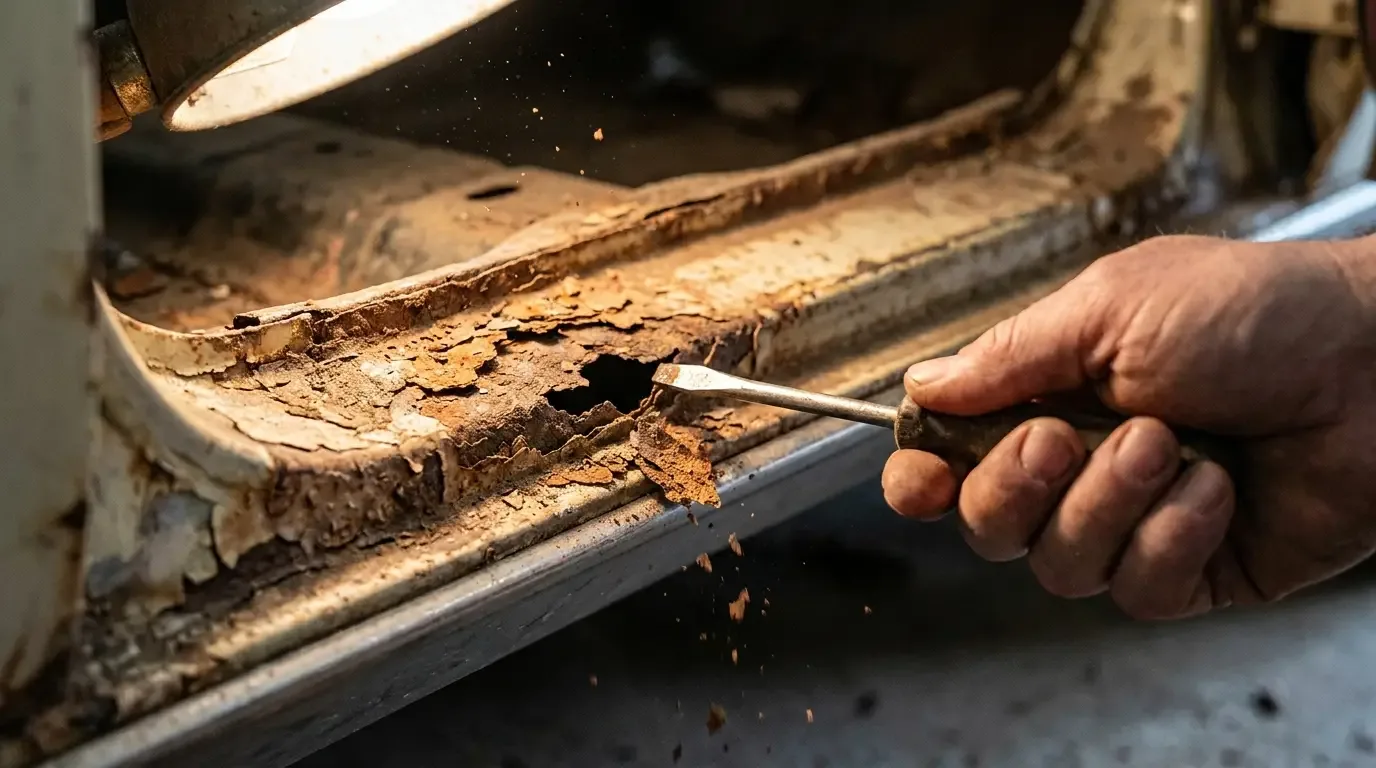
Assessing rust on a stored car is not about spotting orange. It is about knowing the difference between a car that needs metal and a car that needs a new identity. Below is how I work a car over before anybody talks money. If you want the full walk-around beyond rust, start with a proper barn find inspection and then come back here for the metal.
Where the rust actually lives
Surface rust on the outer body is the least of your problems. The parts that hold the car together sit low and out of sight, which is exactly where moisture collects and never leaves. Four areas tell you almost everything, so start there and stay there until you're satisfied.
Floors. Pull the carpet or the old floor mats and look at the pans from inside and underneath. Poke the low spots with a screwdriver, not a flashlight. Metal that flakes or dents in is scale. Metal that goes through is a hole waiting to be found. Check the seat mounts and seatbelt anchors closely, because rot there is a safety issue, not a cosmetic one.
Frame rails. On a body-on-frame car the rails are the car. Run your hand along the boxed sections and tap them. Solid steel rings. Rusted steel thuds and sheds rust scale into your palm. Watch the areas near the rear spring hangers and where the rails kick up over the axle, because those trap mud and hold water.
Rockers. The rocker panels run under the doors and carry a lot of the load on a unibody car. Outer rockers can look fine while the inner rockers and structural sections behind them are gone. Open the doors and look at the bottom of the door itself, then look where the rocker meets the front fender and the rear quarter. Bubbling at those seams means it's already inside.
Cowl. The cowl sits at the base of the windshield and it is the sneakiest rot on the car. Water comes in through the vents and old windshield seals, pools in the cowl, and rusts it from the inside out. You'll often smell it before you see it, a damp musty smell when the heater runs. Cowl repair means pulling the windshield and cutting into the firewall area, so it is never cheap.
Surface rust versus structural rust
This is the whole ballgame, so get it straight. Surface rust is oxidation on the top layer of the steel. It looks ugly, it wipes to a rough brown, and under it the metal still has its thickness. You sand it, treat it, and paint it. Structural rust has eaten through the cross-section of the metal, so the panel no longer has strength. You cannot sand your way back to steel that isn't there anymore. It gets cut out and replaced.
The test is simple. Push on it. Tap on it. Surface rust stays firm and sounds solid. Structural rust flexes, crunches, or lets a screwdriver through. If a magnet won't hold or grabs weakly through a thick soft patch, somebody already filled a hole with body filler, and filler over rot is the oldest trick in the book. A cheap magnet in your pocket is the most honest tool you'll bring to a barn.
- Scale you can brush off: usually surface, still repairable in place.
- Bubbling under paint: rust working outward from inside, deeper than it looks.
- Soft or crunchy metal: structural, plan on cutting and welding.
- Fresh undercoating in odd spots: a seller hiding something, look harder there.
"I've walked away from cars with perfect paint and bought cars that looked like garbage, because I buy the structure, not the shine. You can always make a solid car pretty. You can't make a pretty car solid without spending like it was solid all along."
Mike Sullivan
What a dirt-floor barn does to a car
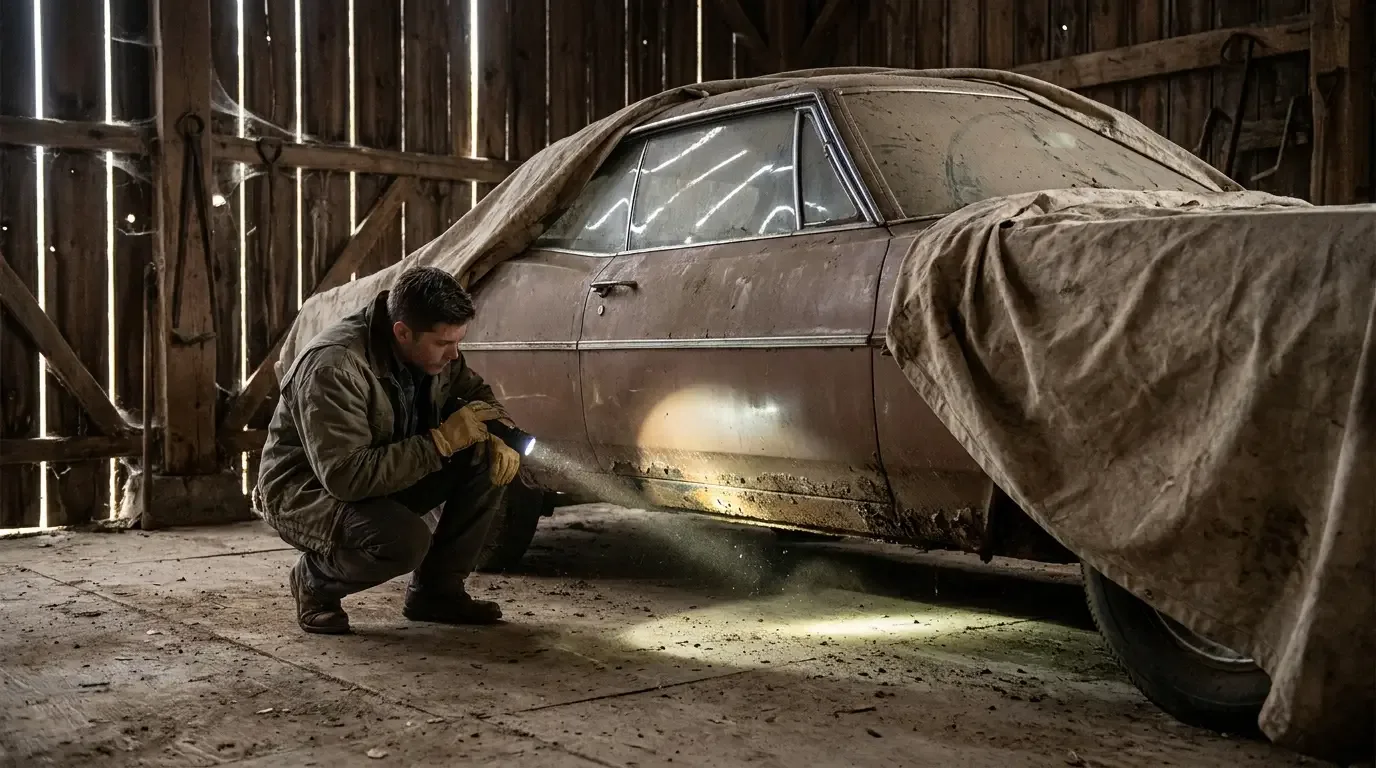
Storage conditions decide the whole outcome, and the barn floor matters more than the roof. A dry building with a concrete slab can preserve a car remarkably well, even under thick dust. Change nothing except the floor, put that same car on bare dirt, and you get a different animal.
Ground moisture rises through dirt year-round. It condenses on the cold steel underside overnight, dries a little in the day, and does it again tomorrow, for thirty or forty years. The floors and frame rails take the worst of it because they're closest to the ground and they trap it. Add a leaky roof dripping onto the cowl and interior, and you've soaked the car from both directions. Mice make it worse, packing seats and rockers with nesting material that holds water like a sponge against the metal.
So when I hear "stored in a barn," my first question is what was under the tires. Dirt means I'm crawling underneath before I do anything else. A car that lived on dirt can absolutely be worth saving, but you price it as a car that needs floors and maybe rails, not as a survivor.
🔧 Inspection Priorities
- Floor pans, both sides. Lift the carpet and probe. Full pan replacement runs roughly $1,500 to $3,000 in labor and metal per side on common cars, more on rare ones.
- Frame rails and crossmembers. Tap the full length. Section repair on a rail starts around $800 to $1,500 per area; a car needing multiple sections gets ugly fast.
- Rockers, inner and outer. Check the seams and door bottoms. Structural rocker work commonly lands around $1,000 to $2,500 per side with proper inner-rocker replacement.
- Cowl. Smell for damp, look under the dash. Cowl repair means windshield removal and firewall work, often $2,000 or more before paint.
- Filler check with a magnet. Costs nothing and tells you whether the seller is honest about all of the above.
Turning rust into a real number
Every hole you find is a line item, and they add up faster than buyers expect. The mistake is treating rust as a discount on the purchase price. It isn't a discount. It's a bill you pay later, usually bigger than the discount you negotiated. A car that's $3,000 cheaper because it "needs a little metal work" can easily carry $12,000 in floor, rocker, and cowl repair once it's on a lift.
Structural rust also changes the kind of shop you need. Surface rust is a paint-and-body job. Structural rust is fabrication and welding, a different skill set and a different rate. If the frame is compromised the car may not be safely drivable at all until it's fixed, so you're paying before you enjoy anything. Match the rust you found to the total spend before you commit. For the full picture on where the money goes, read What a Barn Find Restoration Costs and run your numbers against it.
My rule is blunt. Add up the metal honestly, add the paint that follows the metal, and if that number plus the asking price is more than the finished car is worth to you, the car owes you a walk-away. Rare cars break that rule because the finished value is high enough to justify serious metal. A common car rarely does.
Sources and notes
- Restoration shop labor observations and metal-repair rate ranges from independent body and fabrication shops.
- General corrosion behavior from automotive restoration references and marque restoration guides.
- Storage-condition patterns drawn from barn-find and survivor-car field inspections.
- Cost figures stated as approximate ranges; verify against local shop quotes for your specific car.
Related Reading
Have a
Classic Car
for Sale?
Reach thousands of serious classic car collectors across the US.
Sell It Here →
Are You a Classic Car Dealer?
List your full inventory and connect with targeted classic car buyers.
Join as a Dealer →

About the author
Mike Sullivan
Detroit-area muscle car enthusiast and restoration specialist with three decades of hands-on experience working on American iron.
More in Restoration & Tech
Comments
Be the first to comment on this article.