
You pulled the tarp off, the tires held air, and now you want to hear it run. Slow down. The fastest way to turn a running engine into a boat anchor is to jump in the seat and crank it. An engine that sat for twenty or thirty years is full of dried oil, surface rust, varnished fuel, and moisture that has been sitting on cylinder walls and bearing surfaces the whole time. Treat it like it is fragile, because it is.
Restoration & Tech
7 min read
Reviving a Barn Find Engine
Do not just crank it. The step-by-step order for waking a decades-asleep barn find engine without turning it into a boat anchor.
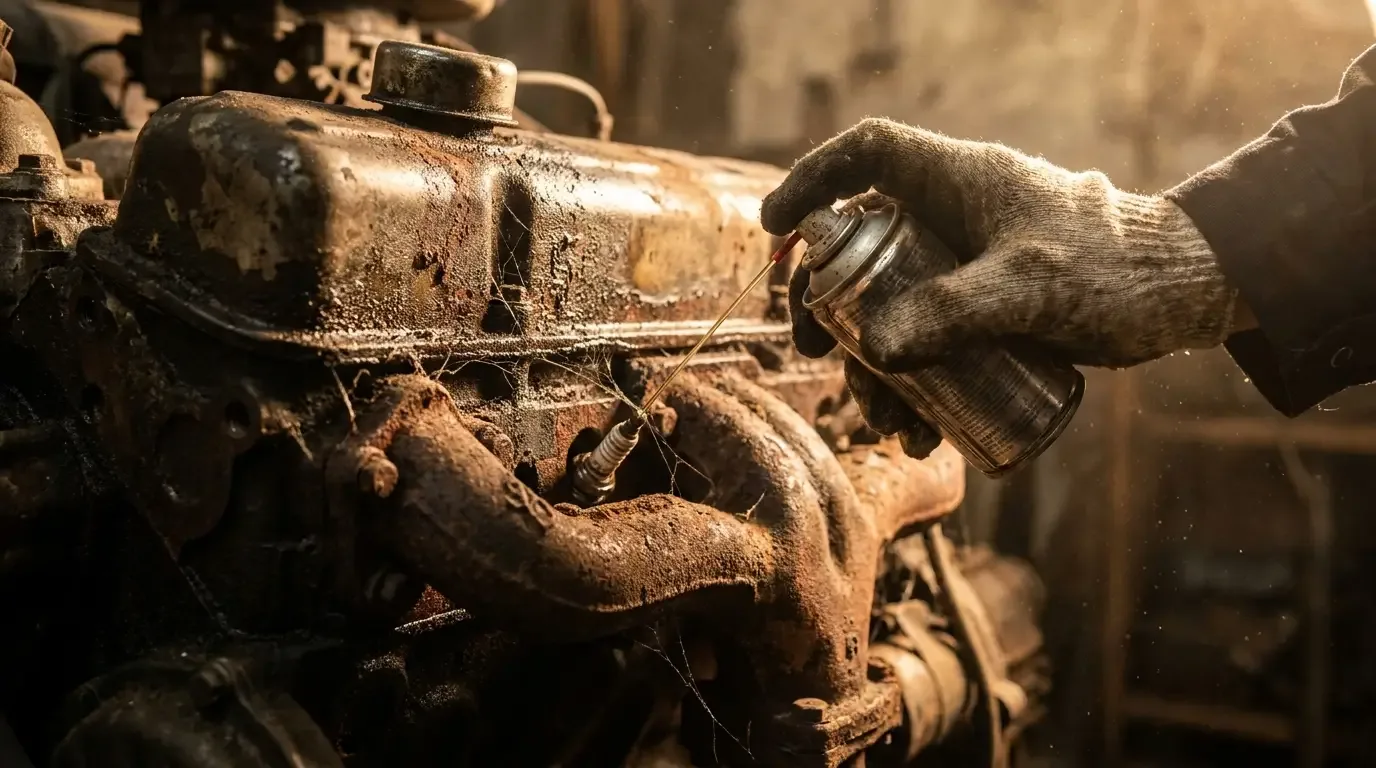
This is the mechanical side of the job. Before you get here you should already have a handle on the car itself through a proper barn find inspection, because a seized engine changes the math on everything. What follows is the order I work in, every time, on an engine that has been asleep for decades.
First question: is it seized?
Before any oil, any fuel, any battery, you need to know if the engine turns. A seized engine is not the end of the world, but you have to know what you are dealing with. Pull the spark plugs. All of them. This does two things: it lets you look inside the cylinders with a borescope or even a flashlight, and it takes compression out of the equation so you can turn the engine by hand with far less effort.
Put a breaker bar and the correct socket on the crankshaft pulley bolt and try to rotate it clockwise, gently. If it moves, even a little, you are in good shape. If it feels solid, do not lean on it with a cheater pipe. That is how you snap a bolt off in the crank snout or bend something you cannot see.
"Everybody wants to hear it fire on day one. I have watched guys crank a bone-dry motor, hear it cough twice, and spend the next year rebuilding it. Patience is cheaper than pistons."
Mike Sullivan
Oiling the cylinders and freeing a stuck engine
With the plugs out, squirt penetrating oil or a marvel-type mystery oil down each spark plug hole. A tablespoon or two per cylinder. Then walk away. Not for an hour, for a few days, and hit it again each day. You are trying to let the oil creep past the rings and break the bond between rusty rings and cylinder walls. This is the step people skip, and it is the step that saves engines.
If it was stuck and now it rocks slightly back and forth, keep working it gently in both directions, adding oil, until it turns a full revolution. Once it spins freely by hand, you have won the hard part. If after a week of soaking it will not budge at all, stop kidding yourself about a driveway revival. A truly seized engine usually means pistons rusted to the bores, and that is a teardown, not a Saturday.
Fresh fluids before it turns under power
That old oil in the pan is not oil anymore. It is a mix of acid, sludge, fuel, and moisture that has been eating at your bearings the entire time it sat. Drain it. Drop the pan if you can and clean the pickup screen, because sludge loves to clog it and starve the pump right when you need pressure most. Pull the old filter and put on a fresh one. Refill with cheap, conventional oil for now, since this is a flush, not the fill you drive on.
Coolant is the same story. Drain the block and radiator, flush it, and check for the milkshake look that says a head gasket or a cracked block let coolant into the oil. While you are down there, look hard at the rest of the car too. Fluids tell you where the rust hid, and that ties straight into a proper Barn Find Rust Assessment before you sink real money in.
🔧 Inspection Priorities
- Oil pan contents. Metal flakes or glitter mean bearing or cam damage. Cost: a teardown, not a flush.
- Coolant condition. Milky oil or oily coolant points to a head gasket or crack. Cost: $300 to $2,000+ depending on the engine.
- Cylinder walls via borescope. Deep pitting or scoring means a rebore. Cost: machine shop time plus pistons.
- Timing chain slack. A stretched chain that jumped can bend valves the second it spins. Cost: valve job.
Cleaning out the fuel system
Whatever is in the tank is not gasoline. Modern pump gas goes stale in months; decades-old fuel turns to varnish and a smell you will not forget. Do not run it. Drop the tank, look inside, and if it is full of rust scale or a shellac-like coating, send it out to be cleaned and sealed or just replace it. A rebuilt carburetor fed by a rusty tank will clog again in a week.
Blow out or replace the fuel lines, rebuild or at least clean the carburetor, and put a clear inline filter close to the carb so you can watch what comes through. For the first start I feed the engine from a small external can of fresh fuel, bypassing the whole car's system, so I know exactly what is going in.
When to just pull it
Here is the honest part. Not every barn find engine should be revived in place, and knowing when to pull it is what separates a smart revival from an expensive mess. If the engine is seized solid after a real soak, if the borescope shows deep cylinder pitting, if you find coolant in the oil, or if there is glitter in the pan, you are past the point of a driveway wake-up. Pull it, put it on a stand, and do it right.
The same goes for a numbers-matching engine you cannot afford to gamble on. A stuck original block is worth saving carefully, not risking on a hopeful crank. That decision is usually about the car's history and value, which is a bigger conversation and part of the story of the barn find itself: what it is, what it was, and whether the heart of it is worth fighting for.
| Symptom | Likely cause | Revive in place or pull? |
|---|---|---|
| Turns freely by hand after soak | Was just dry, minor surface rust | Revive in place |
| Rocks slightly, frees with work | Light ring-to-bore rust | Revive, watch compression |
| Solid after a week of soaking | Pistons rusted to bores | Pull it |
| Milky oil or oily coolant | Head gasket or cracked block | Pull it |
| Metal flakes in the pan | Bearing or cam failure | Pull it |
A barn find engine will tell you what it needs if you let it. Go slow, work in order, and never let excitement put your hand on the key before the engine is ready.
Sources and notes
- Marque and engine shop-manual procedures for long-term storage recommissioning
- Restoration club and registry guidance on recommissioning stored engines
- Independent machine shop and engine builder interviews on seized-engine evaluation
- Period service literature on fuel system cleaning and carburetor rebuilding
Related Reading
Have a
Classic Car
for Sale?
Reach thousands of serious classic car collectors across the US.
Sell It Here →
Are You a Classic Car Dealer?
List your full inventory and connect with targeted classic car buyers.
Join as a Dealer →

About the author
Mike Sullivan
Detroit-area muscle car enthusiast and restoration specialist with three decades of hands-on experience working on American iron.
More in Restoration & Tech
Comments
Be the first to comment on this article.