
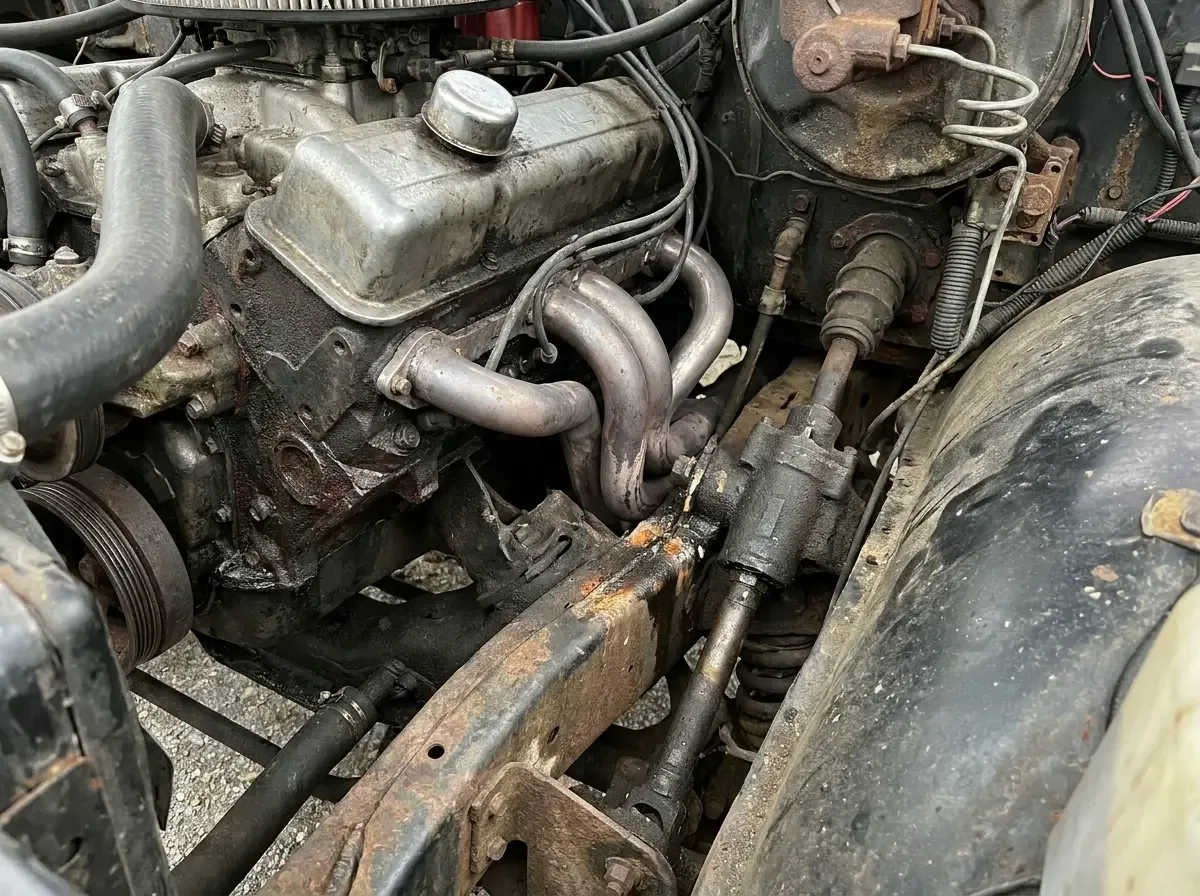
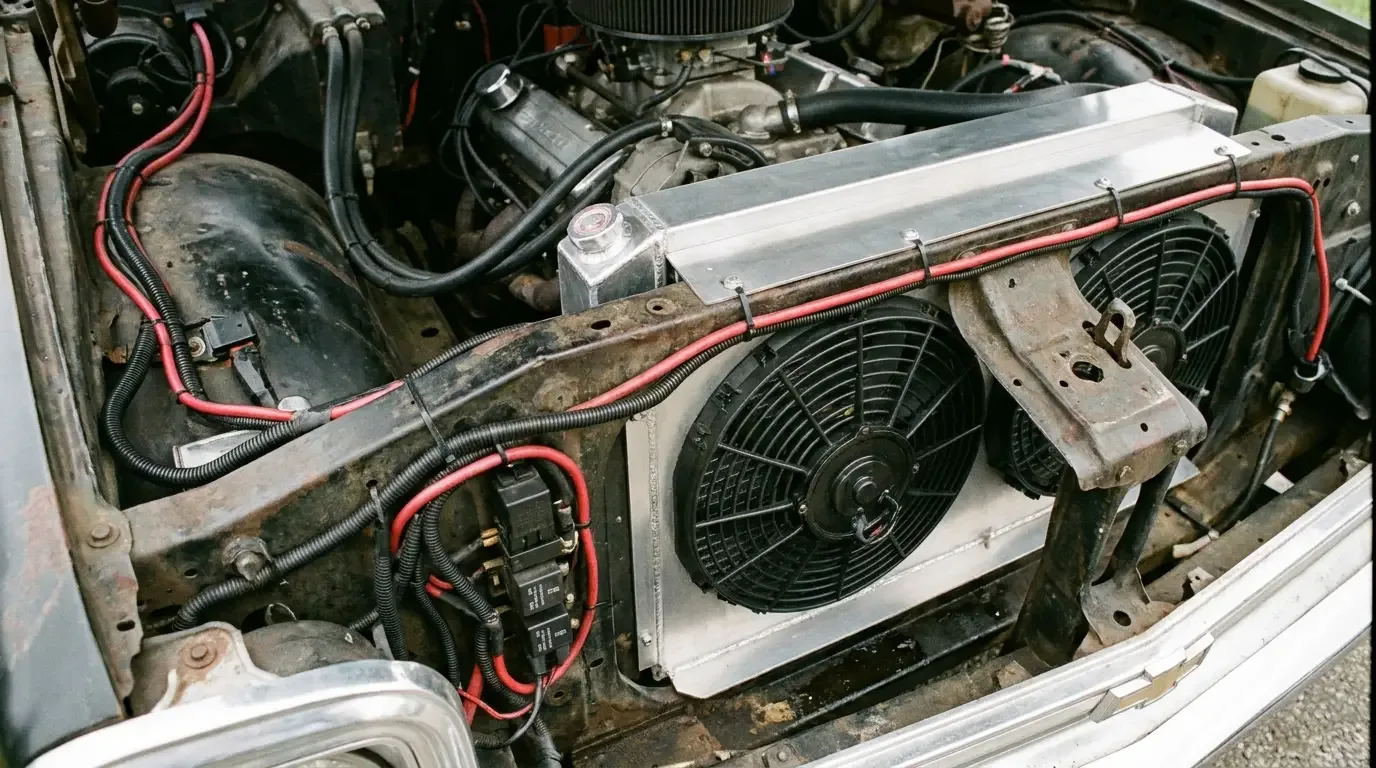
A set of headers that bolts up clean on the bench and won't clear the steering box once the engine's back in the truck is the most common complaint I hear from guys mid-swap. It isn't a header problem. It's a mounting problem, and it shows up almost every time because the C10 chassis was drawn around a cast iron manifold that hugs the block, not a set of tube headers. Swap that manifold out, especially after the kind of engine change covered in the LS swap guide, and every clearance point in that engine bay gets tighter at once. Steering shaft. Motor mount. Starter. Frame rail. None of them move to make room for you.
Restoration & Tech
7 min read
Header Clearance and Fitment on a Small-Block C10
Why headers that bolt up clean on the bench still fight the steering shaft, starter, and frame once they're in a C10, and which fixes actually solve the problem.
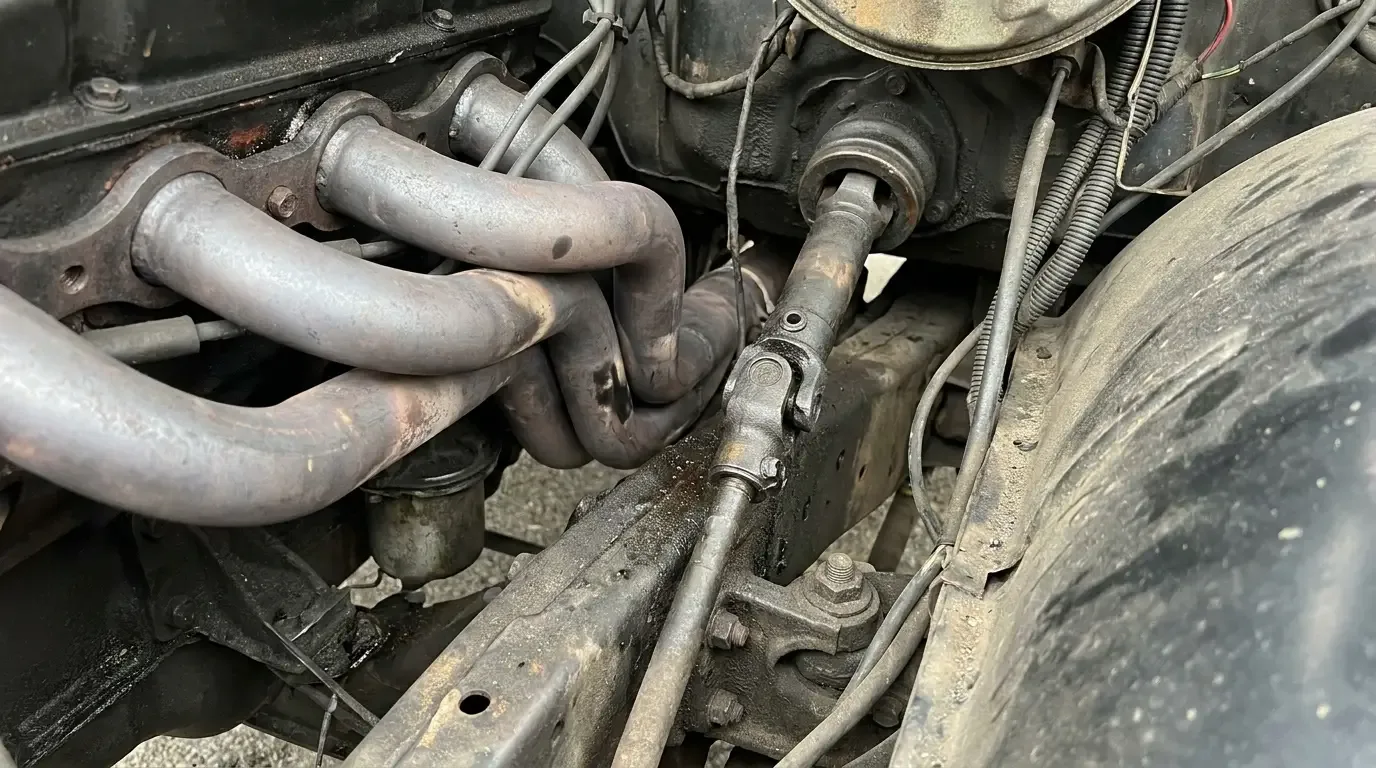
Here's the number that matters: on a stock-frame C10 with stock motor mount positioning, a long-tube header collides with the steering shaft or the idler arm on the driver's side more often than not, especially on manual steering trucks where that shaft runs lower and further forward than a power steering box allows for. Shorty and block-hugger designs exist specifically to dodge that collision. Buy the wrong style because it made more power on somebody else's dyno sheet, and you'll be back on the ground with a die grinder inside a week.
Why headers fight the chassis on a C10
The factory manifold was designed to clear everything around it because GM's engineers had the whole truck on the drawing board at once. A header manufacturer doesn't have that luxury. They build to the block and the exhaust ports, and they assume a certain motor mount position, a certain steering setup, and a certain frame. Change any one of those and the header that fit the last guy's truck stops fitting yours. This is exactly why the same header part number gets five-star reviews from one buyer and a box sent back for a refund from the next. Both trucks are C10s. Neither one is wrong. They're just built differently underneath.
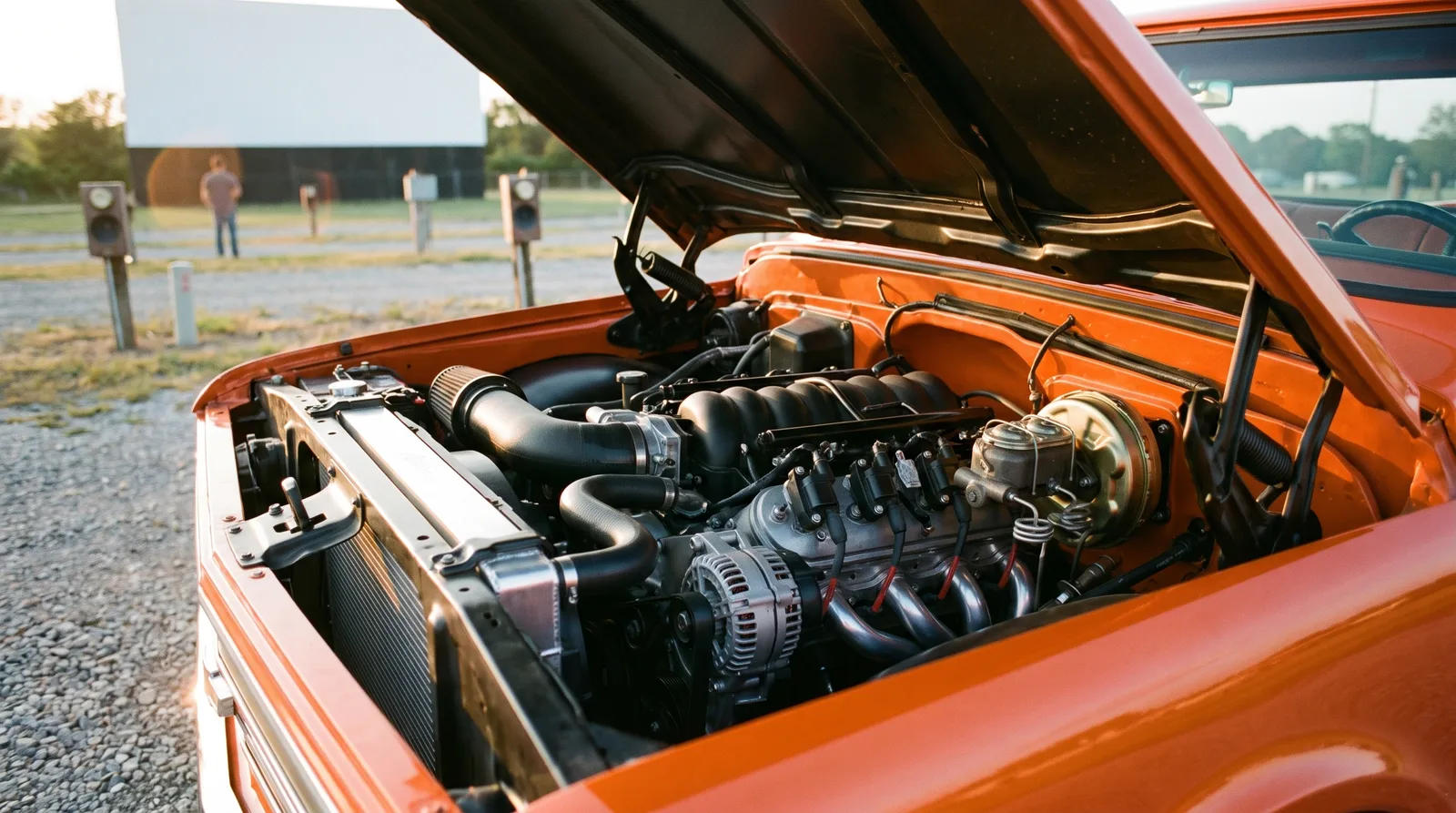
The engine swap makes this worse, not better. A stock small-block sits where the factory put it. An LS or a stroker small-block on aftermarket mounts often sits lower, further back, or slightly rotated compared to stock, because the swap kit prioritized oil pan clearance or firewall clearance over header clearance. That's a reasonable trade for the guy designing the mount kit. It's your problem to solve once the headers show up and don't clear.
The clearance points that actually cause problems
Four spots account for almost every fitment complaint I've heard. The steering shaft and idler arm on the driver's side, which catch long-tube primaries on manual steering trucks. The starter on the passenger side, which fights the collector on some tube header designs, particularly with a mini starter that wasn't accounted for in the header's original engineering. The frame rail lip itself, which clips the collector or the first bend on trucks with stock ride height and a header designed with a lowered stance in mind. And the oil pan rail, where a header's first primary bend runs close enough to catch a pan gasket or a pan bolt during install, not during driving, which is its own kind of frustrating.
| Header style | Typical primary length | Most common clearance fight | Power tradeoff |
|---|---|---|---|
| Block hugger / shorty | 8-12 inches | Rarely fights steering, tighter to block overall | Least peak power, best low-rpm torque retention |
| Mid-length | 14-20 inches | Frame rail lip, starter on passenger side | Middle ground on power and driveability |
| Long-tube | 28-34 inches | Steering shaft, idler arm, driver-side frame | Best peak power gain on a built engine |
Motor mounts decide the fight before you buy headers
This is the part guys skip. The motor mount position, not the header brand, decides most of your clearance outcome. Stock rubber mounts hold the engine at a known height and angle. Aftermarket swap mounts, especially the ones built for LS conversions, often set the engine lower for hood clearance or further back for firewall clearance, and either change shifts every downstream clearance point at once. Measure from a fixed reference, like the frame rail top or the steering shaft centerline, to the same point on the block before you order anything. A header company can tell you what clears a stock-mounted small-block. Almost none of them can tell you what clears your specific mount kit, because they've never seen it.
Fixes that actually work
Clocking the collector is the first move, and it's the cheapest. Most header collectors bolt to the primary tubes with enough rotational adjustment to buy a half inch of clearance without touching metal anywhere else. If that's not enough, a frame notch is next, but it has to be done right. A notch that removes structural material from a boxed frame section without a reinforcement plate welded back in is not a shortcut, it's a liability, and it shows up later as a stress crack in exactly the spot you weakened. Do it with a plate, or don't do it.
Swapping to a different steering box position is the move nobody wants to hear, but it's often the real fix on manual steering trucks converting to an LS-style swap. A quick-ratio steering box or a repositioned steering arm moves the shaft out of the header's way permanently instead of fighting it every time you pull the headers for maintenance. It's more labor up front. It's also the fix that doesn't need to be revisited.
Starter clearance is usually solved with a mini starter and the correct offset flexplate to block spacing, not a different header. Check that combination before you assume the header's collector is the problem, because plenty of guys grind on a perfectly good header trying to fix a starter mismatch.
Living with the compromise
Every header choice on a swapped C10 is a compromise between power, clearance, and how much you want to fight the truck every time you need to service something under there. A long-tube header that makes real power on the dyno but requires dropping the steering shaft to change a spark plug is a bad daily decision even if it's a good dyno number. Decide what the truck is for before you decide what header goes on it. A weekend cruiser that sees a wrench twice a year can live with a tight fit. A truck you drive and maintain yourself every week should not.
"The header that made the most power on the dyno sheet isn't worth much if you're pulling the steering shaft every time you need to change a plug. Fitment is part of the spec, not an afterthought."
Dan Reeves
Measure twice, order once, and treat the motor mount position as the actual spec you're building around. The header is just the part that has to live with whatever decision you already made.
Sources and notes
Related Reading
Have a
Chevrolet C10
for Sale?
Reach thousands of serious classic car collectors across the US.
Sell It Here →
Are You a Classic Car Dealer?
List your full inventory and connect with targeted classic car buyers.
Join as a Dealer →

About the author
Dan Reeves
Performance engine builder from North Carolina's motorsports corridor, focused on swaps, forced induction and making real, repeatable power.
Related Listings - Chevrolet C10
More in Restoration & Tech
Comments
Be the first to comment on this article.