
The exhaust is the first thing you hear and the last thing most builders think about. That is backwards. A set of headers changes how the engine breathes, how it makes power, and what it sounds like idling at a stoplight. Get it wrong and you leave power on the table. Get it right and the car has a voice.
Restoration & Tech
8 min read
Headers and the Hot Rod Sound
Zoomies, street headers, lakes pipes and cutouts. How hot rod exhaust makes power and gives the engine its voice.
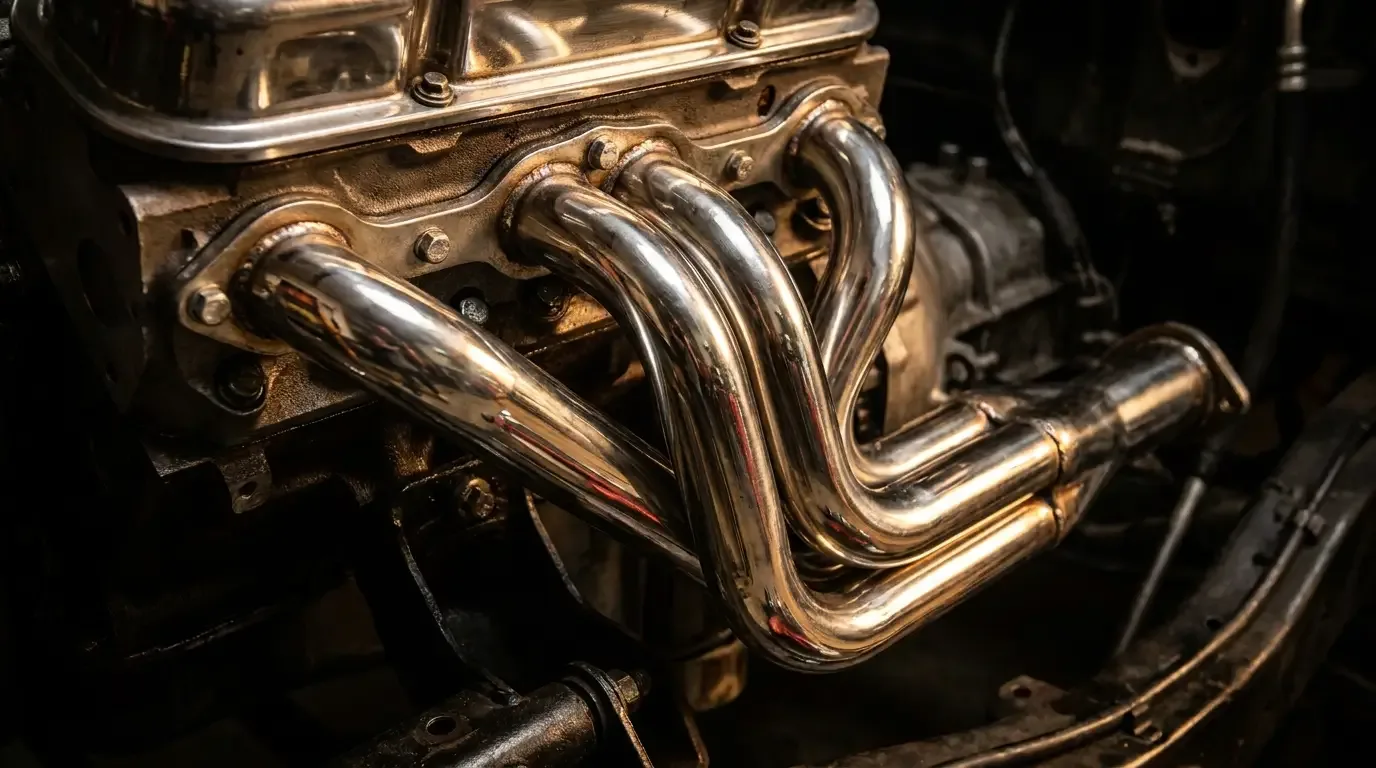
Headers are not decoration. They are a tuning tool. Before you bolt on the shiniest thing in the catalog, understand what the pipe is doing between the exhaust valve and the open air. A hot rod running a warmed-over flathead v8 or a small-block wants a different exhaust than a stock grocery-getter, and the pipe you choose has to match the engine you built.
What a header actually does
Stock exhaust manifolds are cast iron lumps. They are cheap, quiet, and they dump multiple cylinders into a shared casting almost immediately. That shared space is the problem. When one cylinder fires and pushes its exhaust out, that pulse runs into the pulse from the next cylinder. Backpressure builds. The engine has to work to push spent gas out instead of using that stroke to make power.
A header gives each cylinder its own long, smooth tube. Those primary tubes run separately for a stretch, then merge into a collector. The point is scavenging. A fast-moving exhaust pulse leaving one cylinder creates a low-pressure area behind it. Time that right and the low pressure helps pull the next cylinder's exhaust out, and even helps draw the fresh intake charge in during valve overlap. That is free power. No extra fuel, no boost. Just letting the engine breathe out clean.
Primary tube diameter and length are the two numbers that matter. Too big and you kill the exhaust gas velocity that makes scavenging work, so low-end torque goes soft. Too small and you choke the top end. Length tunes where in the rev range the scavenging effect lands. Long primaries help low and midrange. Short primaries favor high rpm. Most street hot rods want the low and midrange, because that is where you actually drive.
Zoomies versus street headers
Zoomie headers are the ones everybody pictures. Short, straight, upswept tubes coming off each port and pointing at the sky or back at the rear tire. They came off the dragstrip, where the only thing that matters is a wide-open engine for a few seconds down the strip. They are loud, they are simple, and they look like nothing else.
Here is the truth about zoomies on a street car. They have almost no scavenging benefit because there is no collector tying the cylinders together. Each pipe just dumps. On a strip car that spends its life at full throttle, that is fine. On a street car, you lose midrange and you deafen yourself and everyone in the neighborhood. Plenty of guys run them anyway because of how they look, and if that is the build you want, run them. Just know what the trade is. You are buying the look and the noise, not the power.
Street headers, sometimes called block-huggers or fenderwell headers depending on how they route, are built to live under a running car. They tuck the primaries in tight, merge into a collector, and feed into an actual exhaust system with mufflers. You keep the scavenging, you keep the car livable, and you can still tune the sound. For most builds this is the smart pipe. If you are working through the rest of a serious engine, the same thinking applies to a good Building a Ford Flathead V8 for Power plan, where the exhaust is part of the package and not an afterthought.
| Header type | Collector | Best use | Street manners |
|---|---|---|---|
| Zoomies | None (open tubes) | Dragstrip, show | Loud, poor midrange |
| Block-hugger | Yes | Tight engine bays, street | Good, quietable |
| Fenderwell | Yes | Max flow, race-street | Loud, tight fit |
| Lakes headers | Optional | Traditional look, cutouts | Loud when open |
Lakes pipes and the dry-lakes look
Lakes pipes are a traditional hot rod signature and they come straight out of the dry-lakes racing days. The idea was simple. Racers ran open exhaust for the speed runs, so they built pipes that ran along the outside of the car, low and horizontal, exiting just ahead of the rear wheels. On a period build, lakes pipes are the correct answer for the look.
What makes them useful instead of just pretty is the cap. Traditional lakes pipes have removable end caps or a cutout partway down the pipe. Bolt the caps on, run your regular muffled exhaust behind them, and the car is street-legal and reasonable. Pull the caps at the strip or the show, and the engine breathes straight out the side. That dual-purpose setup is why the look survived. It was never pure decoration on a real car.
The mechanical catch is heat and clearance. Lakes pipes run along the body and near the frame rails, so they get hot right where your foot, your passenger, and your paint live. Ceramic coating or a heat wrap is not optional on a driven car. Route them where a leg is not going to touch bare steel.
"Everybody wants the open-pipe sound until they take a passenger for a two-hour cruise and their ears are ringing at the diner. Build it so you can cap it. Loud when you want it, sane when you don't. That is the whole trick."
Dan Reeves
Cutouts and the open-header sound
A cutout is a bypass in the exhaust, usually right at or just behind the collector, that lets gas skip the mufflers and dump straight out. Old ones were a capped hole you unbolted by hand under the car. Modern ones are electric, run off a switch on the dash, and open or close a butterfly valve in seconds.
The reason cutouts exist is that open headers, no mufflers, straight out the collector, is the loudest and often the strongest a hot rod engine will run. That wide-open, cracking bark you hear when a car stages at the dragstrip is exhaust with nothing in its way. Mufflers, no matter how good, add some restriction. A cutout lets you have the quiet, legal system for the street and the open-header sound and flow when you flip the switch. Best of both worlds if you wire it up right.
Understand what open headers actually do to the sound. With no muffler, you hear the raw firing pulses and the collector resonance with nothing damping them. A small-block with a good header and an open collector has a hard, metallic crack. A flathead sounds flatter and burblier because of its firing order and port layout. The sound is not just volume. It is the engine's actual character with the muffling stripped off.
Aesthetic and performance, together
The good news is you do not have to choose between how the exhaust looks and what it does. A well-built header system delivers both. The tubes that scavenge best also happen to be the ones that look like a hot rod should, tight equal-length primaries sweeping into a clean collector. Lakes pipes that run correctly capped give you the traditional profile and a street-drivable car. A cutout gives you the show-off sound on demand without living with it every mile.
Where builders go wrong is treating exhaust as the last thing on the list, something to bolt on after the engine is done. Do it the other way. Pick the header when you pick the cam and the carbs, because those parts work together. A big cam with lots of overlap wants an exhaust that can scavenge. A mild street engine does not need race pipes and will drive worse with them. The exhaust is part of the engine combination, not a bolt-on accessory.
Build the exhaust to match the car you are actually going to drive. If it is a strip car, run the zoomies and wear earplugs. If it is a street rod you plan to put miles on, run good street headers, a proper collector, real mufflers, and maybe a cutout for when you want to let it sing. Either way, the exhaust is the engine's voice. Make sure it says what you built.
Sources and notes
- Period hot-rod press and technical articles on header design, scavenging, and primary tube tuning.
- Engine-builder references on exhaust gas velocity, collector function, and camshaft-to-exhaust matching.
- Historical accounts of dry-lakes racing and the origin of lakes pipes and open-exhaust practice.
- Builder interviews and shop practice on cutouts, ceramic coating, and street-legal open-header setups.
Related Reading
Have a
Classic Car
for Sale?
Reach thousands of serious classic car collectors across the US.
Sell It Here →
Are You a Classic Car Dealer?
List your full inventory and connect with targeted classic car buyers.
Join as a Dealer →

About the author
Dan Reeves
Performance engine builder from North Carolina's motorsports corridor, focused on swaps, forced induction and making real, repeatable power.
More in Restoration & Tech
Comments
Be the first to comment on this article.