
Nothing says a hot rod means business like a blower sticking up through the hood. That polished aluminum case with the belt spinning off the crank, the intake bellowing when you crack the throttle, that is a Roots-type supercharger, and most of the time it started life bolted to a diesel truck engine. The GMC 6-71 and 8-71 blowers are the ones you see planted on top of a small-block or a big-block, and they have been the loudest statement of intent in the hobby for sixty years.
Restoration & Tech
8 min read
Superchargers and Blowers on Hot Rods
The blower through the hood is a hot rod's loudest statement. Here is how the GMC 6-71 Roots supercharger makes power, and what it costs you.
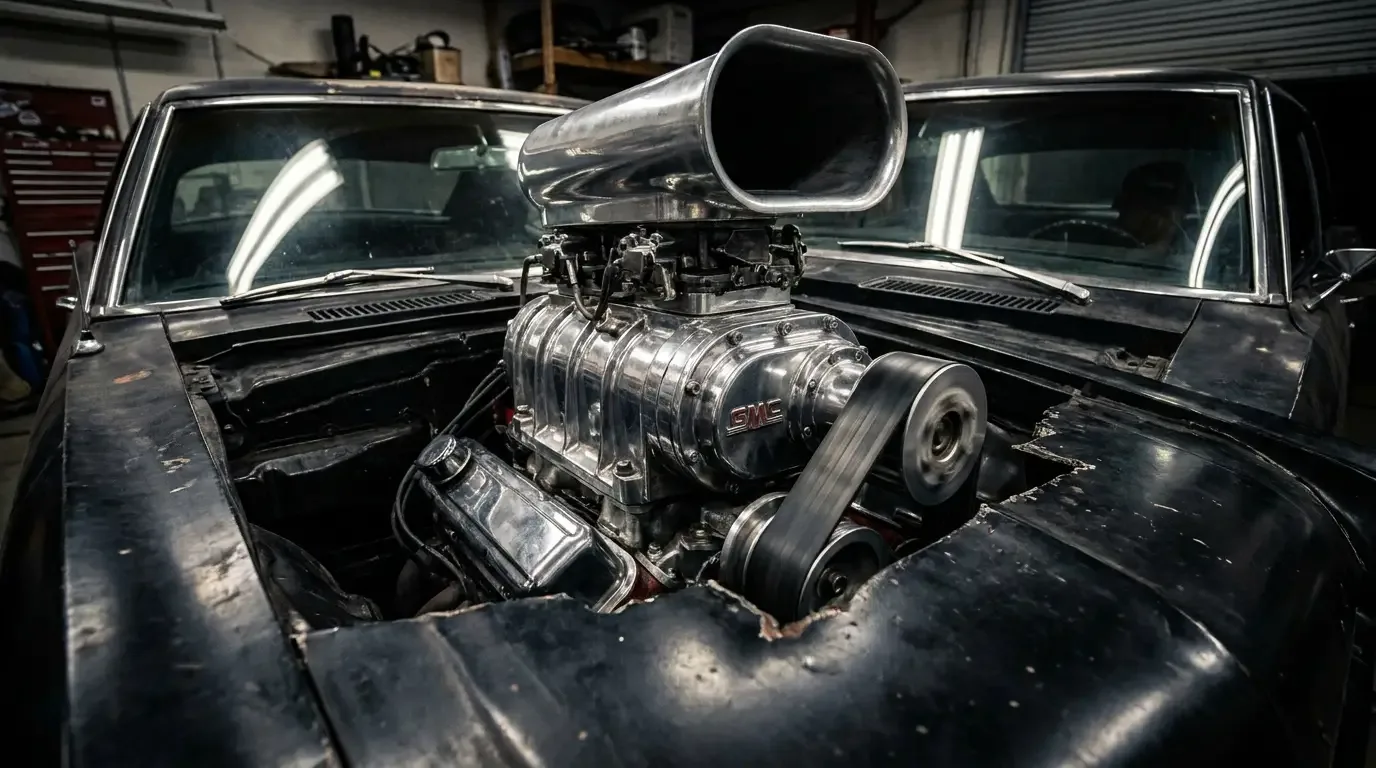
A supercharger does one simple thing. It forces more air into the engine than the pistons could pull in on their own. More air means you can burn more fuel, and more fuel burned per stroke means more power. That is the whole game. The Roots blower does it with two meshing rotors that trap air and shove it downstream into the intake, building positive pressure, or boost, above atmospheric. It is crude compared to a modern centrifugal or a screw compressor, but crude is exactly why it works on an old V8 and why it looks the way it does.
Where the 6-71 name comes from
The number is not a hot rod thing at all. GM Detroit Diesel built two-stroke diesel engines that needed a blower just to run, because a two-stroke cannot scavenge its own cylinders. The naming meant six cylinders of 71 cubic inches each, so a 6-71 blower was sized to feed a 426-cubic-inch diesel six. The 8-71 fed the straight-eight version, the 4-71 the smaller four. Hot rodders in the postwar years found these things cheap in wrecking yards, pulled them off dead trucks and buses, and adapted them to gasoline V8s. The plumbing was already there for pressurizing an engine, the rotors were stout, and the cases were the right kind of big.
Those old case sizes stuck as a language. When somebody says they are running a 8-71 on a blown Chevy, they mean a blower physically the size of the one that fed a 568-cubic-inch diesel straight-eight. Modern manufacturers still cast new cases to those same dimensions because that is the look and the fitment everyone expects.
How a Roots blower actually makes power
Two rotors, each with three lobes on the classic GMC design, mesh inside the case and turn against each other. As they spin they carry pockets of air from the inlet around to the outlet and dump it into the manifold. The blower does not compress air internally the way a screw or turbo does. It just moves a fixed volume per revolution and lets the engine's restriction build the pressure. That is why it is called a positive-displacement pump.
Because it is driven by a belt off the crank, boost comes on instantly. There is no waiting for exhaust gas to spool a turbine. Off idle, right now, the blower is stuffing the engine. That instant hit is the drag racer's whole reason for using one, and it is why a blown motor feels violent from the first inch of throttle.
Boost is set by the drive ratio. The pulley on the crank versus the pulley on the blower snout decides how fast the rotors spin relative to the engine. Overdrive the blower, spin it faster than the crank, and you make more boost. Underdrive it and you make less. A street blown small-block might run only a few pounds of boost, maybe around 4 to 6 psi, while a race setup can push far higher. Every pound of boost is more air, more fuel, more cylinder pressure, and more strain on everything downstream.
| GMC blower case | Original diesel application | Common hot rod use |
|---|---|---|
| 4-71 | 4-cyl two-stroke diesel | Small engines, nostalgia mild street builds |
| 6-71 | 6-cyl two-stroke diesel | The classic all-rounder, street and strip |
| 8-71 | 8-cyl two-stroke diesel | Big-inch motors, serious drag builds |
| 10-71 / 14-71 | Later and aftermarket cases | Blown fuel and top-tier race motors |
The drag strip is where the look was born
The blower-through-the-hood silhouette came straight off the drag strip. Fuel altereds, gassers, and the early blown coupes ran these things because nothing else gave that much power that instantly on the kind of budget a privateer had. A GMC blower and a set of injector hats or a couple of carbs sitting on top made big numbers, and it did it with junkyard iron and a machine shop.
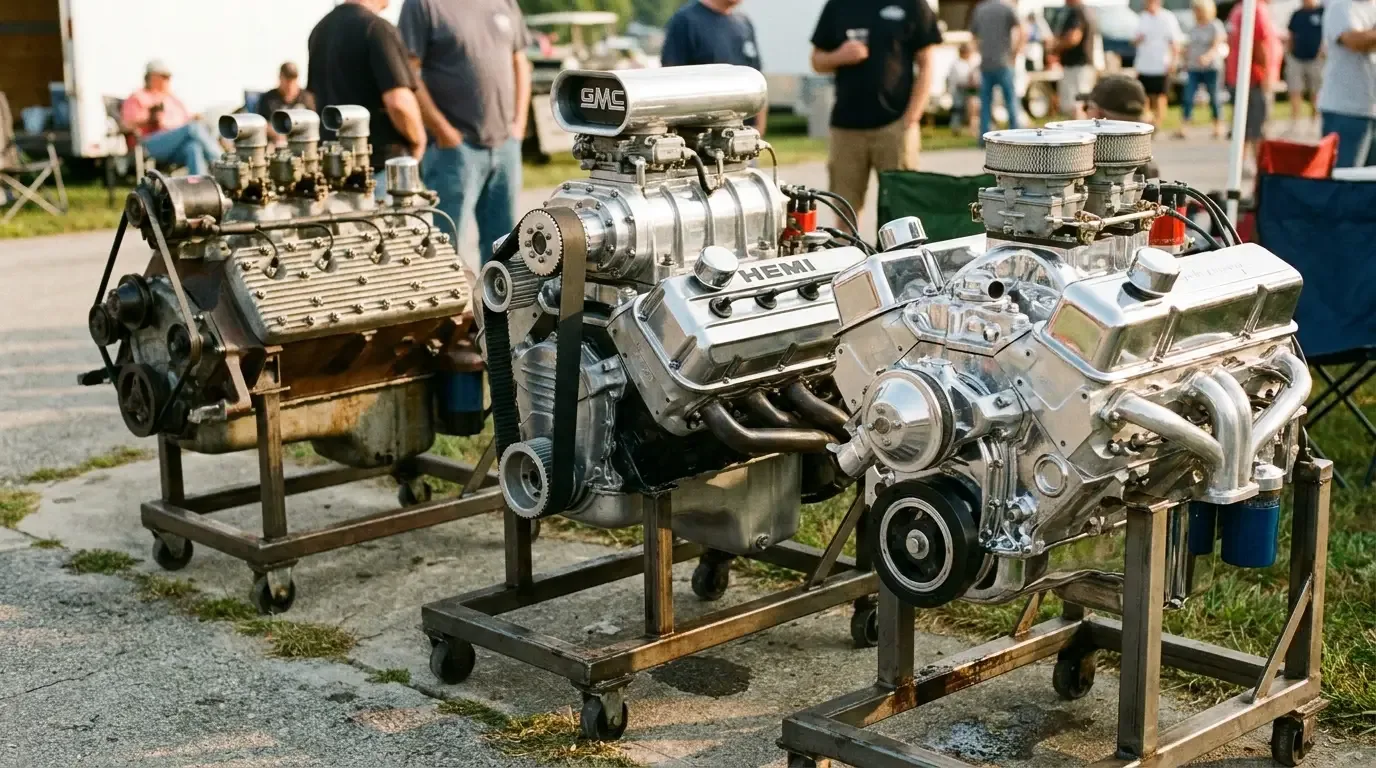
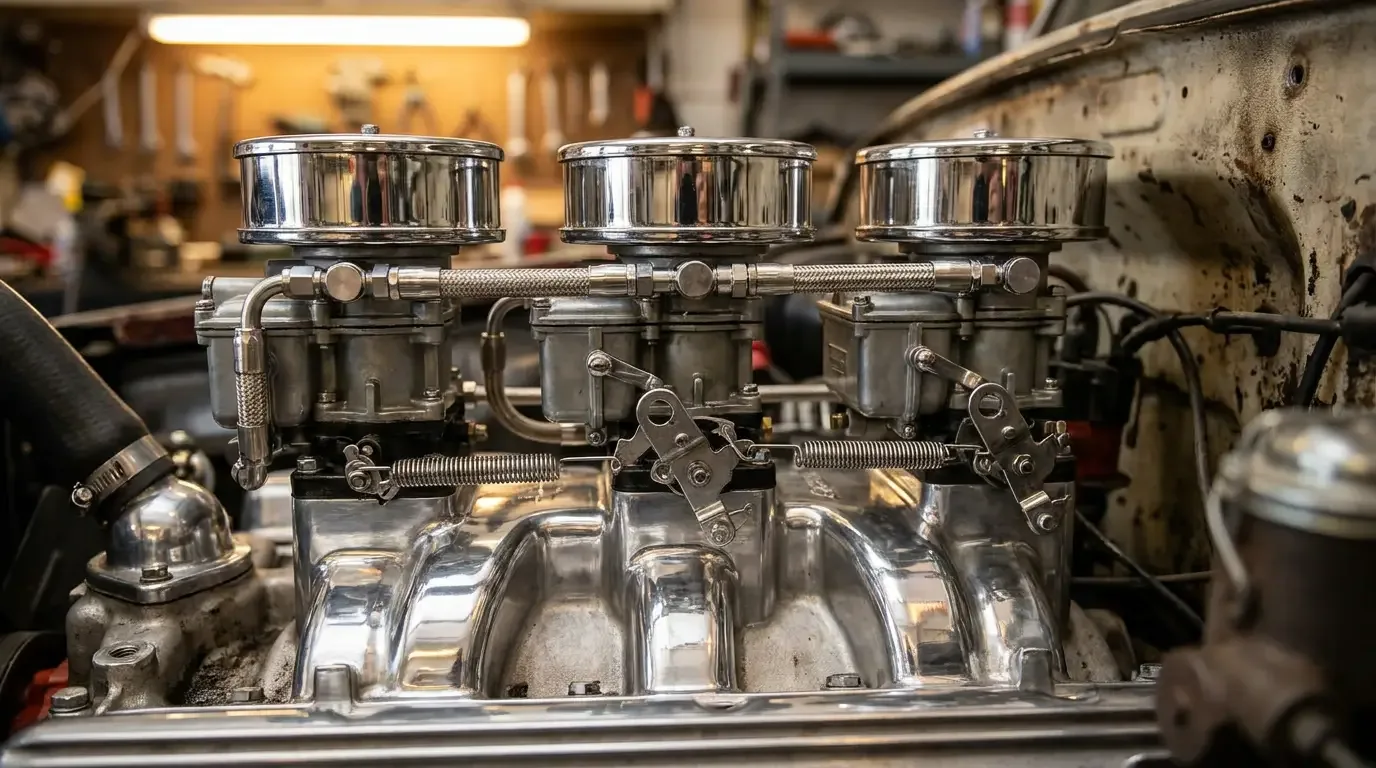
That heritage runs right through the engine bay. Multiple carburetors were often the fueling method before injection took over, and if you want the history on stacking Strombergs and Holleys before boost showed up, the story of the flathead v8 and what came after covers where that carburetor culture started. On a blown motor the carbs sit on top of the case, drawing through the blower, so the whole intake tract is tall and proud and impossible to hide. Builders leaned into that. If the engine could not fit under the hood, you cut a hole and let it breathe through the sheet metal. That was never an accident. It is a badge.
"People think the blower sticking through the hood is showing off. It is not. That case is tall because it has to be, and cutting the hood was cheaper than fabricating a low-profile intake. The look followed the function, same as everything else worth a damn on a hot rod."
Mike Sullivan
Streetability, or what the blower costs you
A blower is not free power. It takes power to make power. A Roots unit is belt-driven, so it robs the crank of some horsepower just to spin the rotors, and on a street car that parasitic loss is real down low when you are not on boost. You are dragging a diesel air pump around town, and it eats fuel and adds heat whether you are using it or not.
Heat is the big one. Compressing air heats it, and hot air is less dense, which fights the whole point. Roots blowers are not efficient at it, so a blown street motor lives closer to the edge of detonation than a naturally aspirated one. You manage that with a lower compression ratio in the base engine, careful timing, and good fuel. Race guys throw alcohol or nitro at it, which burns cooler and tolerates more boost, but on pump gas you stay conservative or you melt pistons.
The rest of the drivetrain has to survive the hit too. Instant boost off idle is brutal on clutches, transmissions, and rear ends. Belt tension has to be right or the blower slips and you lose boost, or it grabs and snaps things. Streetable blown cars exist and plenty of guys daily them, but you accept worse fuel economy, more heat, more maintenance, and a motor that is always working a little harder than it looks.
Carbs, injection, and the top of the case
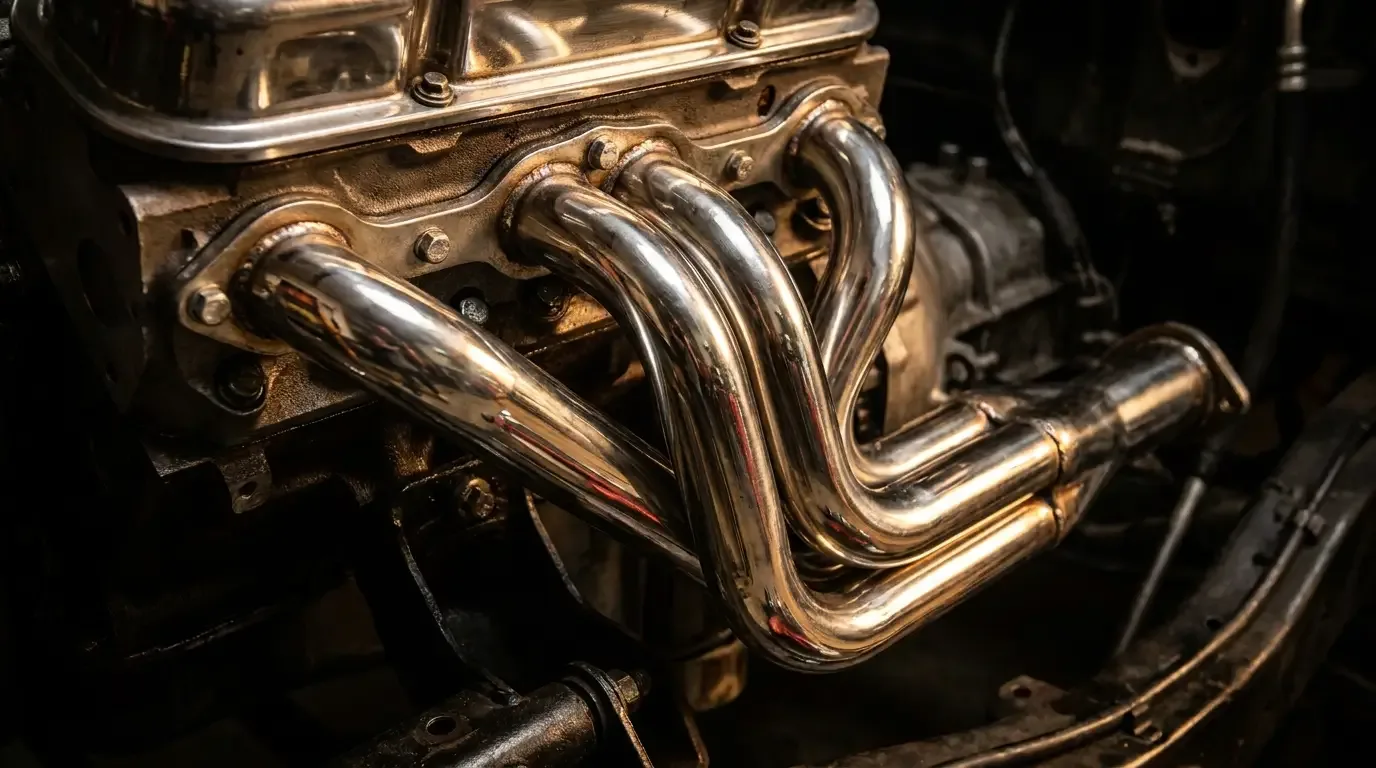
What sits on the blower matters as much as the blower itself. Early setups ran two or more carburetors on a manifold bolted to the case top, drawing fuel through before the rotors. That is the classic nostalgia look and it carries the same lineage as the older Headers and the Hot Rod Sound that finish the exhaust side of a hot motor. Later builds moved to mechanical injection with a hat and butterflies feeding straight into the blower inlet, which is what most serious race cars run because it meters fuel better under boost and looks meaner doing it.
Either way, the fueling has to keep up with the extra air the blower is stuffing in. Lean out a blown motor and you will find the melted pistons in short order. That is the trade the whole package asks of you. It makes silly power for the money and the effort, it looks like nothing else in the hobby, and it demands that you respect what all that forced air is doing inside the cylinders every single pass.
Sources and notes
- Period hot-rod press coverage of blown gassers, fuel altereds, and drag-era engine builds.
- Detroit Diesel two-stroke engine and blower references for original 71-series application and naming.
- Supercharger and forced-induction technical references on Roots-type positive-displacement pumps and drive ratios.
- Builder and engine-shop interviews on blown street-motor compression, timing, and fueling practice.
Related Reading
Have a
Classic Car
for Sale?
Reach thousands of serious classic car collectors across the US.
Sell It Here →
Are You a Classic Car Dealer?
List your full inventory and connect with targeted classic car buyers.
Join as a Dealer →

About the author
Mike Sullivan
Detroit-area muscle car enthusiast and restoration specialist with three decades of hands-on experience working on American iron.
More in Restoration & Tech
Comments
Be the first to comment on this article.