
Pull the small-block, drop in a battery. That is the pitch, and it is a lot cleaner on a slide than it is on a lift. I have worked around enough of these conversions now to tell you the honest version: an EV restomod is doable, the parts are getting better every year, and it is still one of the hardest, most expensive ways to make an old car move. Not because the motor is hard. The motor is the easy part. Everything around it is the work.
Restoration & Tech
7 min read
EV Restomod Swaps
Crate EV kits make the electric swap look easy. The motor is the easy part. Here is the honest version of battery packaging, weight, range, and the purist fight.
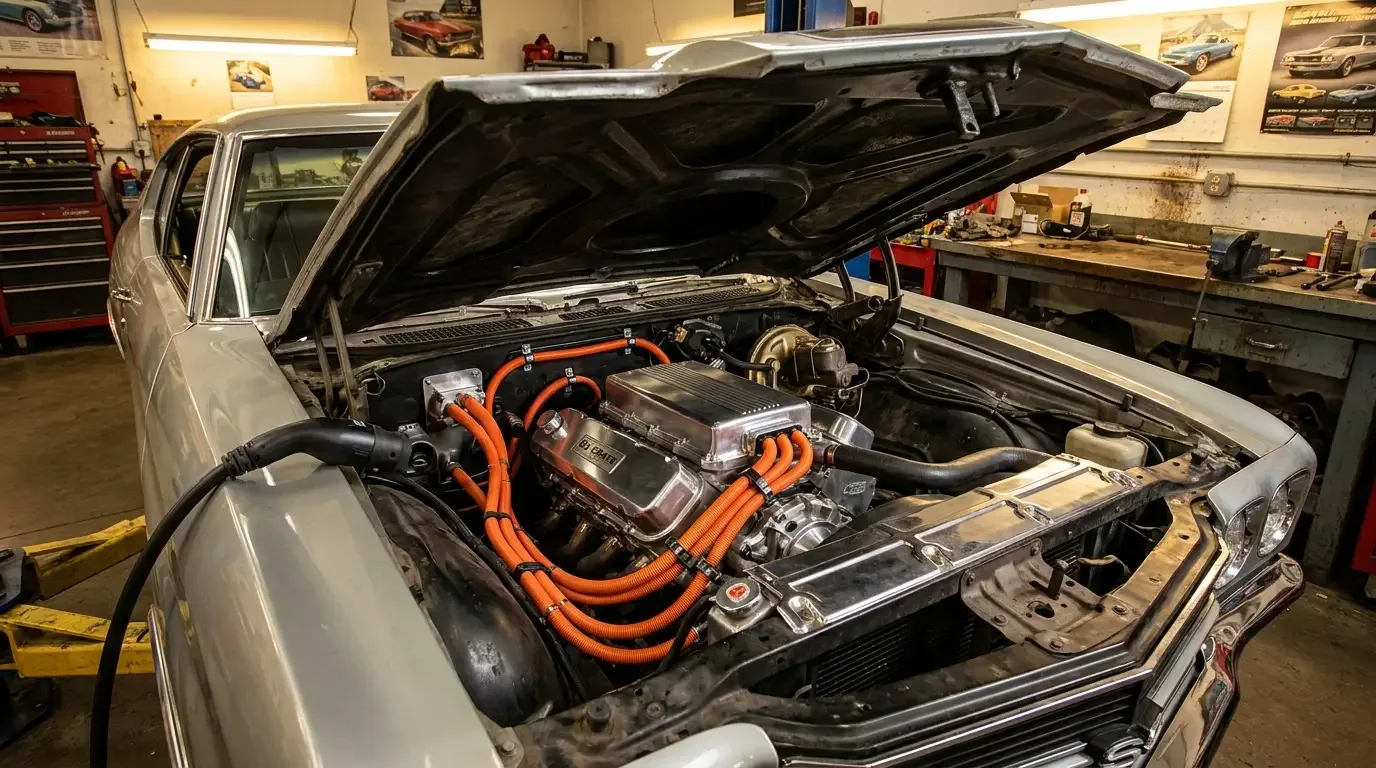
This is a different animal from a bolt-in gas conversion. If you have read the broader piece on the restomod engine swap, you already know the drill for an LS or a Coyote. An EV throws most of that playbook out. No fuel system, no exhaust, no cooling loop the way you know it, and a packaging problem that lives in the whole car instead of just the engine bay.
What a crate EV kit actually gives you
The big names have made this look official. GM sells its Connect and Cruise eCrate package built around the Chevrolet Performance Electric Connect and Cruise system, and Ford Performance offers the Eluminator crate motor, a unit pulled from the Mustang Mach-E platform. Both are real products you can buy, and both are a starting point, not a finished car.
Here is what people miss. A crate motor is one box. A running electric car is a motor, an inverter, a battery pack, a battery management system, a DC-DC converter to feed the 12-volt stuff, a charger, contactors, a cooling circuit, and a wiring harness that ties it all together and does not catch fire. The Eluminator, for example, is rated at 281 horsepower and 317 pound-feet in its published form, but out of the box it is a motor and a mounting problem. You supply the brains and the battery.
That is why I tell guys to stop thinking about horsepower first. On these builds the motor is rarely the limiting factor. The limits are heat, weight, and where you are going to physically put a battery the size of a few suitcases.
Where the battery goes, and why weight is the real story
Batteries are heavy and they take up room. That is the whole design problem in one sentence. A pack big enough for usable range can run several hundred pounds, and you cannot just bolt it wherever it fits. You have to think about front-to-rear balance, ride height, and keeping the mass low and central so the car still drives like something you would want to drive.
Common approaches split the pack. Some of it goes where the fuel tank and the engine used to live, some under the floor, some in the trunk. Do it wrong and you build a nose-heavy boat or a car that squats like it is hauling bricks. Do it right and the low center of gravity can actually make the thing handle better than it ever did with an iron V8 hanging over the front wheels.
Weight also feeds straight into your brakes and suspension. You do not put a modern battery pack in a car and leave 1960s drum brakes on it. The chassis work that goes with a proper handling build, the kind of upgrades a The LS Swap: Why Everyone Does It crowd already respects, becomes mandatory here, not optional.
| Factor | Gas swap (LS/Coyote) | EV swap |
|---|---|---|
| Core part | Crate engine + trans | Motor, inverter, battery, BMS, charger |
| Added weight | Roughly engine-neutral | Often several hundred lb heavier |
| Range / refuel | Tank + gas stations everywhere | Typically 100-200 mi real-world, plan charging |
| Cooling | Conventional radiator loop | Liquid loop for pack + inverter |
| Hardest part | Mounts, tune, exhaust | Packaging, HV safety, integration |
Range, output, and the numbers to be honest about
This is where people oversell. Real-world range on a home-built EV restomod usually lands in the low-to-mid hundreds of miles at best, and that is with a serious pack and a car that is not shaped like a brick. Call it roughly 100 to 200 miles for most builds. Highway speed, heat, and hills eat that fast. An old body with the aerodynamics of a barn door does not help.
Output is the opposite problem. There is usually more than you need. Instant torque off idle makes even a modest setup feel quick, which is fun until you remember the driveline was designed for a lazy carbureted six. The skill is not making power. It is delivering that power without snapping something and without draining the pack in twenty minutes of showing off.
"People ask me how fast it is. Wrong question. Ask me how far it goes and what it weighs, because those two numbers decide whether you built a car or a very expensive golf cart."
Mike Sullivan
The purist fight, and who this actually suits
I am not going to pretend this is settled. Plenty of the old guard hate it, and I get why. Pulling a numbers-matching V8 to run silent offends people who grew up on the sound and the smell. To them it is not a hot rod anymore. Fair. Nobody has to like it.
But the case for it is real too. An EV swap gives you a classic that starts every time, needs almost no maintenance, and does not choke your garage with fumes. For someone in a city with tight emissions rules, or a person who just wants the shape without the fuss, it makes sense. My honest take: do it on a car that is already modified, not a rare original. Cutting up a pristine survivor to go electric is how you make everybody mad and lose money. Doing it to a rough project body that was never going to be original anyway is a fair game.
If you want the longer view on how this movement grew out of the whole custom scene, the restomod story puts the electric branch in context. It is one more chapter, not the end of the book.
Sources and notes
- Manufacturer crate-EV product literature (GM Chevrolet Performance eCrate / Connect and Cruise, Ford Performance Eluminator).
- Builder and shop interviews on EV conversion packaging and driveline reinforcement.
- General EV powertrain references for battery, BMS, and cooling system fundamentals.
- Output and range figures are drawn from current manufacturer specs and stated as approximate where real-world results vary.
Related Reading
Have a
Classic Car
for Sale?
Reach thousands of serious classic car collectors across the US.
Sell It Here →
Are You a Classic Car Dealer?
List your full inventory and connect with targeted classic car buyers.
Join as a Dealer →

About the author
Mike Sullivan
Detroit-area muscle car enthusiast and restoration specialist with three decades of hands-on experience working on American iron.
More in Restoration & Tech
Comments
Be the first to comment on this article.