
Watch a hop pit for five minutes with us and you'll understand why people fall in love with this. A car noses up, the front end slams the pavement, and it climbs. Thirty inches. Forty. On a wild single-pump car it can go higher. The crowd counts out loud, someone yells a number, and the driver keeps working the switch until the nose is standing at the sky or the car bounces sideways off the line. Car hopping is the loudest, most physical corner of lowrider culture, and it is a lot more technical than the chaos suggests.
Restoration & Tech
7 min read
Lowrider Hopping and Dancing
Single pump or double, a wall of batteries and a good switch hand. Inside lowrider hopping and dancing, the sport, the skill and the danger.
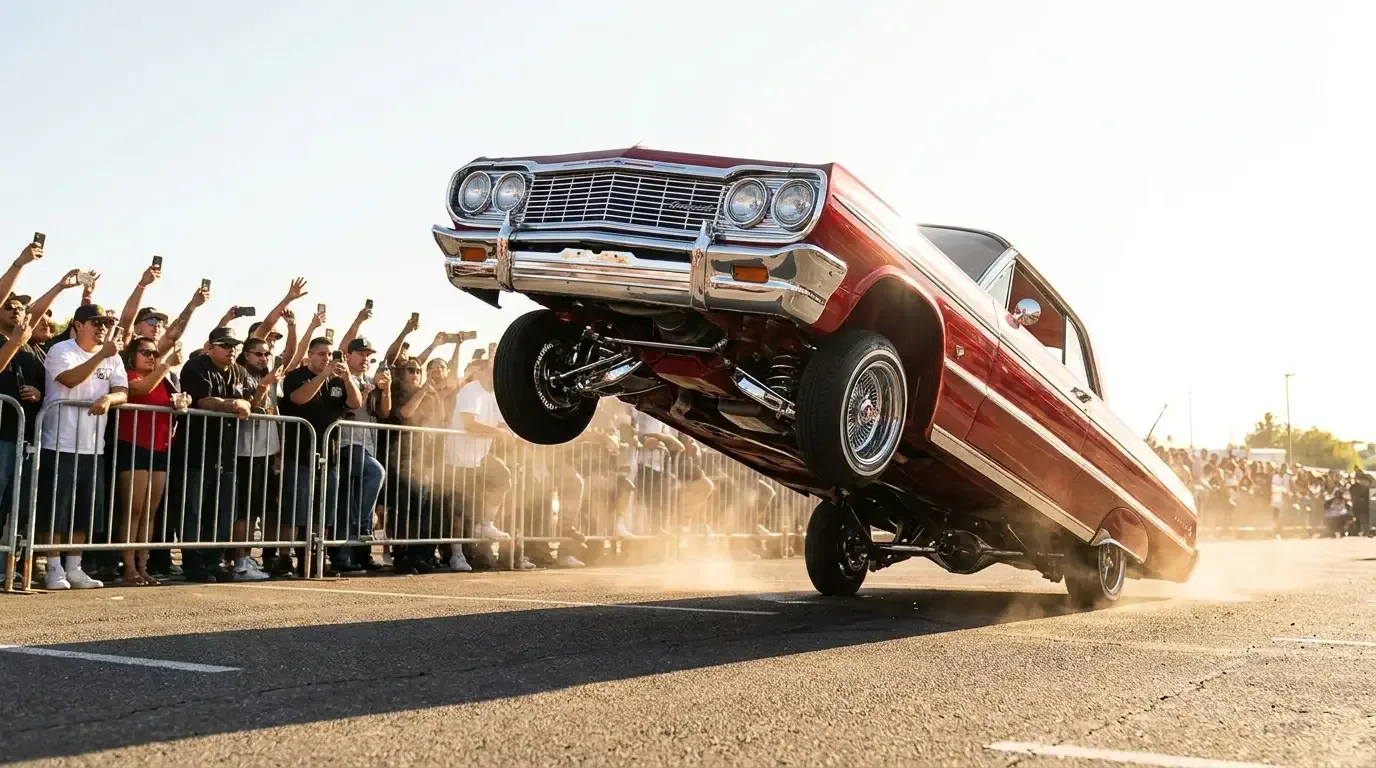
Hopping and dancing both come from the same place: the hydraulic setup under the car. If you want the full picture of how the fluid, pumps and cylinders lift a car, that lives in our deeper piece on lowrider hydraulics. This article is about what happens when you push that system past cruising and into competition, where guys build cars that do nothing but jump.
Where hopping came from
Hopping started as a party trick and turned into a sport. In the early cruising days, a driver would hit the switch to clear a speed bump or just to show off at a light. Somebody hopped higher, somebody else answered, and by the 1970s you had crowds gathering to watch two cars trade inches in a parking lot. Lowrider shows formalized it with tape measures, height classes and rules, and now there are hop-offs at major events with cars built for one job.
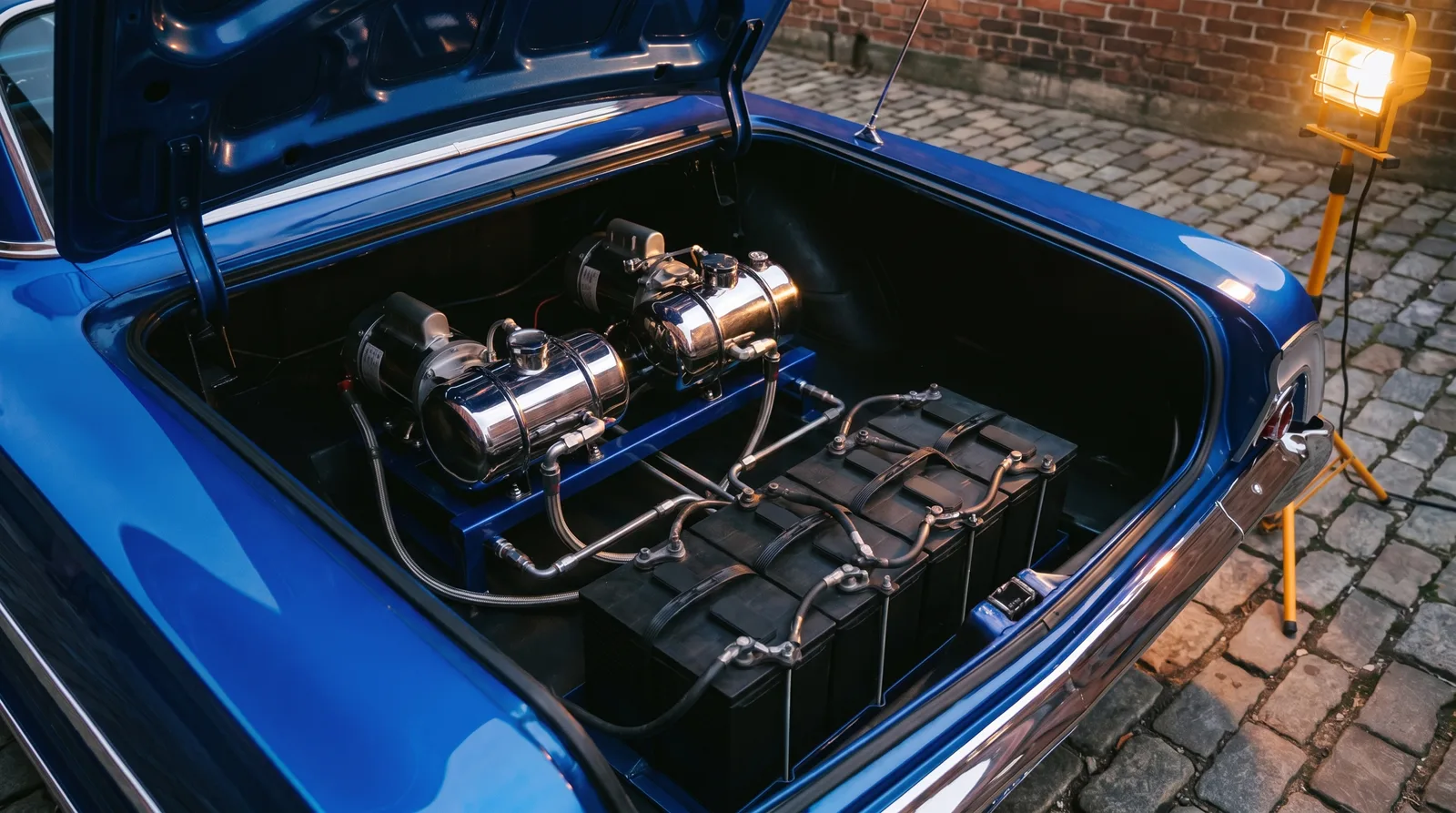
That single job changes everything about the build. A show car is candy paint, chrome and a soft ride. A hopper is a tool. The paint gets chipped, the trunk is a wall of batteries, and the frame is reinforced so it does not fold in half. These are two different animals that happen to share a body style.
Single pump versus double pump
The first question anyone asks about a hopper is how many pumps drive the front end. It comes down to one or two.
A single-pump car uses one pump to lift the nose. It is lighter, cheaper to build, and the class where a lot of the wildest numbers show up because the light front end can swing high and fast. A double-pump car runs two pumps to the front, which moves more fluid, more quickly, and gives you more control and consistency. Double-pump cars tend to be the heavy hitters that hop tall and repeat it lap after lap without dying. Most show rules split these into separate classes so a two-pump car is not measured against a one-pump car.
| Feature | Single pump | Double pump |
|---|---|---|
| Pumps to front | One | Two |
| Fluid volume moved | Less | More |
| Typical trait | Light, fast, can swing very high | Consistent, controllable, hits hard |
| Battery draw | High | Higher |
| Build cost | Lower | Higher |
| Common use | Single-pump hop class | Double-pump hop and radical classes |
Neither is automatically better. A well-built single pump embarrasses a lazy double pump all day. The number on the stick comes from the whole package: pump pressure, battery bank, weight balance and how the driver hits the switch.
Batteries, gearing and the trunk full of power
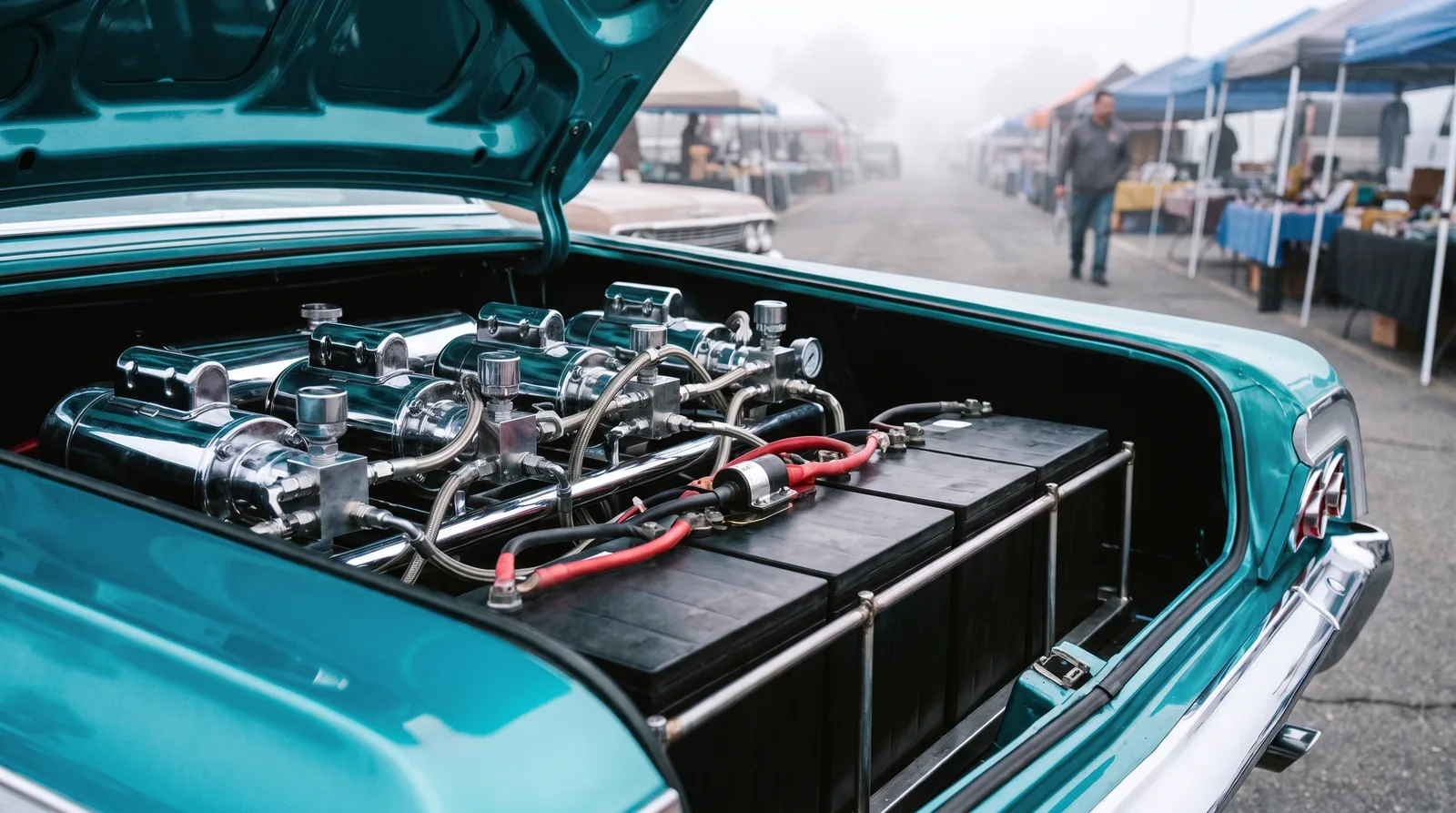
Height is electricity. Hydraulic pumps are hungry, and the more voltage you feed them the harder and faster they slam the front up. A mild street setup might run on a handful of batteries. A competition hopper runs a wall of them, wired in series to push the system voltage way up, and that pile of lead is also ballast that helps the car snap. Builders chase the balance between raw voltage and the weight it adds, and that trade-off is a craft of its own. We go deep on wiring, pump gearing and bank layout in Lowrider Batteries, Pumps and Setups.
Gearing inside the pump matters as much as the battery count. A pump geared for volume moves a lot of fluid slowly for a smooth show ride. A pump geared for pressure hits fast and hard, which is what a hopper wants. Swapping gears and dialing the setup is where a builder earns the height, not by throwing parts at it.
Wheelie bars, danger and keeping the car alive
When a nose comes up 40 inches, the car wants to keep going and flip over backward onto the trunk. Wheelie bars stop that. They are steel bars off the rear that catch the car before it goes past the point of no return, and on a hard-hitting hopper they are not optional. Cars still get away from drivers. Nosed too high, the back end lifts, the car walks, and a bad hit can bend a frame, blow a cylinder or put the car on its roof. This is a contact sport played against gravity and steel.
The skill is in the switch hand. A good hopper driver feels the rhythm of the car, catches it at the top of the bounce, and keeps it stacking height without letting it get loose. Too aggressive and you break parts or flip. Too soft and you leave inches on the table. That timing, done to a car making a violent motion a few feet away from a crowd, is why respected switchmen have real reputations in this world.
"People see a hopper and think it's about money, just buy more batteries. It isn't. I've watched a cheap single pump built by somebody who knows the switch beat a fat double pump every time. The car tells you when to hit it, and either you're listening or you're not."
Hector Morales
Dancing is a different discipline
Hopping is about height on the front end. Dancing is about motion, and it is a separate skill and a separate build. A dancer runs cylinders at all four corners so the driver can lift and drop each wheel on its own. Worked together, the car rocks, twists, three-wheels, stands on its bumper, and in the radical classes it can lay over on its side or get a wheel completely off the ground. It looks like the car is alive.
Dancing needs more pumps, more switches and more plumbing than a hopper, because every corner is controlled by itself. Radical dancers are essentially performance machines with a body draped over them, built for the show floor rather than a straight-up height battle. A pure hopper wants to jump. A dancer wants to move. Some cars try to split the difference, but the top competitors in each class commit to one job.
Respect the culture behind the show
It is easy to reduce hopping to a spectacle, but this grew out of Chicano car clubs who built these cars with their own hands, on their own money, over decades. The hop pit is competition, and it is also craft and pride and family. The guy standing next to a flipped car he spent a year building is not a stunt. He is a builder who took a risk in public. That is worth remembering when you are counting inches from the fence.
Sources and notes
- Lowrider club and event records, including hop-class rules and height categories
- Builder and switchman interviews on single- and double-pump setups
- Hydraulic component references for pump gearing and cylinder configuration
- Period lowrider press coverage of hop competition and its origins
Related Reading
Have a
Classic Car
for Sale?
Reach thousands of serious classic car collectors across the US.
Sell It Here →
Are You a Classic Car Dealer?
List your full inventory and connect with targeted classic car buyers.
Join as a Dealer →

About the author
Hector Morales
East LA lowrider builder and lifelong member of the car-club scene, writing lowrider culture, hydraulics and custom paint from the inside.
More in Restoration & Tech
Comments
Be the first to comment on this article.