
Everybody wants to see a car jump. That is the part of lowriding that ends up on phones and in music videos, the front end reaching for the sky. But hopping is the loud cousin of what hydraulics actually do, which is let you lay a car flat on the ground at a stoplight and then lift it to clear a driveway thirty seconds later. Get that wrong and you will boil batteries, snap chrome, and put a cylinder through your hood. Get it right and the car does exactly what you tell it, every time, on demand.
Restoration & Tech
10 min read
Lowrider Hydraulics and Air Suspension
Pumps, cylinders, batteries, and the switch, how lowrider hydraulics really work, plus how airbags compare for a clean lay-low ride.
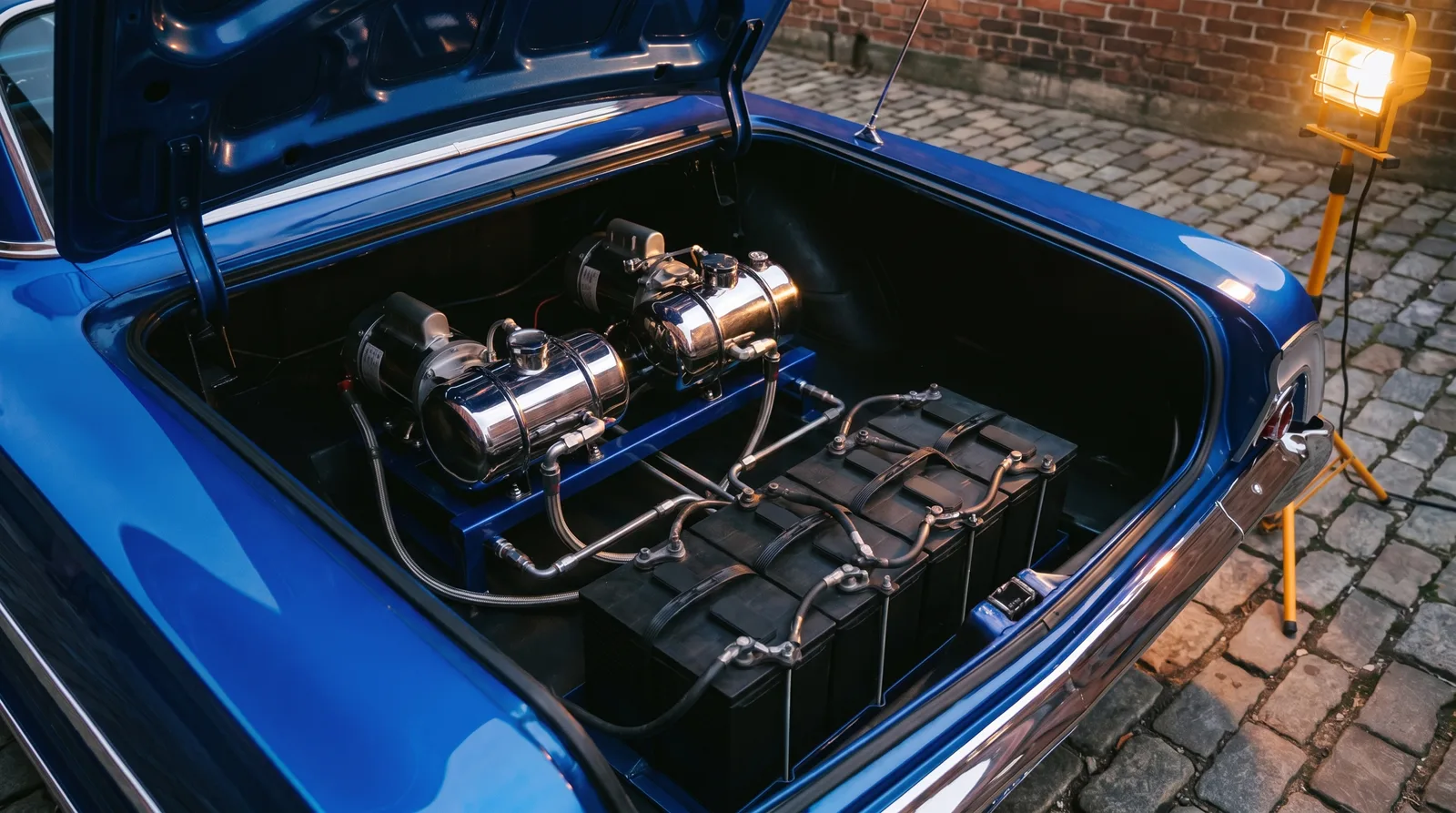
I have set up a lot of these systems, and the first thing I tell anybody who walks up asking about a switch is that a hydraulic setup is not a bolt-on. It is a small industrial machine living in your trunk, and it deserves the same respect you would give any machine that moves a two-ton car with a fingertip. Before you spend a dollar, it helps to understand where this came from and, honestly, what a lowrider really is, because the suspension is the heart of the whole thing.
Why hydraulics exist in the first place
The setup is old, and it was born out of a law. In 1958 California made it illegal to run a car with any part of the body lower than the bottom of the wheel rims. Guys who wanted to ride low needed a way to raise the car when a cop was watching and drop it back down when he was not. The answer came from aircraft surplus. Postwar, you could buy hydraulic actuators pulled off B-52 bombers and other aircraft cheap, and those parts became the first lift kits under a Chevy.
That origin story matters because it tells you what the system is really for. The point was adjustable ride height, and everything else, the hopping, the dancing, the three-wheel motion, came later as people pushed the same basic parts harder. A modern setup is more refined but the logic has not changed. You are using pressurized fluid to move a cylinder that pushes on the suspension, and a switch decides which cylinder gets fluid and when.
The parts that actually move the car
A hydraulic setup is a chain of parts, and each one has a job. If you understand the chain you can diagnose almost anything that goes wrong, because a failure shows up as fluid not getting where it should.
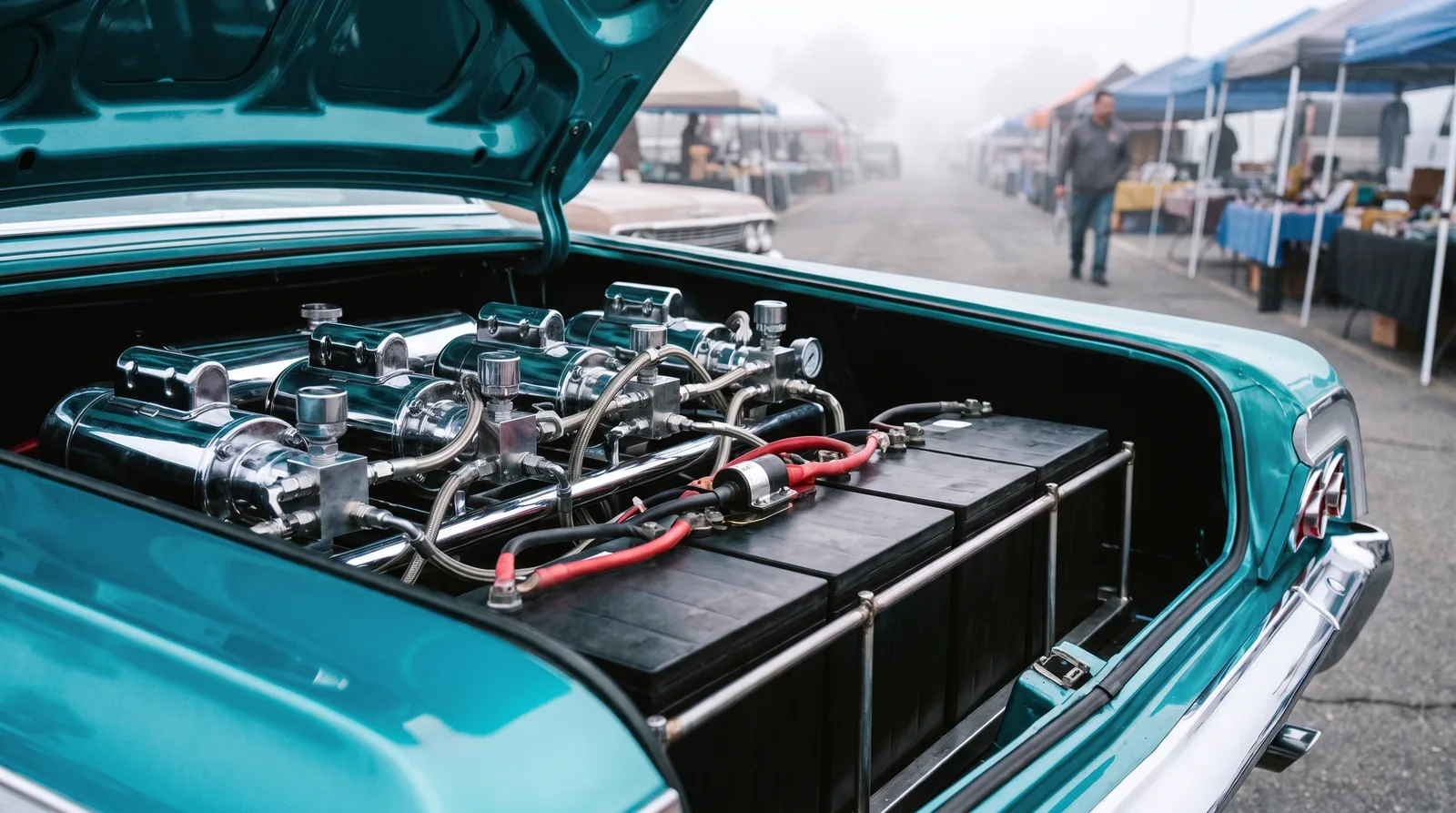
The pump is the muscle. It is an electric motor driving a gear pump that pressurizes hydraulic fluid. Most street and show setups run pumps built around a Marzocchi-style gear head, and they move fluid fast enough to lift a corner of the car in a fraction of a second. The cylinders are the arms. A cylinder sits at each corner in place of, or in line with, the coil spring, and when fluid enters it, it extends and lifts that corner. The batteries are the fuel. Hydraulic pumps are voltage-hungry, and builders stack multiple 12-volt batteries in series to feed them, because more voltage means a faster, harder lift.
| Component | What it does | Typical street-setup range |
|---|---|---|
| Pump | Pressurizes fluid, one pump feeds one or two cylinders | 2 to 4 pumps |
| Cylinders | Extend to lift each corner | 4 (one per corner) |
| Batteries | Supply high voltage to the pumps | 4 to 10 (roughly 48V to 120V) |
| Solenoids | Route fluid to the chosen cylinder | 1 per pump direction |
| Dumps | Release fluid so the corner drops | 1 per corner or axle |
| Switch box | Driver control for each corner and pair | 4 to 6 switches |
Between the pump and the cylinder sit the solenoids and the dumps. A solenoid is an electric valve that sends pressure to a cylinder when you hit the switch. A dump is the valve that opens to let fluid run back out so the corner falls. When people talk about a car dropping fast, they are really talking about big dump valves that dump fluid quickly. Everything else being equal, a bigger dump means a harder, faster drop.
The switch, and why it is the whole art
The switch box is a handful of toggles wired to the solenoids and dumps. Hit a switch one way and a corner goes up, hit it the other and that corner dumps. That sounds simple, and mechanically it is. The art is entirely in the timing.
Hopping the front end is a rhythm. You charge the front cylinders, dump, charge again, and if you catch the natural bounce of the car at the right instant you build the hop higher each time. Dancing, where the car rocks corner to corner or does the three-wheel where it balances on one rear and the opposite front, is the same idea across four switches instead of one. A good hopper reads the car through the switch the way a drummer reads a kit. It is muscle memory and feel, and no amount of expensive hardware replaces the hand on the switch.
This is also where setups get dangerous. Slam a car hard enough, often enough, and you find the weak link. Chrome trailing arms twist, mounts tear, and if a cylinder comes loose under load it becomes a projectile. Anybody building a hopper is building a car that is deliberately trying to hurt itself, and the good builders spend as much time reinforcing the frame and the arms as they do plumbing the pumps.
Air suspension, the quieter alternative
Not everybody wants a trunk full of batteries and the violence of a hydraulic hop. Air suspension, airbags, is the other way to lay a car low and lift it on demand, and it has taken over a big share of the lay-it-low world.
An airbag setup replaces the spring at each corner with a rubber and fabric air spring. An onboard compressor fills a small air tank, and valves fill or empty each bag to raise or lower that corner. Instead of a switch box wired to hydraulic solenoids, most modern air setups run a small electronic management unit and a phone app or a controller, and you can save ride heights as presets. Tap a button and the car settles to your cruising height on its own.
The trade-offs are real and they run in both directions. Air rides smoother because the air spring soaks up bumps in a way a stiff hydraulic setup does not. Air is also quieter, cleaner in the trunk, and easier to live with as a daily driver. What air will not do is hop. You cannot slam an airbag up and down fast enough to throw a front end skyward, because air compresses and the response is soft by nature. If your goal is the show-and-hop scene, air is the wrong tool. If your goal is a clean lay-low cruiser you drive every day, air is often the smarter one.
| Consideration | Hydraulics | Air suspension |
|---|---|---|
| Lift speed | Instant and violent | Smooth and gradual |
| Can it hop? | Yes, this is its purpose | No |
| Ride quality | Firm, can be harsh | Soft, absorbs bumps |
| Trunk space | Heavy, batteries and pumps | Lighter, compressor and tank |
| Control | Manual switches, driver skill | Presets, app or controller |
| Culture fit | Traditional lowrider standard | Newer, common on custom cars |
Which one belongs under your car
The honest answer depends on what the car is going to do, and I say this to everyone who asks me to pick for them. If you are chasing tradition, if the car is going to compete, if you want to hop or three-wheel, you run hydraulics. That is the real deal in the lowrider world and nothing else does the job. Air will get you laughed off a hop pit.
If you want a car that lays frame in a parking lot, rides like a cloud on the freeway, and comes back up to a saved height at the tap of a button, air is a legitimate and often better choice. Plenty of beautiful cars ride on bags, and pairing a clean bag setup with the right stance and the right lowrider paint makes a car that turns heads without a single battery in the trunk.
There is also a middle truth about cost. A serious hydraulic setup with multiple pumps, a rack of batteries, reinforced arms, and quality plumbing adds up fast, and a proper hopper build climbs into serious money once you count the frame work. A quality air setup is not cheap either, but the parts count is lower and the labor is often simpler. Whichever way you go, buy the setup as a system, not as a pile of the cheapest individual parts, because a hydraulic system is only as strong as its weakest fitting.
"People fall in love with the hop, but the switch is where the car earns its respect. Anybody can wire a pump. Making a two-ton car do exactly what you want, exactly when you want it, that takes a hand you build over years."
Jim Vasquez
Buying a car that already has a setup
Most people do not build from a bare frame. They buy a car that already runs hydraulics or bags, and that is where you have to be careful, because a bad install is worse than no install. When you go looking through the lowriders for sale, treat the suspension as the single most important thing to inspect, above the paint and above the interior.
🔧 Inspection Priorities
- The batteries and wiring. Swollen, corroded, or mismatched batteries mean a system that was run hard and maintained poorly. A full replacement rack of quality batteries is a real cost.
- Fluid leaks and stains. Look under the pumps, at every fitting, and at the cylinder seals. Weeping fluid points to tired seals and future failures.
- Frame and arm reinforcement. On any car that hops, check the lower arms, mounts, and rear frame for cracks, poor welds, or bending. Frame repair is expensive and safety-critical.
- Cylinder and mount security. Every cylinder should be solidly located. A loose cylinder under pressure is genuinely dangerous.
- The switch or controller function. Test every corner up and down. A corner that lifts slowly or drops unevenly signals a weak pump, a bad solenoid, or a failing dump.
None of these are reasons to walk away by themselves. They are reasons to negotiate, and they tell you what you are really buying. A honest seller will let you run the switch through its whole range and will not flinch when you crawl under the car. If somebody will not let you cycle the suspension, that is your answer.
Sources and notes
- Period accounts of California's 1958 vehicle-height law and early hydraulic lowrider builds.
- Lowrider community and builder interviews on pump, cylinder, battery, and switch setups.
- Hydraulic and air-suspension component references for street and show applications.
- Club, event, and hop-competition records documenting hydraulic versus air use.
Related Reading

Article
The Lowrider Story

Article
Lowrider History and Chicano Culture

Article
Lowrider Style: Paint and Murals

Article
How Lowrider Hydraulics Work

Article
Lowrider Hopping and Dancing
Article
Lowrider Batteries, Pumps and Setups

Article
Airbags vs Hydraulics on a Lowrider: Honest Tradeoffs
External
/lowriders-for-sale
Have a
Classic Car
for Sale?
Reach thousands of serious classic car collectors across the US.
Sell It Here →
Are You a Classic Car Dealer?
List your full inventory and connect with targeted classic car buyers.
Join as a Dealer →

About the author
Jim Vasquez
Southern California hot rod and custom car builder with roots in the traditional kustom kulture scene.
More in Restoration & Tech
Comments (1)
L
Linda Kowalski
3 months ago
Classic car community is generally helpful. Marque-specific forums are where the real knowledge lives — find the dedicated one before you buy.