
Ask ten people how a lowrider goes up and down and nine of them will point at the switch. The switch is the last thing in the chain, not the first. What actually lifts two tons of Impala off the pavement is a hydraulic pump moving oil into a cylinder faster than the car can resist it. Everything else, the batteries, the dumps, the accumulators, exists to make that one action happen on command and, ideally, not tear the car apart while it does. I have built cars that hit clean and cars that hit like a dropped anvil, and the difference was almost never the switch. It was how the rest of the system was set up behind it.
Restoration & Tech
7 min read
How Lowrider Hydraulics Work
The switch is the last thing in the chain, not the first. Here is how pumps, cylinders, dumps, accumulators and batteries actually move a lowrider.

This is the mechanical explainer I wish someone had handed me at eighteen. If you want the culture and the roots behind all this, read the story of the lowrider first, then come back and we will get our hands dirty.
The pump is the heart, and it runs on car batteries
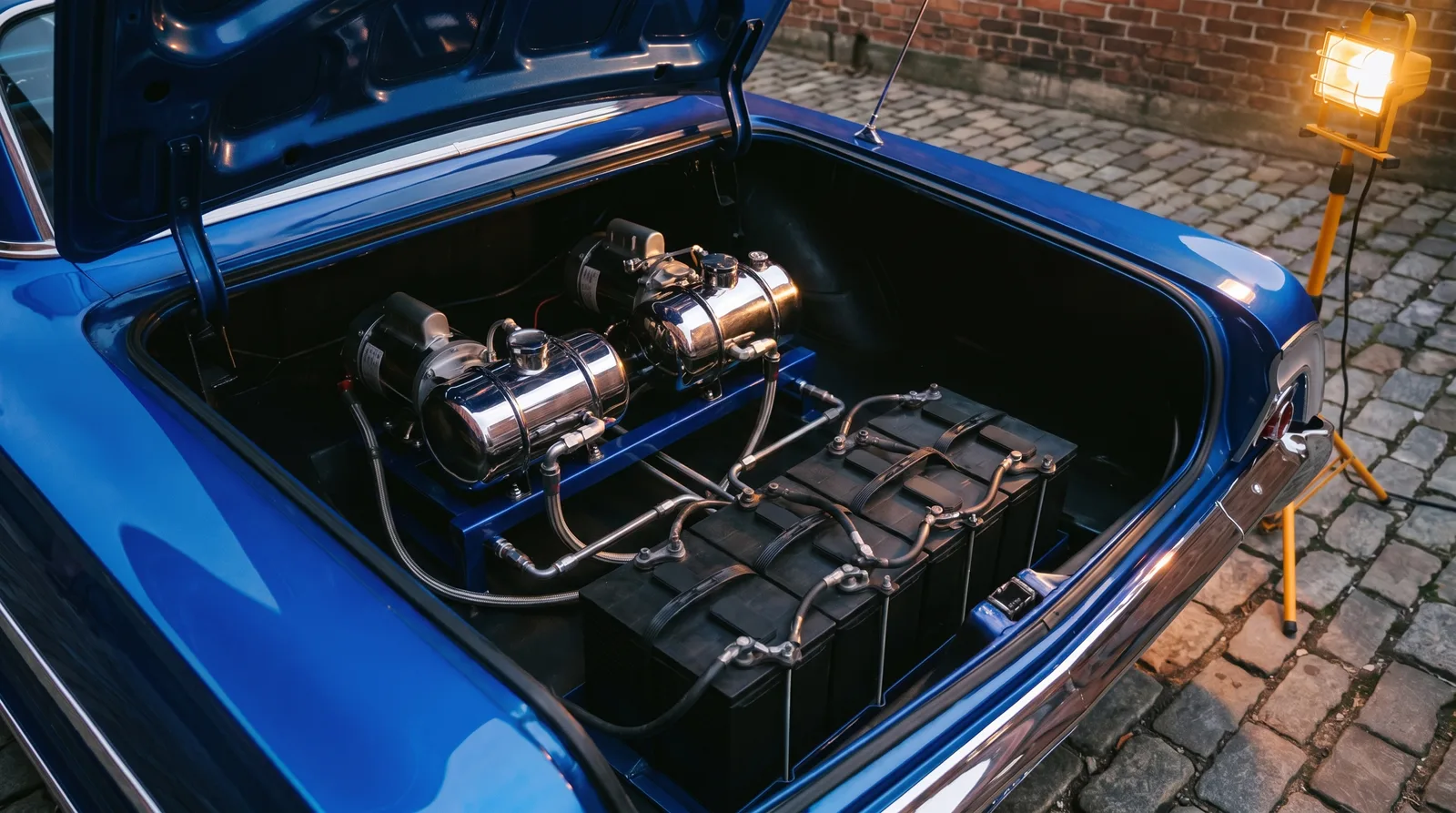
A lowrider hydraulic pump is a small electric motor bolted to a gear pump and a reservoir of hydraulic oil. When you throw the switch, current from a bank of batteries spins the motor, the gear pump pushes oil out under pressure, and that oil has to go somewhere. It goes up a hard line into the cylinder at the suspension. That is the whole trick. Push oil into a sealed cylinder and the piston has no choice but to move.
The reason lowriders run so many batteries is voltage. A single 12-volt battery spins the motor slow and lifts the car slow. Stack them in series and you raise the voltage, and voltage is speed. Two batteries give you 24 volts, three give you 36, and serious hop cars run 48, 60, even 72 volts through a single pump for a few violent seconds. More volts means the piston moves faster, which means the corner of the car leaves the ground harder. That is why a hopper's trunk looks like a submarine engine room. Those batteries are not for show, they are the fuel.
Cylinders and the geometry of up
The cylinder is where oil pressure turns into movement. It is a steel tube with a piston inside and a chrome shaft that extends out the top. Oil enters the bottom, pushes the piston up, and the shaft pushes against the suspension, usually seated inside the coil spring at each corner. When the shaft extends, that corner of the car rises. Simple in theory, brutal in practice, because the cylinder does not care that your factory suspension geometry was never designed to travel that far.
Cylinder length is a real decision, not a spec sheet number. Longer cylinders lift the car higher and, on a hopper, throw the nose up harder. But length costs you control and puts the strain on the mounts and the frame. Most street builds run shorter cylinders up front for a clean stance and quick response. Dedicated hop cars run long strokes up front and often nothing meaningful in the rear, because a hopper only needs the nose to fly. Match the cylinder to what the car is actually for.
| Component | What it does | Why it matters |
|---|---|---|
| Pump | Electric motor plus gear pump forces oil out under pressure | Sets lift speed; the heart of the system |
| Batteries | Wired in series to raise voltage feeding the pump | More volts equals more speed and harder hits |
| Cylinder | Oil pushes a piston and chrome shaft against the suspension | Converts pressure into lift; stroke sets travel |
| Dump valve | Opens to release oil back to the reservoir | Controls how the car comes down |
| Accumulator | Nitrogen-charged cushion in the oil line | Softens the drop, saves the frame |
| Solenoids | Heavy relays that switch battery current to the pump | The muscle the switch actually triggers |
Dumps, accumulators, and the whole art of coming down
Going up is easy. Coming down is where cars get destroyed. To drop, you open a dump valve, a solenoid that unseats and lets the pressurized oil dump straight back to the reservoir. Gravity does the rest. The question is how fast. A wide-open dump on a car with no cushion drops the corner so hard the tire slaps the pavement and the impact travels straight into the frame. Do that a few hundred times and you crack welds.
That is what the accumulator is for. It is a small chamber charged with nitrogen gas behind a diaphragm, spliced into the oil line. Gas compresses, oil does not, so the nitrogen acts as a spring that absorbs the shock of the drop and smooths the motion. Street cruisers almost always run accumulators because they want the ride to feel like a ride, not a car crash. Hoppers often delete them on purpose, because they want the raw slam. It is a genuine tradeoff between a car you can drive to the show and a car built to do one violent thing in a parking lot.
"I can tell what a car is built for in one drop. If it lands soft and settles, somebody cared about the accumulators. If it hits like a hammer and rattles your teeth, that trunk was built to hop, and everything else was an afterthought."
Jim Vasquez
The switch: up, down, and side to side
Now the switch makes sense. The switch does not move the car. It is a low-current signal that tells the solenoids what to do, and the solenoids handle the real battery current going to the pump and the dumps. Throw a switch one way, it fires the pump to a corner and that corner rises. Throw it the other way, it opens the dump and that corner falls. That is it.
Where it gets interesting is a four-pump setup, one pump per corner, each on its own switch. Fire the front two and the nose goes up. Fire the rears and the tail lifts. Fire the left front and left rear together and the car leans right, drop them and it leans back. Alternate corners fast and the car rocks and walks. This independent corner control is the foundation of everything you see when a car dances, and it is a whole discipline in itself, covered in Lowrider Hopping and Dancing. A basic two-pump car just does front and back. A full setup with a bank of switches is a car you play like an instrument.
Get all of it working together and you understand the appeal. This is real hydraulic engineering scaled down and bolted into a trunk, and when the plumbing, the voltage, and the geometry are dialed in, the car does exactly what your thumb tells it to. For the deeper dive into the full suspension side of the craft, including the airbag alternative, our guide to lowrider hydraulics and air setups covers the whole picture.
Sources and notes
- Period lowrider press and club publications covering hydraulic setup practice
- Hydraulic component references for pump, cylinder, valve, and accumulator function
- Builder and installer interviews on street versus hop configurations
- Historical accounts of California vehicle-height law and its influence on the craft
Related Reading


Have a
Classic Car
for Sale?
Reach thousands of serious classic car collectors across the US.
Sell It Here →
Are You a Classic Car Dealer?
List your full inventory and connect with targeted classic car buyers.
Join as a Dealer →

About the author
Jim Vasquez
Southern California hot rod and custom car builder with roots in the traditional kustom kulture scene.
More in Restoration & Tech
Comments
Be the first to comment on this article.