
Ask ten guys at a show what they think sectioning is and most of them will describe a chop. They are wrong, and the mistake tells you something. Chopping lowers the roof. Channeling drops the body over the frame. Sectioning does neither. Sectioning is cutting a horizontal slice out of the middle of the body, all the way around, and welding the top back down to the bottom so the whole car loses height and bulk through its beltline. It is the least understood and the least attempted of the big three cuts, and when it is done right it is close to invisible, which is exactly why so few people bother.
Restoration & Tech
8 min read
Sectioning a Car Body
Sectioning takes a horizontal slice out of the middle of a body to kill its height and bulk. The hardest of the big three cuts, and why few builders dare it.
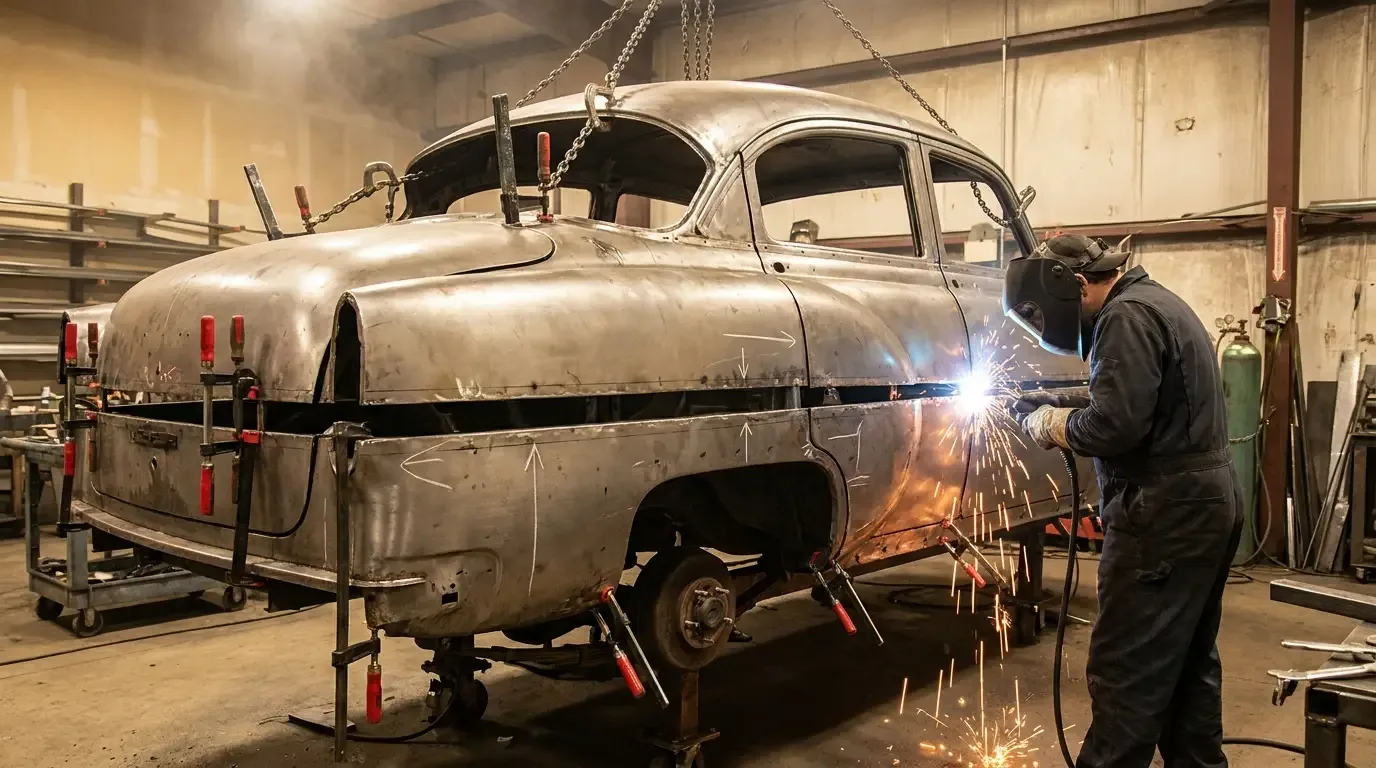
I have watched builders talk themselves out of a section a dozen times. They start measuring, they see how many things the cut runs through, and they go back to chopping the top instead. That instinct is not cowardice. It is math. But a car that has been sectioned properly sits with a lowness that a chop and a channel together cannot fake, because you have taken mass out of the body itself, not just rearranged it around the frame. This piece walks through what the cut actually is, why the panel count makes it brutal, and what you get for the trouble.
What sectioning actually removes
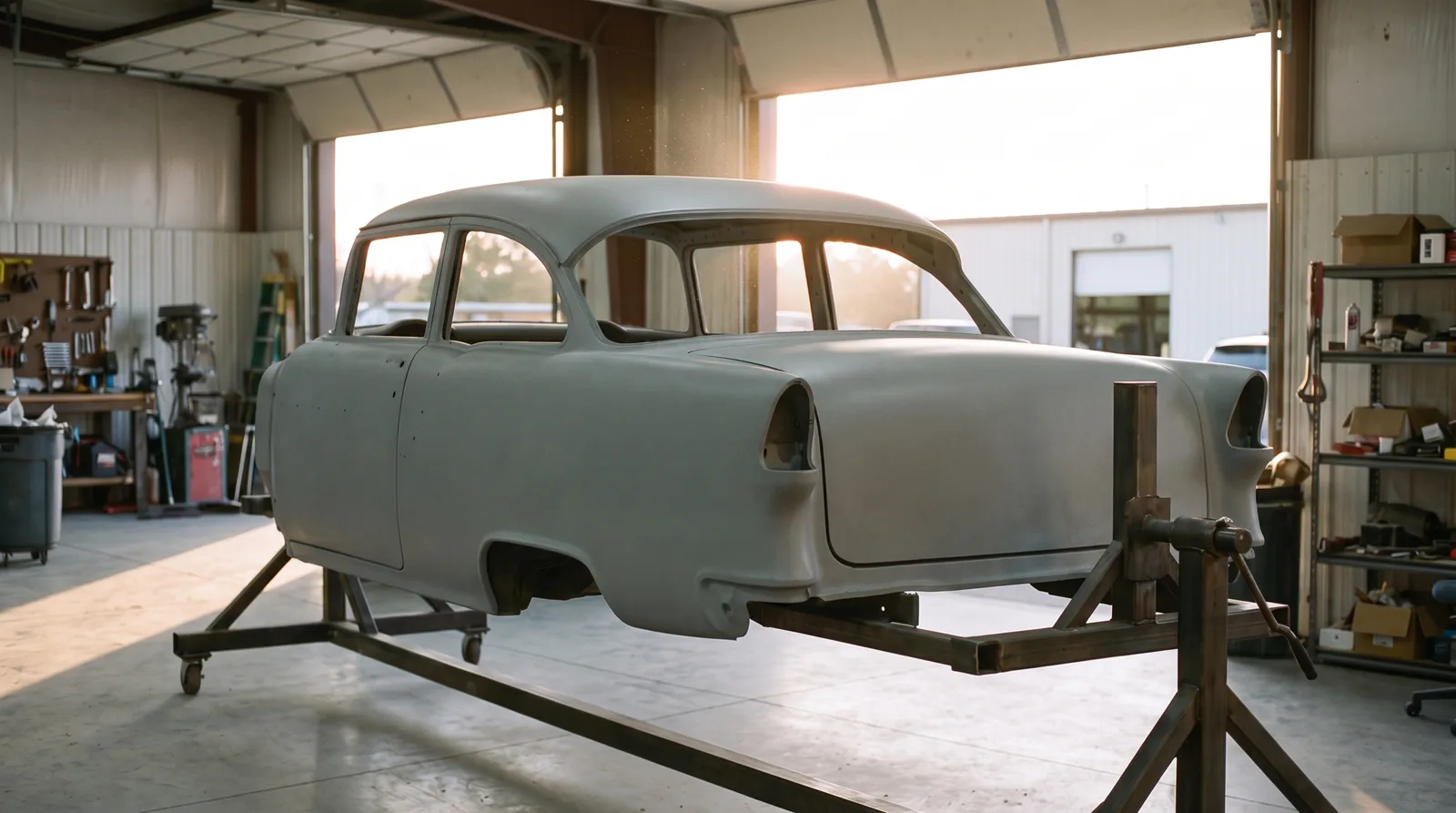
Picture a horizontal band drawn around the entire body, maybe two or three inches tall, running through the doors, the quarters, the cowl, and the hood sides. Sectioning is removing that band and closing the gap. The roofline stays the same shape. The greenhouse stays the same. What shrinks is the distance between the beltline and the rockers, so the body gets shorter top to bottom while the roof and the wheels stay where they were designed to be.
That is the difference from the other two cuts, and it matters. A chop shortens the pillars and lowers the roof toward the beltline. A channel lifts the floor up inside the body so the whole shell drops closer to the ground over the frame rails. Sectioning attacks the middle. On a fat-fendered car from the late thirties or forties, sectioning is what pulls the visual weight out of a body that otherwise looks tall and heavy no matter how low you sit it. That is the reason the classic candidates for a section are the bulbous postwar bodies, not the already-lean early stuff.
Why almost nobody does it
The reason is the panel count. When you cut a horizontal line around a body, that line does not pass through flat sheet metal in a straight run. It passes through doors that have to keep opening and closing, through door gaps that have to stay even top and bottom after you shorten them, through the cowl where the dash and the windshield frame live, and through curved quarters where the section line changes shape as it wraps around the car. Every one of those crossings is its own problem.
Here is the part that scares people off. When you remove a horizontal slice from a body that tapers or curves, the top half no longer matches the bottom half at the cut. A body is wider in some places than others as you go up and down. Take out a band and the upper piece is a slightly different width and shape than the lower piece where they now have to meet. You end up having to add or remove wedges, re-taper panels, and reshape the door skins so the two halves marry cleanly. On a channel you drop the body and deal with the floor. On a section you are re-engineering the profile of the entire car.
- Doors have to be sectioned to match the body, and the latches, hinges, and glass tracks all move.
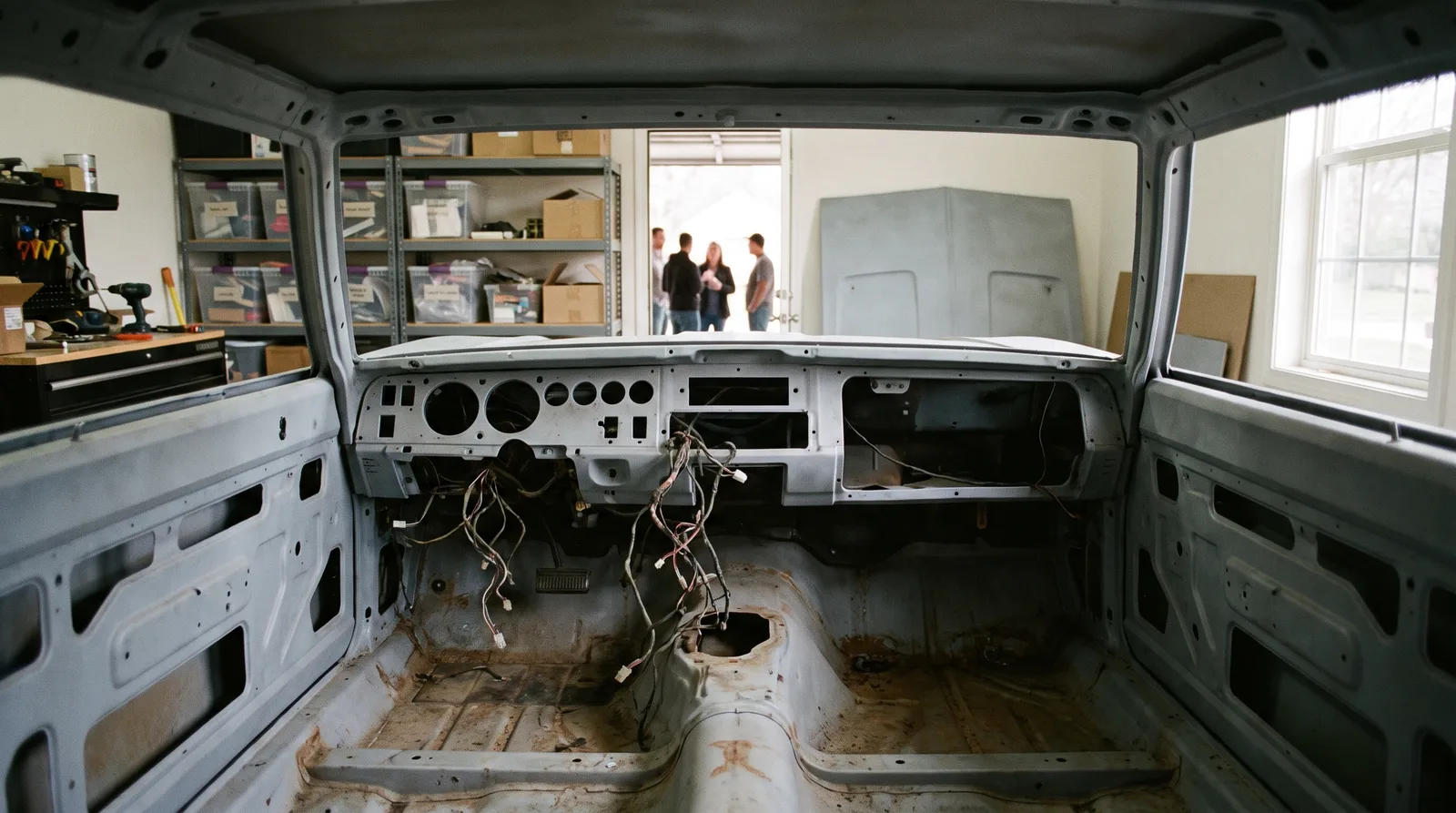
- The cowl cut runs through the firewall and the base of the windshield, so the dash and glass frame shift.
- Curved quarters mean the slice you remove is not a constant width, so the closing gap is not constant either.
- Every body line, every reveal, and every crease has to line back up across the weld or the eye catches it instantly.
That last point is the killer. A chop hides in the roofline where people expect change. A section runs straight through the parts of the car people stare at, the doors and the sides, so any misalignment shows. There is nowhere to hide a mistake.
"First time I sectioned a car I spent more hours on the four door gaps than on the whole rest of the cut. Get those wrong and every guy at the show sees it before he sees anything else. The metal is the easy part. Making four doors still shut like doors after you shortened the body around them, that is the job."
Ray Delgado
How the cut goes together
The order matters as much as the cutting. You do not just draw a line and start a saw. You brace the body first, inside and out, because the second you cut a band out of a unit the whole shell wants to move. Most guys weld in temporary cross braces and outriggers to lock the doors, the roof, and the cowl in place relative to each other before a single panel is separated. Lose that reference and you will never get the gaps back.
From there it is patience. You establish a level datum line all the way around, usually off the frame or a surface plate, so the slice is truly horizontal and the same height everywhere it needs to be. You cut the outer skins, deal with the inner structure separately, and bring the top down onto the bottom in stages, tacking and checking, tacking and checking. The doors usually come last because they have to be fitted to the hole that is left, not the other way around. This is the same family of skills you use elsewhere on a build, the metal shaping and finishing that runs through how to build a hot rod from the first cut to the last coat of primer.
Finishing the seams so they disappear
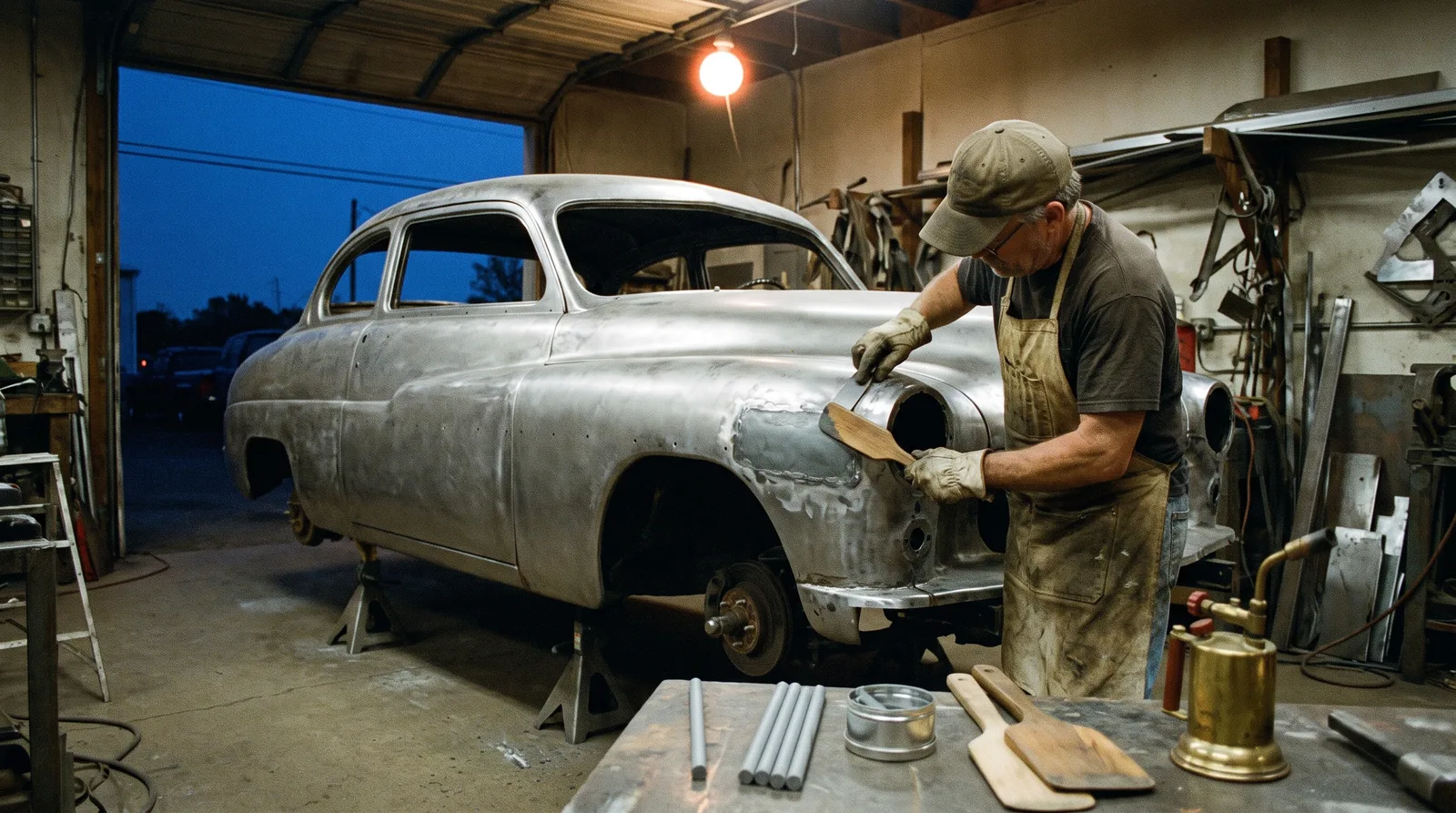
A section is only as good as its finish work, because the whole point is that nobody can tell it happened. That means the weld seams around the body cannot show, and the old way to make them vanish is not plastic filler. It is body solder, worked over the seam and filed flush, the same craft covered in Lead Work: The Lost Art of Metal Finishing. Lead moves with the metal and files down to a hard, permanent surface that will not crack out of a stressed seam the way filler can.
Get the metal true first, then the lead is thin. That is the rule. If you are floating a quarter inch of anything over a section seam to hide a bad joint, it will telegraph or crack sooner or later, and the whole radical body will read as a hack job the day it does. A properly sectioned car has seams you cannot find with your fingers, let alone your eyes.
🔧 Inspection Priorities
- Door gaps top to bottom. Even, consistent gaps mean the section was leveled and the doors refitted right. Tapered or wandering gaps mean corners were cut. Fixing them later is most of the job over again.
- Body-line continuity across the seam. Sight down every reveal and crease. If a line steps or wanders where the slice was closed, the two halves were not married cleanly.
- Seam finish, lead vs filler. A magnet or a careful eye tells you what is under the paint. Thick filler over a structural seam is a future crack and a bargaining point on price.
Why the payoff is worth it
So why do it at all, if it is the hardest cut and almost nobody notices it consciously? Because they notice it unconsciously. A sectioned car has proportions no other technique gives you. The body looks light instead of heavy. It sits low without the tucked, hunched look a deep channel can produce, and it keeps a usable interior and driveline height that a channel sacrifices. Take three inches out of a tall postwar body through the middle and it stops looking like a lowered stock car and starts looking like it was designed that way from the factory in some better world.
That is the reward. Not applause for a trick, but a car that looks right in a way people cannot quite name. It is the mark of a builder who took the long road when the short road was sitting right there. Few will ever attempt it, fewer will finish one that reads clean, and that rarity is exactly the point.
Sources and notes
- Period hot-rod and kustom press coverage of radical body modification techniques.
- Kustom kulture build histories and shop records documenting chopping, channeling, and sectioning practice.
- Metal-finishing and bodywork references on leading, welding, and panel alignment.
- Builder interviews and shop-floor practice on bracing, datum setup, and door fitment.
Related Reading
Have a
Classic Car
for Sale?
Reach thousands of serious classic car collectors across the US.
Sell It Here →
Are You a Classic Car Dealer?
List your full inventory and connect with targeted classic car buyers.
Join as a Dealer →

About the author
Ray Delgado
Metal fabricator and chassis builder who has spent 25 years turning flat sheet and mild steel into hot rods, gassers and restomod underpinnings.
More in Restoration & Tech
Comments
Be the first to comment on this article.