
Walk into a real kustom shop and you can smell the work before you see it. There is the sharp bite of flux, a faint metallic haze, and a bench covered in wooden paddles stained dark from years of use. Somewhere on a fender there is a low spot getting filled, not with a can of plastic body filler, but with molten lead wiped on by hand and worked smooth. This is lead work, and it is the reason the old customs got the name that stuck to them for good.
Restoration & Tech
9 min read
Lead Work: The Lost Art of Metal Finishing
Body solder versus modern filler, why the leadsleds got their name, the technique, the health risks, and why traditional builders still fill seams with lead.
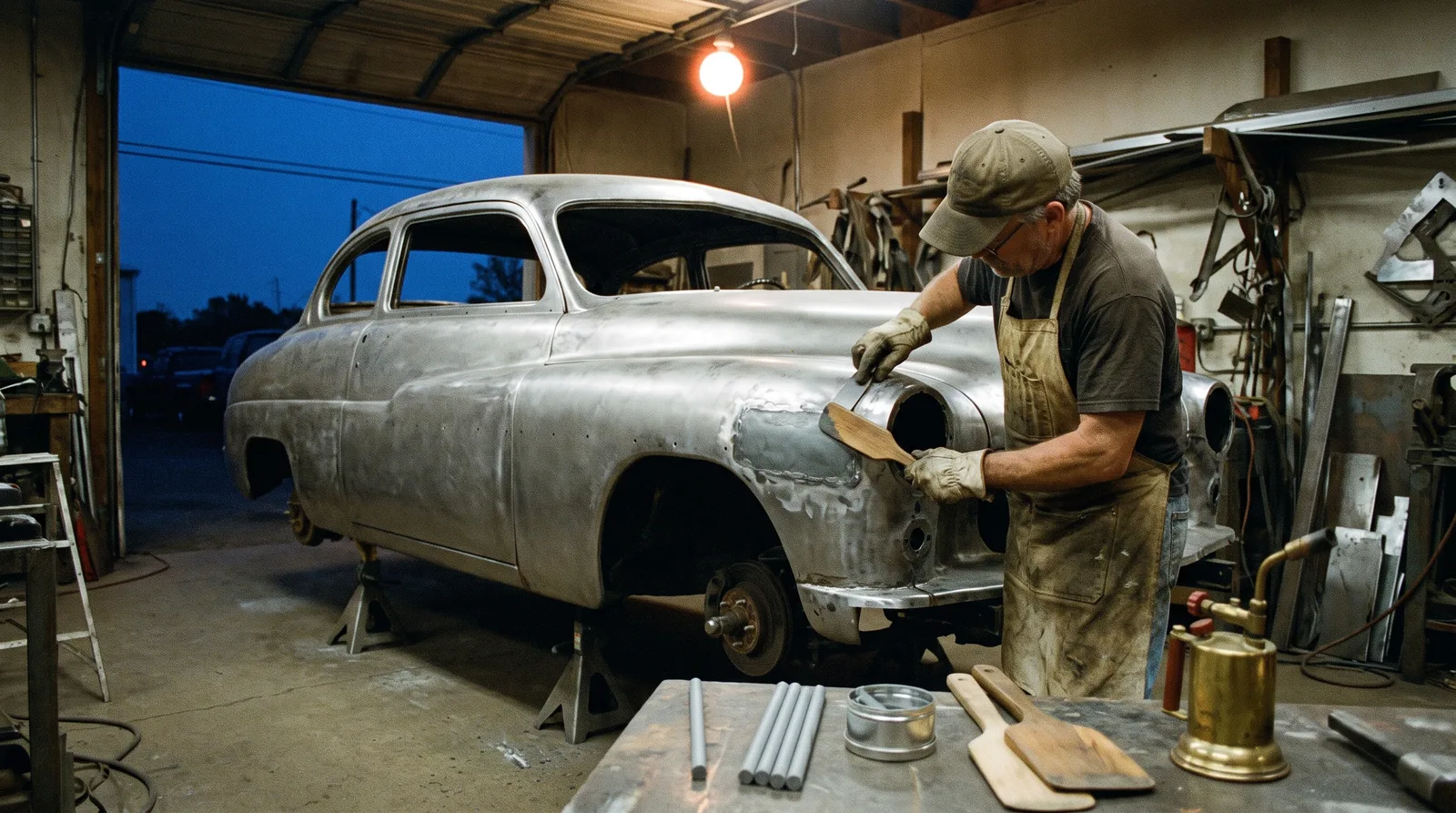
Most people building a car today reach for filler and never think twice. That is fine for a lot of jobs. But there is a reason the traditionalists still keep a can of body solder on the shelf, and it goes deeper than nostalgia. Lead work is body solder, a tin-lead alloy melted onto clean steel and shaped to bridge a seam or fill a dent. Done right it becomes part of the panel. Done wrong it slumps off onto the floor and you start over. If you want to understand where this fits in the bigger picture, it sits alongside every other metal skill in how to build a hot rod, but it is the one craft most builders quietly gave up.
Why they called them leadsleds
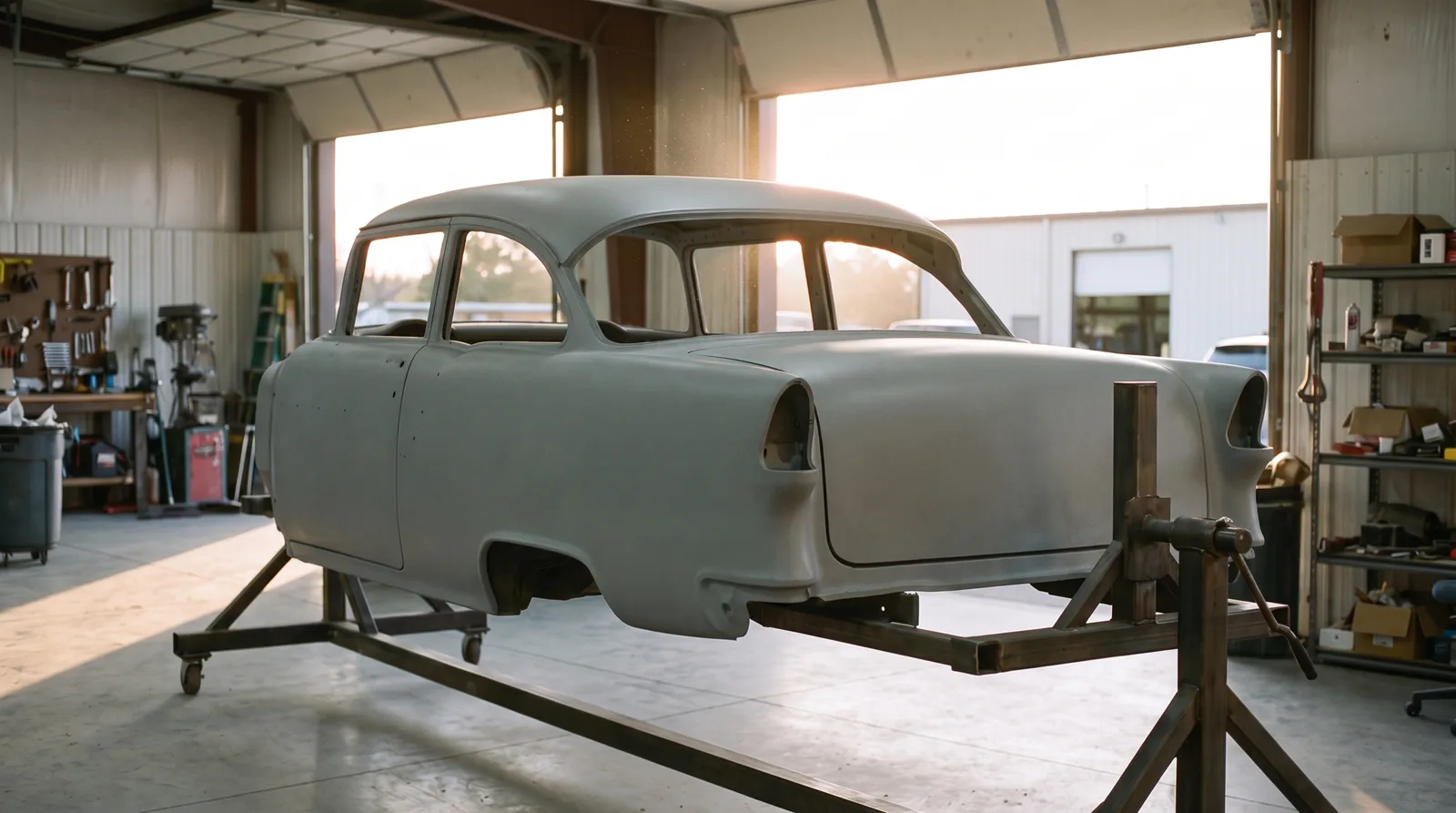
The term leadsled started as an insult and turned into a badge of honor. Back in the early 1950s, when guys were chopping tops, filling headlight buckets, and molding seams on Mercs and Chevys, the only way to get that smooth, flowing surface was lead. A heavily customized car could carry a serious amount of body solder in its roof pillars, door seams, and quarter panels. Rival crowds, especially the lighter, faster hot rod guys running the dry lakes, looked at those heavy, sled-slow customs and called them leadsleds. Too much weight, too much filler, not enough go.
The name stuck because it was partly true. A full custom Merc with a chopped top, filled seams, and molded fenders could carry a meaningful amount of lead by the time the bodywork was done. That is real weight sitting up high on the body. It made a car heavier and it did not make it faster. But to the men building those cars, the weight was the point. It meant the panels were one continuous surface with no visible joins, no trim breaking up the line, just paint over metal. The insult became the name of an entire style, and the smoothest customs still wear it proudly.
How lead work is actually done
The process looks simple and is anything but. Everything starts with clean, bright metal. Lead will not stick to rust, paint, or oil, so you grind the area down to shine. Then you tin the surface, which means coating it with a thin layer of solder and flux so the body solder has something to grab. Miss this step and the lead peels off in sheets.
Once the panel is tinned, you heat the area with a torch, hold a bar of body solder against it, and let it soften into a thick paste. Here is where the skill lives. You cannot melt it fully or it runs straight off a vertical panel and pools on the floor. You keep it in that plastic state, then work it with a hardwood paddle dipped in tallow or beeswax so it does not stick. You push and wipe the lead across the seam, building it up slightly proud of the surface. When it cools you file it down with a body file, called a vixen file, until it blends flush with the steel. Then you finish with progressively finer abrasives before primer.
- Clean: grind to bright bare metal, no rust or paint.
- Tin: lay down a thin bonding layer of solder and flux.
- Heat and apply: soften the lead bar to a paste, not a liquid.
- Paddle: wipe and shape with a waxed hardwood paddle.
- File and finish: knock it flush with a vixen file, then refine.
The torch control is the hard part. Too little heat and the lead will not flow onto the panel. Too much and you either burn through thin sheet metal or watch your fill slide off. Reading the color of the metal and the sag of the solder is a feel you only get from doing it, ruining a few panels, and doing it again.
Lead versus modern body filler
Plastic filler, the stuff everyone calls Bondo after the brand, showed up in the 1950s and changed bodywork overnight. It is cheap, it needs no torch, it sands easily, and anyone can learn the basics in an afternoon. That is exactly why it took over. For the average repair it is the right tool.
So why does anyone still fight with lead? Because the two materials behave differently over time. Lead expands and contracts with the steel it is bonded to, since it is metal wiped onto metal. Plastic filler expands at a different rate than steel, and over decades of heat cycling and flex it can crack, lift, or let moisture in behind it. On a car that will sit in the sun and get driven for forty years, a properly leaded seam tends to stay put. Lead also handles a small amount of flex around a door seam or a molded corner better than a thick pad of filler will.
| Factor | Body lead | Plastic filler |
|---|---|---|
| Bond to steel | Metallurgical, moves with the panel | Adhesive, different expansion rate |
| Longevity | Decades if sealed properly | Good, but can crack or lift over time |
| Skill needed | High, torch and paddle control | Low, mix and spread |
| Tools | Torch, paddles, flux, vixen file | Spreader, sandpaper |
| Health risk | Lead dust and fumes, real hazard | Sanding dust and resin fumes |
| Weight | Heavy, added up over a full custom | Light |
The honest answer is that filler is better for most jobs and lead is better for a few specific ones. A traditionalist chopping a top and molding the seams wants lead in those joints for both authenticity and durability. Someone filling a parking-lot ding does not need to fire up a torch. The trouble comes when people treat one as always right. Both have a place, and a good builder knows which the panel in front of him calls for. The same judgment shows up in structural cuts like Suicide Front Ends and Z-ing the Frame, where the traditional method and the shortcut give very different results.
The health and skill considerations
Lead is toxic, and there is no way around that. The fumes when you heat it and the dust when you file it are both hazards, and lead accumulates in the body over time. Anyone doing this work needs proper ventilation, a respirator rated for the job, gloves, and disciplined cleanup so dust does not spread around the shop or ride home on their clothes. This is a real reason the craft faded. Shops moved away from it partly on cost and speed, and partly because the health exposure was hard to justify when a plastic alternative existed. Nobody should pick up a lead paddle casually.
Then there is the skill barrier. Lead work takes practice that most people never put in. You will ruin panels learning to read the heat. You will watch fills sag and peel. The muscle memory of holding a torch in one hand and a paddle in the other, keeping the solder in that narrow plastic window, comes only with repetition. A weekend builder can learn to spread filler competently in a day. Learning to lead a chopped roofline to a clean, durable finish takes far longer, and there are fewer old hands left to teach it.
"First time I leaded a seam, I put half the bar on the floor and burned through the panel doing it. The old guy watching just laughed and told me to grind it out and go again. That is how you learn this. Nobody gets it from a video."
Jim Vasquez
Why traditionalists still do it
So why keep a dying craft alive when filler is easier, safer, and lighter? Part of it is durability, and that argument is real. But most of it is about doing the car right, the way it was done when the style was born. A traditional builder molding the seams on a chopped custom wants the same material and the same method the original leadsled builders used. It is the difference between a car that looks the part and one that is the part, all the way down to what is under the paint.
There is also pride in the difficulty. Anyone can spread filler. Not everyone can lead a panel. When a builder wipes a clean fill into a door seam and files it flush without a bubble or a lift, that is a skill earned over years, and it shows in the finished surface in a way that is hard to fake. For the people who care about the roots of the craft, lead work connects a modern build back to the whole tradition, which is the thread running through the classic hot rod story from the dry lakes to the show floor.
Lead work will probably never come back as everyday practice. It is too slow, too hazardous, and too hard for that. But it is not going to disappear either, because there will always be a handful of builders who refuse to let it. As long as someone is chopping a top and wants the seams done the old way, the smell of flux and the sound of a paddle on hot metal will still be part of it.
Sources and notes
- Period hot-rod and custom-car press covering 1950s bodywork and the leadsled era.
- Traditional metal-finishing and body-solder technique references.
- Builder interviews and shop practice from working kustom shops.
- General occupational-health guidance on lead handling and exposure.
Related Reading
Have a
Classic Car
for Sale?
Reach thousands of serious classic car collectors across the US.
Sell It Here →
Are You a Classic Car Dealer?
List your full inventory and connect with targeted classic car buyers.
Join as a Dealer →

About the author
Jim Vasquez
Southern California hot rod and custom car builder with roots in the traditional kustom kulture scene.
More in Restoration & Tech
Comments
Be the first to comment on this article.