
A stock 10-bolt or 12-bolt rear end will hold up to a lot of ordinary driving, right up until you put real torque through it, and then the ring gear starts howling or the carrier breaks and you're on the side of the road figuring out what just happened. That's the number that matters with a Ford 9-inch swap: it isn't about whether the stock rear is bad, it's about whether it matches the torque you're actually running behind it. A stock small-block making stock power never stresses the factory rear end. The kind of build laid out in the engine and performance guide changes that math completely, and the rear end is usually the last thing anybody upgrades even though it's the first thing to fail.
Restoration & Tech
7 min read
Swapping a 9-Inch Rear End into a C10
Why a swapped engine's torque outgrows the stock 10-bolt or 12-bolt, and what it takes to get a Ford 9-inch's width, pinion angle, and gearing right in a C10.
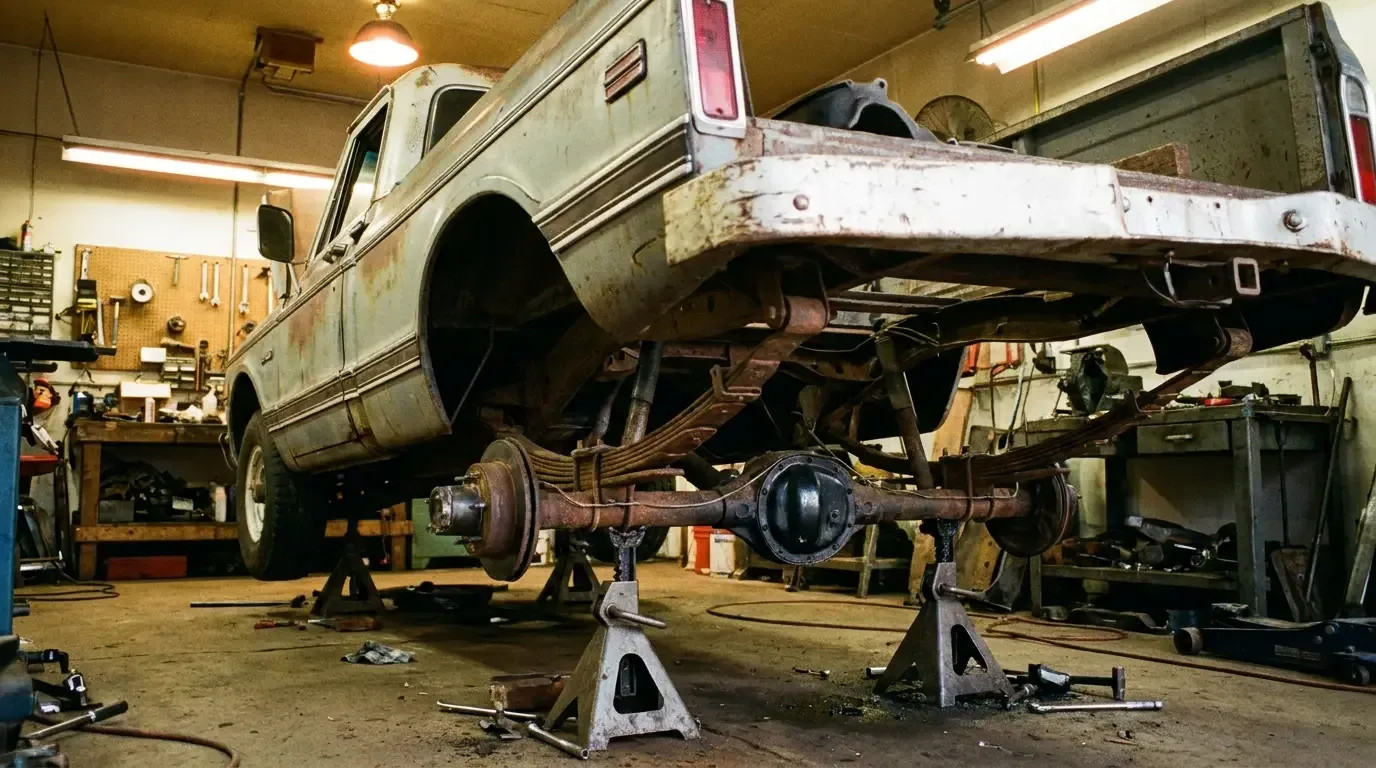
Why the stock rear end gives up under more torque
The factory 10-bolt and even the stouter 12-bolt options were engineered around the torque figures of the engines GM actually put in these trucks from the factory, not around a swapped-in engine putting down two or three times that number at the wheels. The carrier bearings, the ring and pinion, and the axle shafts all have a fatigue limit, and once torque exceeds it, failure isn't a gradual thing you can catch early. It's a broken tooth on the ring gear or a snapped axle shaft, usually under hard acceleration, which is the worst possible moment for a drivetrain failure.
A 9-inch's advantage isn't mystique, it's the pinion support design. The factory 10-bolt and 12-bolt hang the pinion gear on two bearings inside the housing. The 9-inch supports the pinion with a removable third-member carrier that mounts on its own bearings independent of the housing, which spreads load more evenly and makes the whole assembly more tolerant of torque spikes from hard launches or a heavy right foot.
What a 9-inch actually brings to the table
Beyond the pinion support, the real-world benefit is parts availability and aftermarket support. Because the Ford 9-inch was used across so many platforms for so many decades, gear sets, third members, and axle shafts in nearly any ratio or spline count are in stock at multiple suppliers, not special-order items. That matters more than it sounds like it should when you're trying to finish a build on a schedule, because waiting six weeks on a backordered ring and pinion set kills momentum on a project faster than almost anything else.
| Rear end | Pinion support | Typical torque ceiling | Parts availability |
|---|---|---|---|
| Factory 10-bolt | Two-bearing, housing-mounted | Lower, matched to stock small-block output | Common but limited on heavy-duty parts |
| Factory 12-bolt | Two-bearing, housing-mounted | Moderate -- a roughly 13% larger pinion than the 10-bolt (1.625 in./30-spline vs. 1.438 in./25-spline) generally holds up well under 700 hp | Good, but heavy-duty gear sets cost more |
| Ford 9-inch | Removable third member, independently supported | High -- commonly the go-to choice once a build pushes past the 12-bolt's comfortable range | Excellent, broadest aftermarket support |
Spring perches, pinion angle, and width numbers that matter
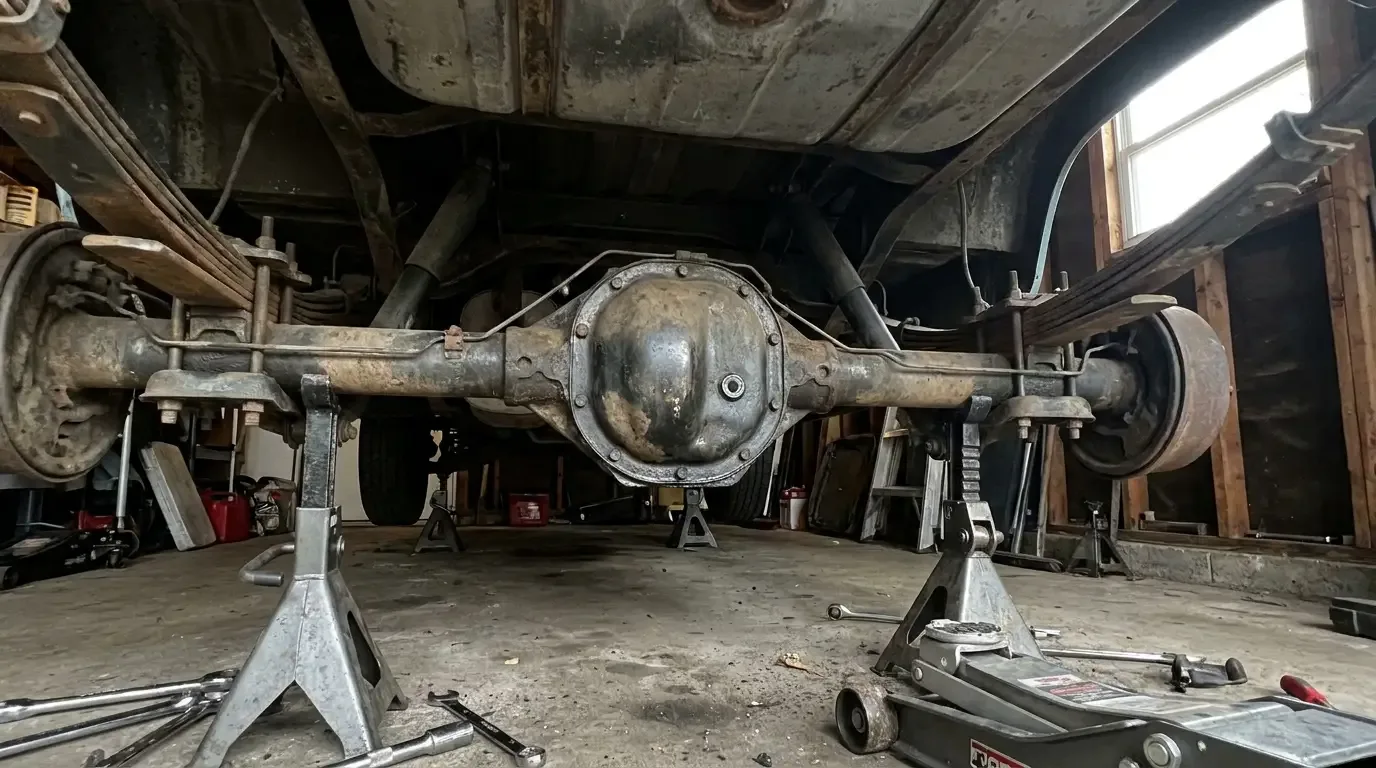
Bolting a 9-inch into a C10 that wasn't built with one means relocating spring perches to match the factory leaf spring width and position, and getting that measurement wrong shows up immediately as a rear end that sits crooked or tracks off center. Measure from the factory housing's perch location before cutting anything off the donor housing, and weld the new perches on with the axle loaded to ride height, not sitting unloaded on a stand, because spring position shifts under load in ways that matter for a clean weld.
Pinion angle is the number that gets skipped and causes the most driveline vibration complaints afterward. The 9-inch's pinion angle needs to match the transmission's output shaft angle within a couple of degrees, and that's a measurement you take with an angle finder on the actual truck, not a number you copy from someone else's build thread. A rear end welded in with the wrong pinion angle vibrates under load even with a perfectly balanced driveshaft, and guys chase that vibration through balancing and rebalancing the driveshaft for months before somebody checks the angle itself.
Housing width matters just as much. A 9-inch pulled from a donor car is very often narrower or wider than the C10's stock track width, and running the wrong width changes handling and can rub tires against the wheel wells at full compression. Measure the stock housing flange-to-flange width and match a 9-inch housing built to that same width, or budget for a housing shortened or narrowed to spec by a driveline shop.
Gearing it for the engine you actually have
Gear ratio is where guys either chase a number they read on a forum or actually think through what the engine and transmission combination needs. A stock-height, mild-cammed small-block with an overdrive transmission wants a different ratio than a stroker with a low-stall converter and no overdrive. Get the ratio wrong in either direction and you either give up highway cruising RPM to a rear end that's too steep, or give up the launch and midrange pull to one that's too tall. Match the ratio to the actual transmission's gearing and the tire diameter you're running, not to a number that worked for somebody else's completely different combination.
What it costs and what it's worth
A quality 9-inch swap, done right with correct perch relocation, matched pinion angle, and a gear ratio picked for the actual drivetrain, is not a cheap Saturday afternoon job. Between the housing, third member, axle shafts, and the shop time to weld and align everything correctly, it's a real line item in the build budget. It's also the item that stops being optional the moment the engine swap pushes torque numbers past what the factory rear end was ever built to survive. Spend the money here before the stock rear end spends it for you on the side of the road.
"Nobody upgrades the rear end until it breaks, and by then you're replacing a broken part on the side of the road instead of installing a good one on your own schedule. Do the math on torque before the rear end does it for you."
Dan Reeves
Match the housing width, get the pinion angle right, and pick a ratio for the drivetrain you actually built, not the one you read about online. Get those three things right and the 9-inch outlasts every other part of the swap it's backing up.
Sources and notes
- Currie Enterprises: Ford 9-Inch vs GM 12-Bolt
- DrivingLine: The History of the Ford 9-Inch Rear End
- Speedway Motors: Ford 9-Inch Housing Identification and Axle Measurement
- Mac's Motor City Garage: Secrets of the Ford 9-Inch Rear Axle
- JEGS: Ford 9-Inch Rear End & Axle Guide
- Strange Engineering: Ford 9-Inch Torque Specs
Related Reading
Have a
Chevrolet C10
for Sale?
Reach thousands of serious classic car collectors across the US.
Sell It Here →
Are You a Classic Car Dealer?
List your full inventory and connect with targeted classic car buyers.
Join as a Dealer →

About the author
Dan Reeves
Performance engine builder from North Carolina's motorsports corridor, focused on swaps, forced induction and making real, repeatable power.
Related Listings - Chevrolet C10
More in Restoration & Tech

Comments (1)
B
Bill Cassidy
3 months ago
Condition grade IV cars are where most real buyers actually operate. Nice to read something that takes that seriously.