
The flathead built hot rodding. The early Hemi is what killed it at the top. When Chrysler dropped the FirePower V8 into its 1951 cars, the flathead crowd suddenly had a problem they could not out-cam or out-carb their way around. The head was the whole story. A hemispherical combustion chamber breathes in a way a flathead never could, and once the drag racers figured that out, the old side-valve Ford was done as the engine to beat.
Restoration & Tech
7 min read
The Early Hemi: Hot Rodding's First Modern V8
The early Chrysler Hemi's hemispherical heads outbreathed the flathead and built the first fuel dragsters. Here is why hot rodders chased it.
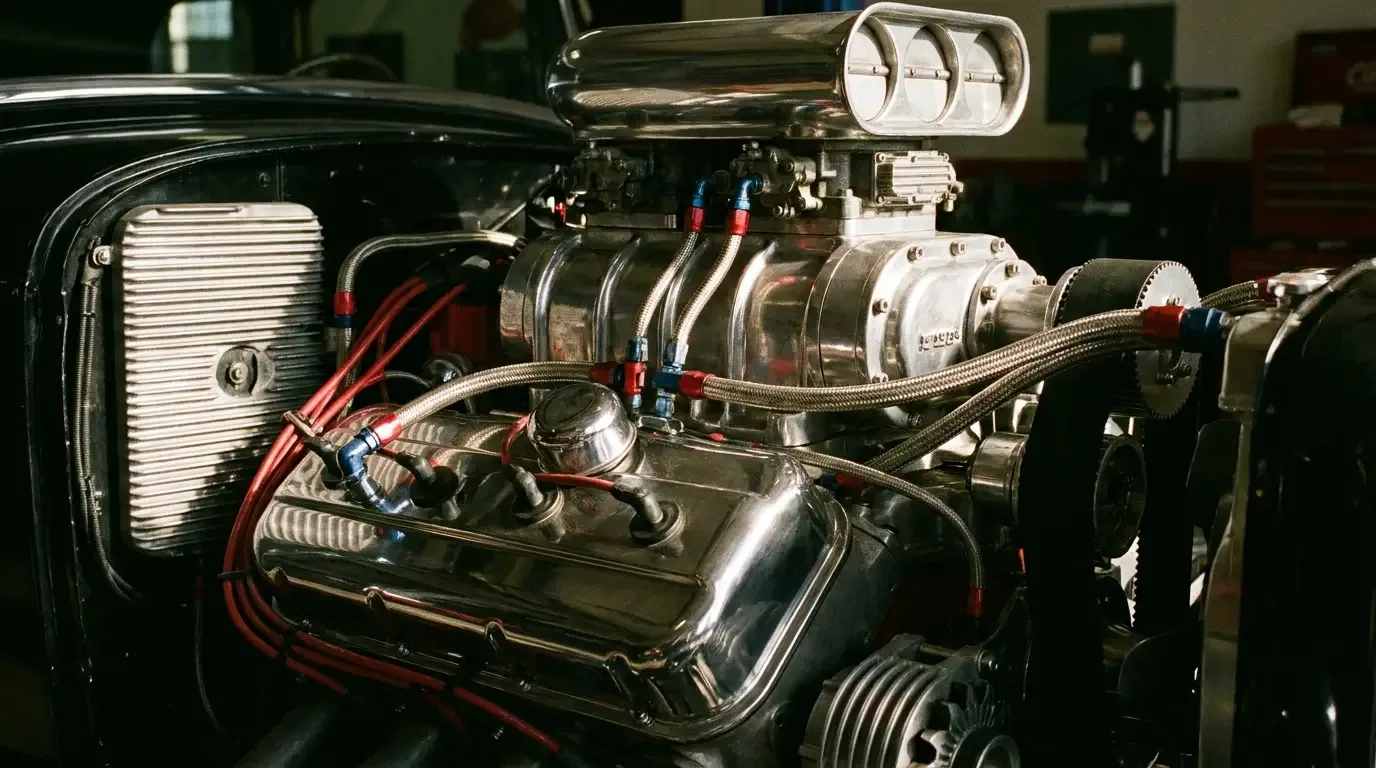
This is the engine that connects the postwar flathead v8 era to the overhead-valve world that followed. It was heavy, expensive, and a pain to work on. Rodders put up with all of it because nothing else made that kind of power per cubic inch in the mid-1950s.
Why the hemispherical head changed everything
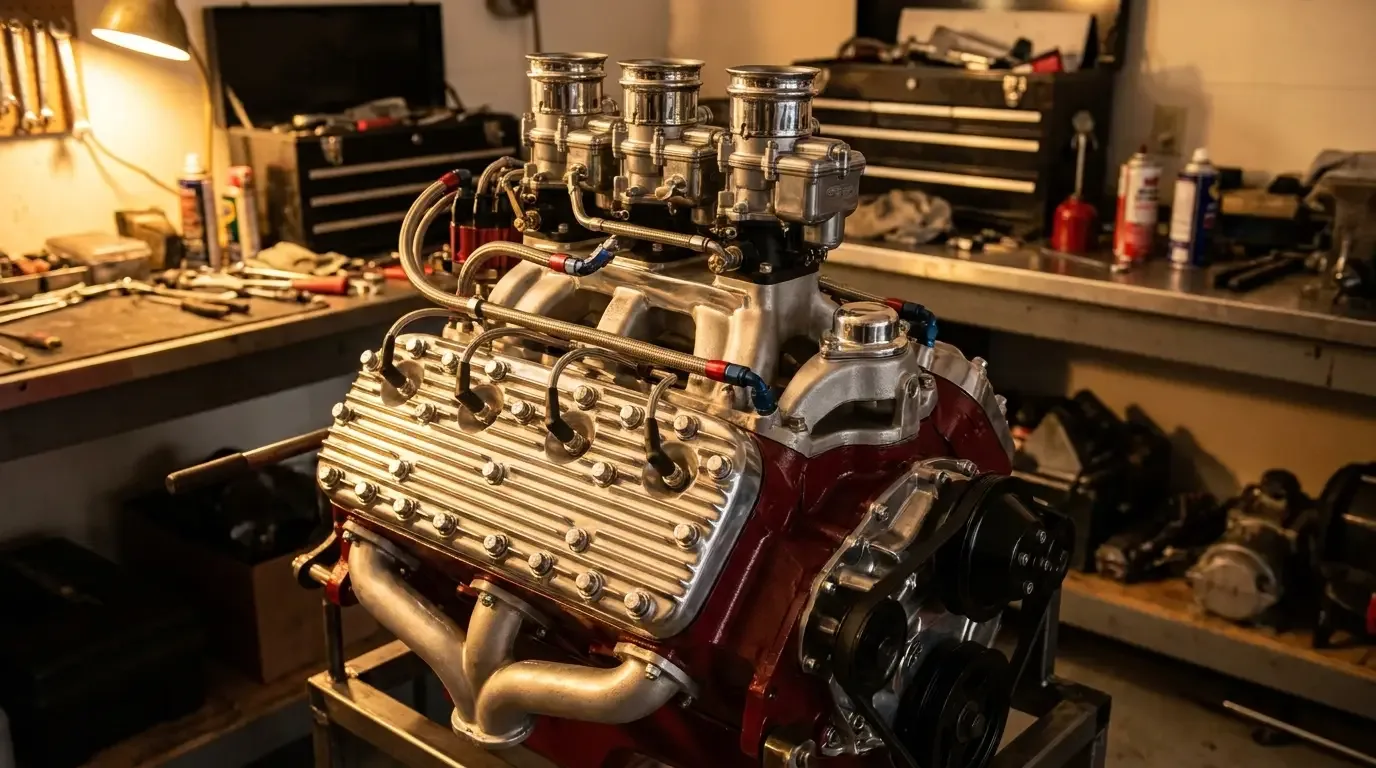
Look at a flathead and the valves sit in the block, beside the cylinder. The intake charge has to make a U-turn to get in and another to get out. That path costs you. It traps heat, it limits how much air you can move, and it caps compression because the combustion space is an awkward shape.
The FirePower flipped that. Valves went overhead, angled apart in a dome-shaped chamber. Two things fall out of that geometry. First, you can run big valves without them shrouding each other, because they sit on opposite sides of the dome. Second, the spark plug goes dead center, so the flame front reaches the whole charge fast and even. That means you can run more compression before the mixture knocks.
The valvetrain to make that work is the catch. Because the valves splay in two planes, you need two rocker shafts per head and long, crossing pushrods. More parts, more weight, more machining. Chrysler built it anyway because the breathing was worth it.
- Big valve area. The dome lets intake and exhaust valves grow without crowding.
- Central plug. Even flame travel, less tendency to detonate, room for more compression.
- Efficient chamber. Low surface-area-to-volume ratio keeps heat in the charge, not the head.
- The cost. Dual rocker shafts, splayed valves, heavy castings. Nothing about it is cheap or light.
What Chrysler actually built, 1951 to 1958
People say "early Hemi" like it was one engine. It was three related families across Chrysler's divisions, and they do not share parts freely. Knowing which one you have matters before you buy a single gasket.
The Chrysler version, the FirePower, was the big one. It launched in 1951 at 331 cubic inches. Chrysler grew it over the run, to 354 and then 392 cubic inches by the mid-to-late 1950s. The 392 is the one the racers wanted, and it is still the one people chase today. DeSoto had its own Hemi, the FireDome, and Dodge had the Red Ram, both smaller and built on their own blocks. A Dodge Hemi head does not bolt to a Chrysler block.
| Attribute | Early Chrysler Hemi (FirePower) |
|---|---|
| Years built | 1951 to 1958 |
| Configuration | OHV V8, hemispherical chambers, dual rocker shafts |
| Displacements | 331, 354, 392 cu in (Chrysler division) |
| Introductory output | Around 180 hp in 1951 331 |
| Top factory output | 375 hp, dual-quad 392 in top 1957-58 trim |
| Sister engines | DeSoto FireDome, Dodge Red Ram (separate blocks) |
The block itself is stout. Chrysler over-built the bottom end for a passenger-car engine, which is exactly why it took to boost and nitro without grenading. That reserve strength is half the reason racers loved it.
Why hot rodders and drag racers chased it
Power per cubic inch. That was the pitch. In the early 1950s a stock FirePower already made more than a hot flathead, and the head was nowhere near its limit. Speed shops started building intakes, cams, and adapters almost immediately.
The dragstrip proved it out. Through the mid and late 1950s, the fast dragsters and the early Top Fuel cars ran early Hemis because the head fed enough air to swallow a blower and a load of nitromethane. You could pour fuel and boost into it, and the chamber and the bottom end would take it. A flathead would not, not for long.
Builders adapted the Hemi into Fords and other light bodies with motor-mount and bellhousing adapters. That is a swap with real weight and cost penalties, so nobody did it for looks alone in period. They did it because it won.
"The flathead was a great engine right up until you put it next to a blown 392. Then it was a boat anchor with a nice exhaust note. The Hemi didn't care what you threw at it. Fuel, boost, more compression, it just made more."
Dan Reeves
The blown Hemi look and its dragster legacy
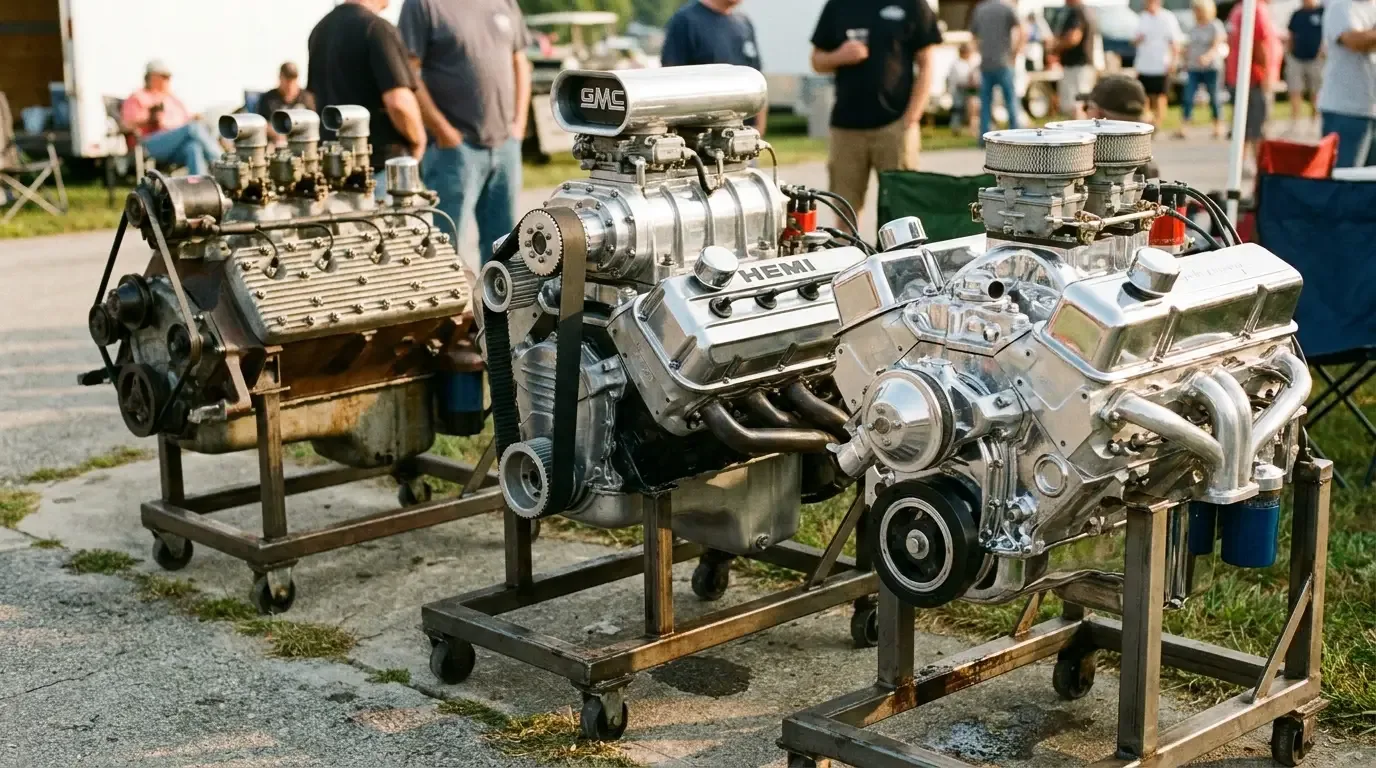
The visual everyone knows came out of the strip. A big supercharger sitting on top of an early Hemi, a hat with velocity stacks or a scoop, and headers coming straight off those wide heads. That silhouette is drag racing in the 1950s and early 1960s, and it is why the blown Hemi still reads as "fast" from across a show field.
The width is real, not styling. The dual rocker shafts push the valve covers far apart, so a Hemi is a wide engine that fills an engine bay corner to corner. Those tall, distinctive valve covers are how you spot one at a glance. On a gasser or an altered, the whole point was to show the engine, blower stacking up out of the hood.
🔧 Inspection Priorities
- Confirm the family first. Chrysler, DeSoto, and Dodge Hemis look similar but do not interchange. Check casting numbers before you spend a dime on parts.
- Cracks between the seats. These heads are old and the hemispherical seats sit close. Have them checked for cracks and worn guides. Head work is where the money goes.
- Valvetrain wear. Two rocker shafts, long pushrods, lots of geometry to go wrong. Look for wiped lobes and worn rockers before you trust the top end.
- Parts reality. Speed parts exist but cost more than small-block equivalents. Price the intake, headers, and adapters before committing to a build.
Living with an early Hemi today
Be honest about what it is. This is a heavy, wide, expensive engine that needs a machinist who knows the family. It does not make sense as a cheap horsepower path. Compared with the The Small-Block Chevy Swap, the Hemi loses on weight, cost, and parts availability every time.
What it wins on is character and history. A running early Hemi in a traditional rod is the real thing, the engine that beat the flathead and built the first fuel dragsters. If that story matters to you, and it does to a lot of builders, the penalties are the price of admission.
Sources and notes
- Period hot-rod and drag-racing press covering early Chrysler, DeSoto, and Dodge Hemi engines.
- Chrysler FirePower engine references and factory specification summaries (displacement and output figures marked for verification).
- Drag-racing historical records on early Top Fuel and gasser Hemi applications.
- Builder and speed-shop interviews on Hemi swaps, valvetrain service, and supercharging.
Related Reading
Have a
Classic Car
for Sale?
Reach thousands of serious classic car collectors across the US.
Sell It Here →
Are You a Classic Car Dealer?
List your full inventory and connect with targeted classic car buyers.
Join as a Dealer →
#hemi engine
#hot rod engines
#early hemi
#chrysler firepower
#drag racing history
#supercharged hemi

About the author
Dan Reeves
Performance engine builder from North Carolina's motorsports corridor, focused on swaps, forced induction and making real, repeatable power.
More in Restoration & Tech
Comments
Be the first to comment on this article.