
Every hot rodder eventually meets the small-block Chevy. You pop the hood on a Deuce coupe, a Model A, a shoebox Ford, and there it sits: a compact iron V8 that was never supposed to live in that car. It got there because it works. Cheap, light, and easy to make power, the small-block did more to change how rods got built than any other engine. When Chevrolet released it for the 1955 model year, nobody at the factory was thinking about a chopped '32 Ford. The hot rodders figured that out on their own, fast.
Restoration & Tech
7 min read
The Small-Block Chevy Swap
The 1955 small-block Chevy reset hot rodding: cheap, light, and easy to power. Here is why it beat the flathead and how the swap goes down.
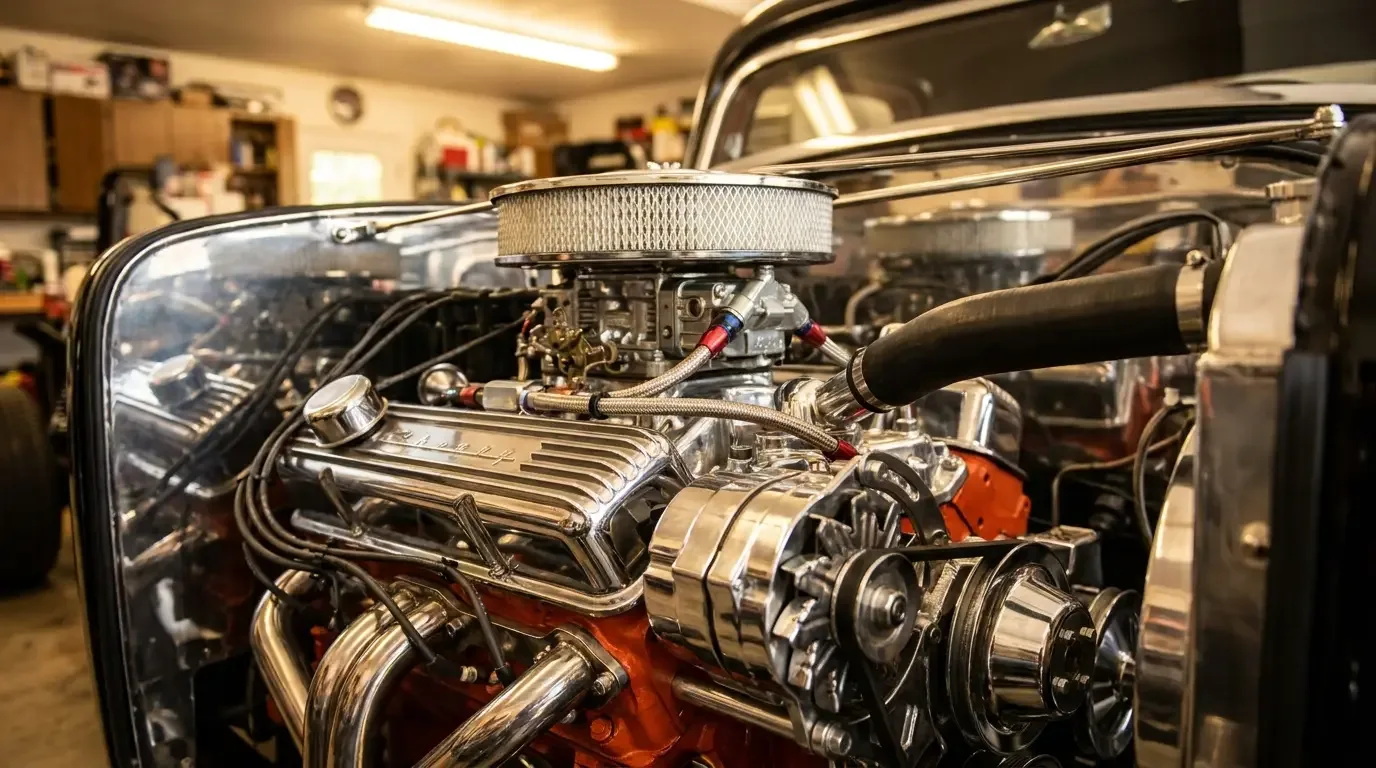
This is the swap that reset the rulebook. Before it, a rod ran a Ford flathead and you lived with what the flathead gave you. After it, you ran a Chevy and lived with almost nothing holding you back. Here is why it happened and how it went down under the car.
Why the flathead had to go
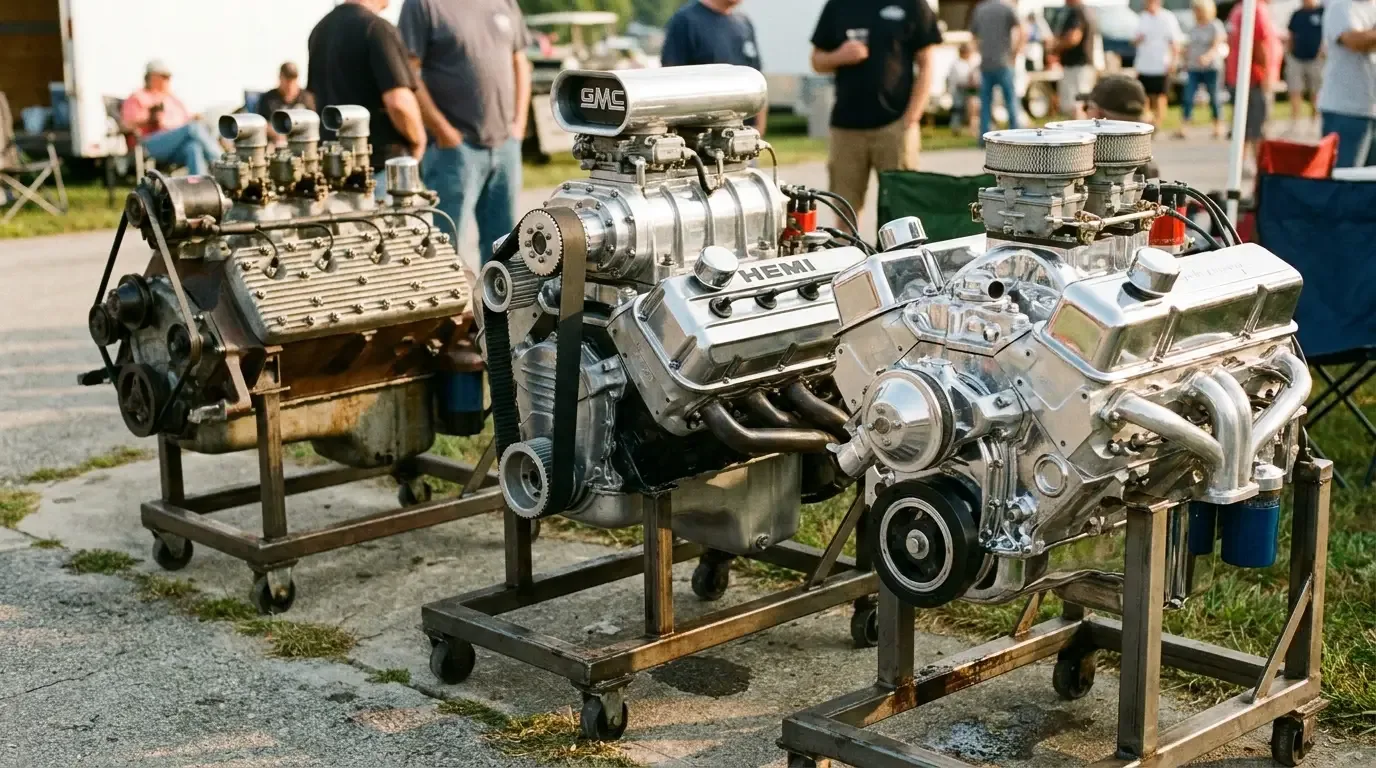
The flathead v8 built the hobby. It put a V8 in a working man's car in 1932 and stayed the hot rod standard for two decades. But by the mid-1950s its limits were plain to anyone turning wrenches. The flathead's exhaust ports run through the block, so heat dumps straight into the cooling passages. Push one hard and it runs hot, always. The valves sit in the block beside the cylinders, which chokes airflow and caps how much a stock-style flathead will breathe no matter what you bolt on top.
You could build a flathead to make real power. Guys did, with Ardun overhead conversions, multiple carbs, and stroker cranks. But that money and labor bought you maybe 150 to 200 horsepower out of a hot street motor, and it still ran hot and still fought you on airflow. The small-block walked in and gave you a similar number close to stock, with room above it, and it stayed cool doing it.
What made the small-block right
The engineering is the whole story. The small-block is an overhead-valve V8 with a valvetrain that flows. Intake and exhaust valves sit in the head, ports run where the designers wanted them, and the exhaust exits the head instead of cooking the block. It breathes. Bolt on a better cam and a bigger carb and it answers.
It is also small and light. The 265 that launched in 1955 and the 283 that followed are physically compact and, for an iron V8, they do not weigh much, roughly 550 to 575 pounds dressed. Drop one into a light prewar Ford and the front end does not sag the way a heavy motor makes it sag. The weight sits where you want it.
Then there is the valvetrain trick that made it cheap to build. The small-block uses individual stud-mounted rocker arms riding on a ball, instead of a shaft that all the rockers share. Fewer parts, less machining, and a self-adjusting setup once you set lash. It kept the engine cheap to manufacture and cheap to rebuild, which is exactly what a rodder on a budget needs.
| Engine | Layout | Displacement | Era in rods |
|---|---|---|---|
| Ford flathead V8 | Side-valve (L-head) | 221 / 239 cu in | 1930s to mid-1950s |
| Chevy 265 | OHV V8 | 265 cu in | 1955 on |
| Chevy 283 | OHV V8 | 283 cu in | 1957 on |
| Chevy 327 / 350 | OHV V8 | 327 / 350 cu in | 1960s on |
The SBC-in-everything era
Once the word got around, the small-block went into everything. Fords, Willys, Studebakers, English sports cars, anything with a hole big enough. The 283 got the reputation first, especially the fuel-injected version that Chevrolet advertised at one horsepower per cubic inch. Most rodders never ran the injection. They ran a four-barrel or stacked carbs and got most of the way there for a fraction of the cost.
The aftermarket did the rest. Because there were so many of these engines out there, every speed shop stocked parts for them. Intakes, headers, cams, cranks, cylinder heads, all of it, in every state of tune from mild to wild. That parts flood is the real reason the small-block took over. You were never hunting for something rare. You walked in and bought it off the shelf.
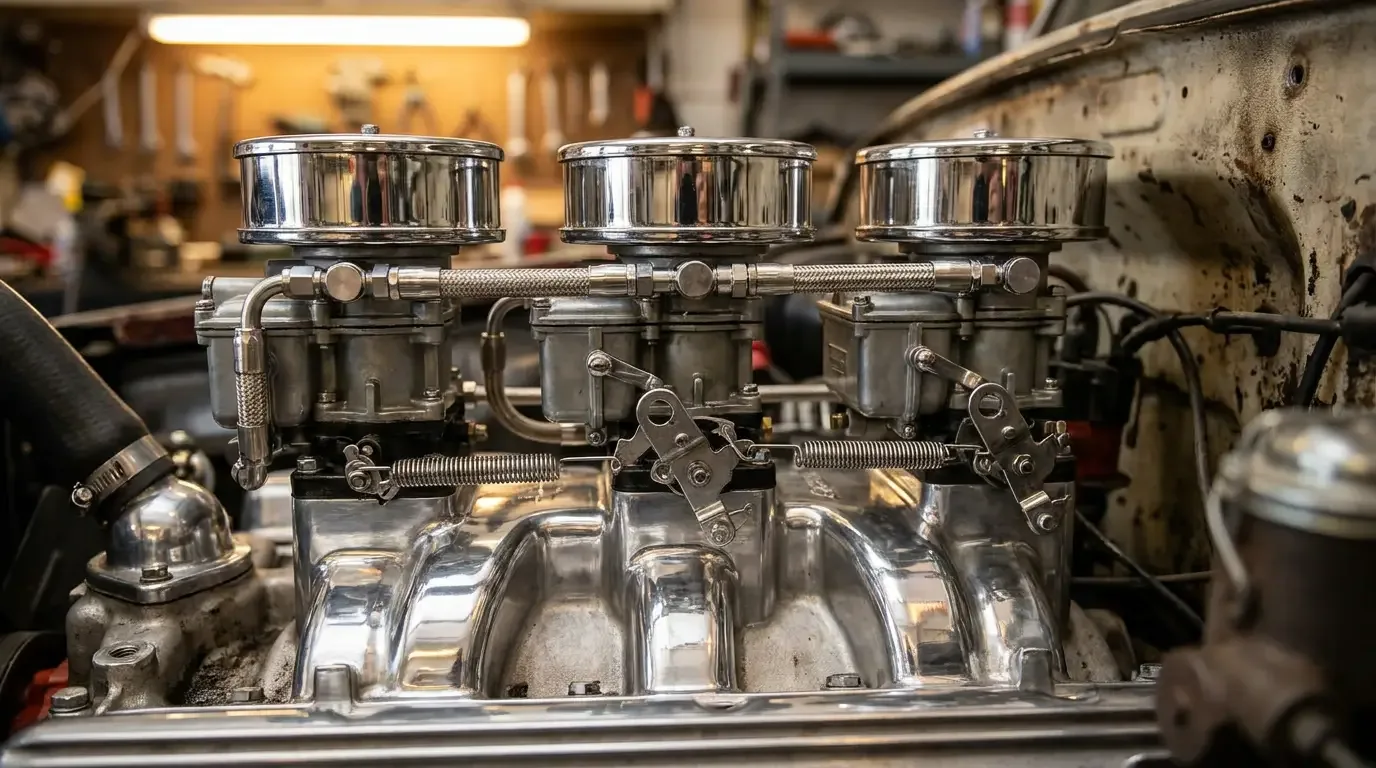
Carburetion was where a lot of guys spent their weekends. A single four-barrel is the honest baseline, but the small-block's manifold options opened the door to more ambitious plumbing. If you want to go down that road, read up on Multi-Carb Setups: Tri-Power and Beyond before you buy an intake, because getting three carbs to idle and transition cleanly is a different job than bolting on one.
"I have pulled dead flatheads out of nice cars and dropped in a junkyard 350, and the owner never looked back. It starts, it stays cool, it makes power, and when something breaks you can fix it with parts from any store in the country. That is the whole appeal. Nothing exotic about it."
Dan Reeves
Doing the swap right
A small-block swap is not hard, but people rush the parts that matter and then chase problems. The engine mounts, the oil pan, and the steering are what bite you. On an early Ford chassis the stock steering box and the small-block's front sump can fight for the same space, so you check pan clearance before you drop the motor the last inch, not after.
Cooling is the other thing. The small-block runs cooler than a flathead, but a chopped rod has almost no room for a radiator. Size the radiator for the engine, not for the hole, and get a shroud on the fan or it will not pull air at idle. Wiring and the fuel system deserve the same care. An old fuel line and a marginal pump will starve a healthy engine at exactly the wrong moment.
The purist pushback
Not everyone cheered. To a certain crowd, dropping a Chevy into a Ford was close to heresy, and the phrase "traditional rod" came to mean a flathead, not a small-block. Some of that is loyalty and some of it is history worth respecting. A flathead in a period '32 sounds right and looks right and keeps a car honest to its era. The small-block swap makes a car easier to live with, but it also makes a lot of cars look the same under the hood.
Both sides have a point. If you are building a period-correct traditional car, the flathead earns its place and the extra work that comes with it. If you want a rod you can drive across the country next week without babying it, the small-block is the answer and has been since 1955. Most builders land somewhere in between, and that is fine. The small-block did not kill the flathead. It just gave everyone a choice the flathead never could.
Sources and notes
- Period hot-rod press and how-to coverage from the 1950s and 1960s.
- Chevrolet engine references for first-generation small-block specifications and production history.
- Speed-shop and aftermarket parts catalogs documenting small-block availability.
- Builder interviews and shop practice on swap fitment, cooling, and carburetion.
Related Reading
Have a
Classic Car
for Sale?
Reach thousands of serious classic car collectors across the US.
Sell It Here →
Are You a Classic Car Dealer?
List your full inventory and connect with targeted classic car buyers.
Join as a Dealer →

About the author
Dan Reeves
Performance engine builder from North Carolina's motorsports corridor, focused on swaps, forced induction and making real, repeatable power.
More in Restoration & Tech
Comments
Be the first to comment on this article.