
One carburetor feeds an engine fine. Two or three feed it with attitude. Multi-carb intake setups are where a hot rod stops looking stock under the hood and starts looking like somebody meant it. The row of chrome air cleaners sitting on a polished manifold says power before the engine ever turns over. Half the time the setup makes real power. The other half it makes a headache. Both are worth understanding before you bolt one on.
Restoration & Tech
8 min read
Multi-Carb Setups: Tri-Power and Beyond
Dual quads and tri-power intakes on hot rods: how the layouts work, the classic manifolds, and why more carburetors means more to tune.
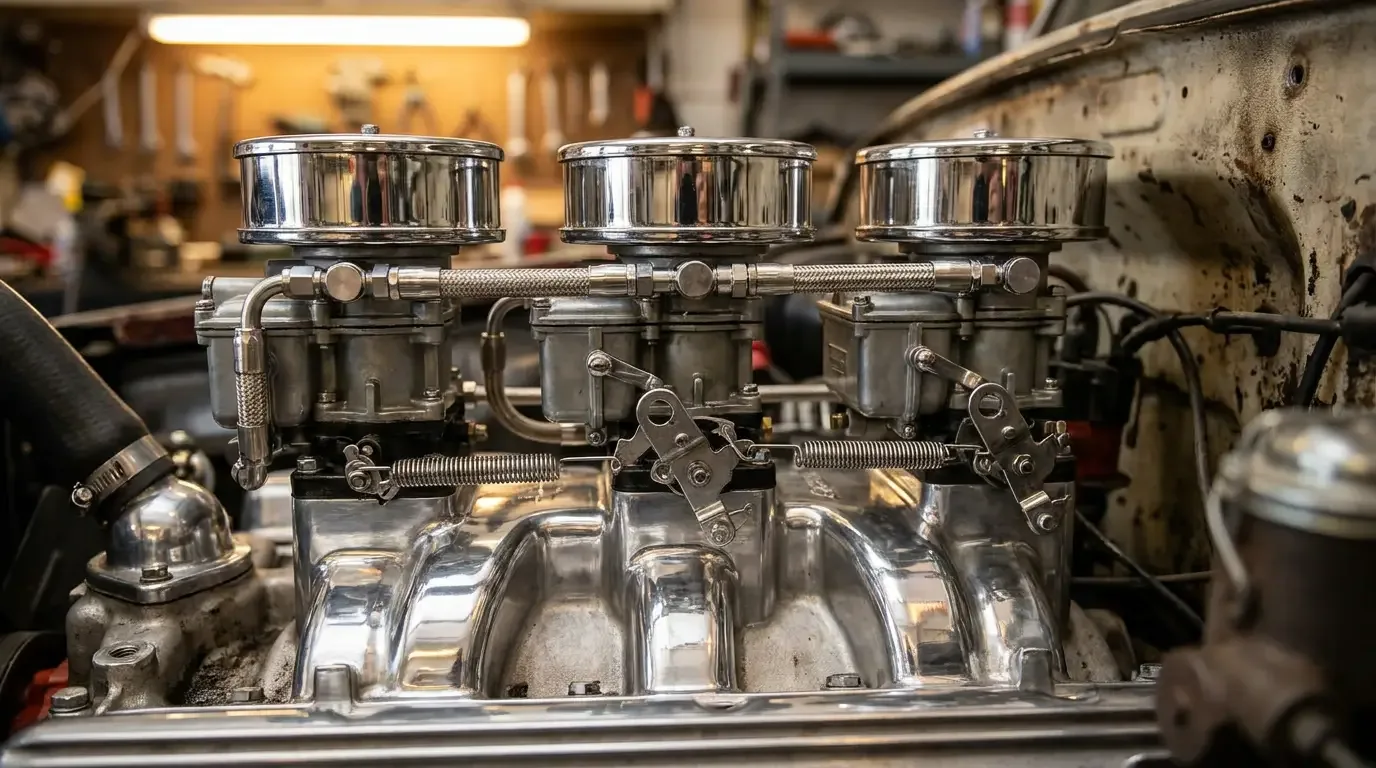
The idea is simple. More carburetor throat area means more air and fuel can get into the cylinders at high rpm, and on the old low-compression engines the factory single two-barrel or small four-barrel was a bottleneck. Guys building on the early Ford flathead V8 figured this out fast, because that engine breathes through the block and needs all the help it can get. Stack more carburetors on top and you feed it. That is the whole reason multi-carb intakes exist. Everything after that is detail, and the detail is where people get in trouble.
Dual quads and tri-power: the two classic layouts
Two setups define the era. Dual-quad means two four-barrel carburetors on one manifold. Tri-power, also written 3x2, means three two-barrel carburetors in a row. Both put a lot of carburetor on top of the engine. They get there different ways and they behave different ways.
Dual quads are the brute. Two four-barrels give you eight barrels total and a huge amount of airflow. Factory muscle used them, the 426 Max Wedge and early Hemi setups ran dual quads, and Chevrolet offered dual-quad small-blocks and big-blocks. On a hot rod a pair of four-barrels on a tall manifold is a statement. The downside is that eight barrels is more carburetor than most street engines can use below wide-open throttle, so part-throttle manners suffer if you do not tune it right.
Tri-power is the clever one. The center carburetor runs the engine at idle and light cruise. The two outboard carburetors, the end units, stay closed until you get into the throttle, then they open through a progressive linkage or a vacuum diaphragm. So around town you are running on one small two-barrel, which sips fuel and idles clean, and when you stand on it all three come alive. That progressive setup is why tri-power was popular on street cars. Pontiac built the Tri-Power name into a legend on the 389 and 421, roughly 1957 through 1966, and Oldsmobile ran its own three-two setup on the J-2. Done right, tri-power gives you docile low-speed behavior and a top-end kick.
Why they look and sound the way they do
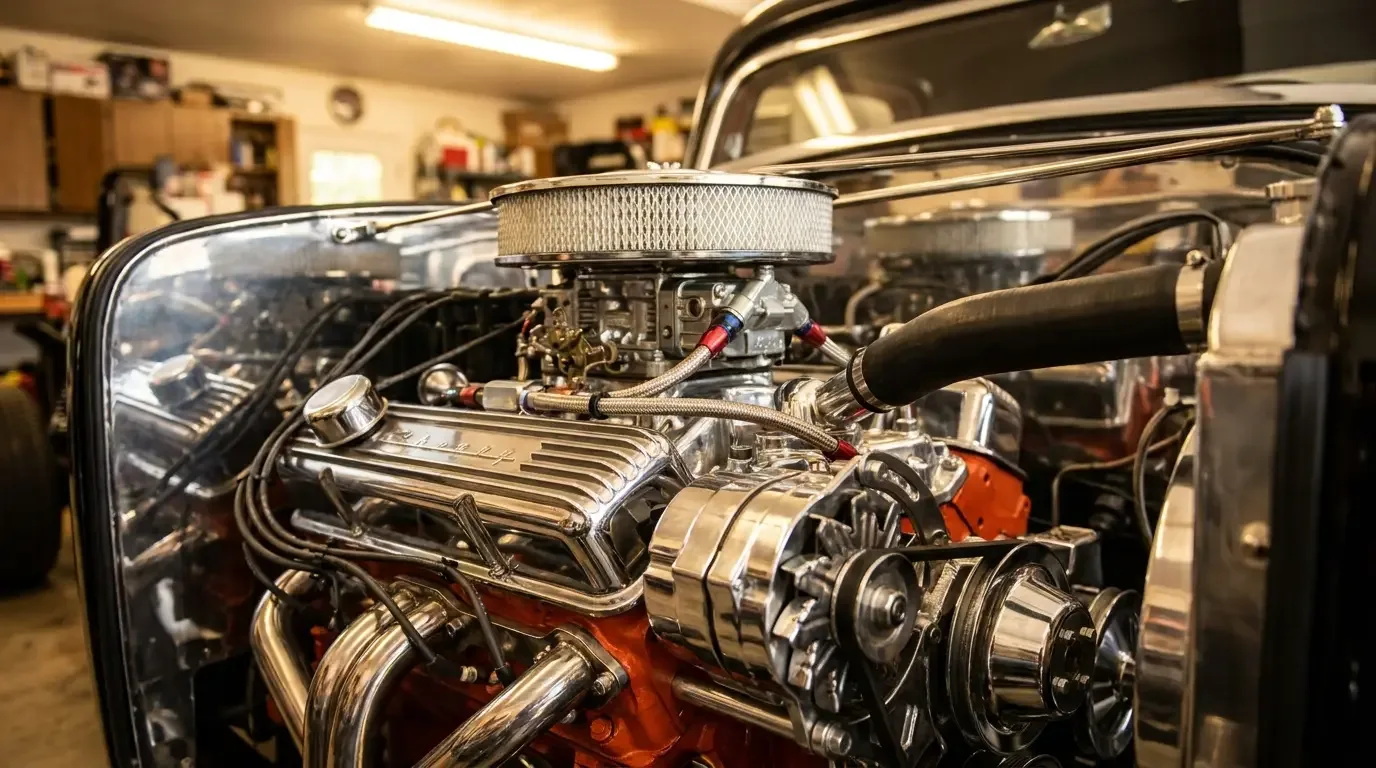
People run multi-carb for two reasons, and one of them is not power. It is the look. A tri-power under an open hood, three chromed air cleaners in a row, is one of the defining images of the hot rod. Dual quads sitting on a finned aluminum manifold do the same job for the visual. It is period-correct in a way that a modern four-barrel or fuel injection never will be, and for a lot of builders that is reason enough.
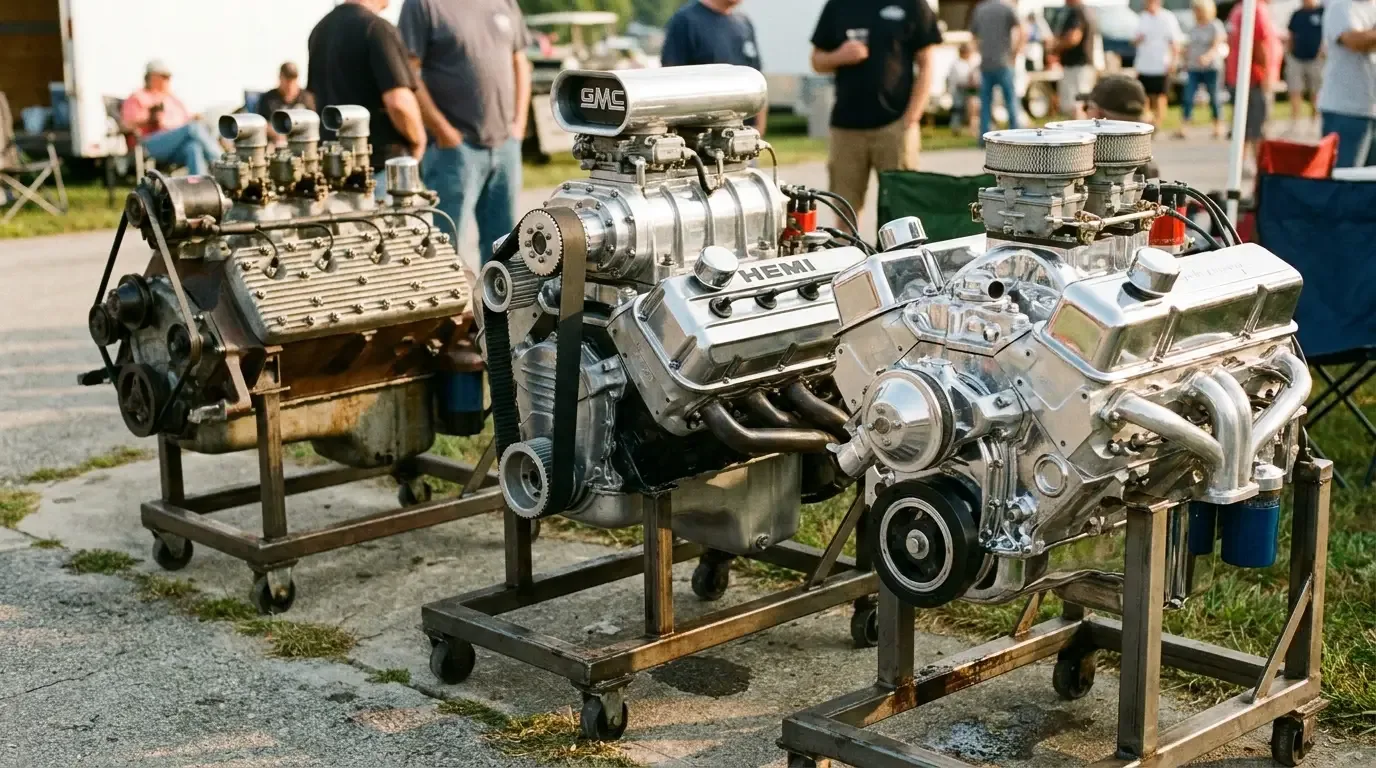
The sound matters too. When those secondary carburetors open, the engine takes a big gulp of air and the induction note changes. You hear the carbs draw. A single four-barrel opening its secondaries does some of this, but a tri-power slamming both end carbs open has a character to it that people chase. This is the traditional side of hot rodding, and it pairs naturally with a hand-built engine like a proper flathead build or an old overhead-valve mill. If you want to see how these intakes fit into the bigger picture of hot rod engine building, start with the flathead v8 and work up from there.
"A tri-power is not a power adder you bolt on and forget. It is three carburetors that have to agree with each other. Get them agreeing and it is the best-running induction on the block. Get them fighting and you will chase a stumble for a month."
Mike Sullivan
Why multi-carb setups are finicky
Here is the part the chrome does not tell you. More carburetors means more of everything that can go wrong. One carburetor has one float level, one set of jets, one idle circuit. A tri-power has three of each, and they all have to be balanced against one another. Get one float a little high and it dribbles fuel. Get the linkage timing wrong and the end carbs come in too early or too late. The complexity is real and it is why a lot of these setups sit crooked and stumbling on cars that look great parked.
The core problems are these:
- Synchronization. On dual quads especially, both carburetors have to open together and pull the same amount of air. Out of sync, one carb does the work and the other just sits there rich or lean. You balance them with a flow meter, not by eye.
- Fuel distribution. A long intake manifold feeding eight cylinders from carbs sitting at the ends will not feed every cylinder the same. The runners nearest a carb throat get more, the ones in the middle get less. This is manifold design, and it is why a good casting matters.
- Linkage and progression. The progressive setup on tri-power is a mechanical dance. Worn linkage, wrong return springs, or a dry vacuum diaphragm and the end carbs behave badly. Vacuum-secondary setups add another failure point.
- Vacuum leaks. Three carburetor bases, three sets of gaskets, more throttle shafts to wear. Every one of those is a place air can sneak in and lean out your idle.
The classic manifolds and how to choose
The intake manifold is the whole game. It decides carburetor spacing, runner length, and how evenly the fuel gets spread. On the flathead, the classic names are Edelbrock, Offenhauser, and Sharp, and their two-carb and three-carb intakes are the reason those engines are still driven. For overhead-valve V8s, Edelbrock and Weiand cast dual-quad and tri-power manifolds through the muscle era, and Offenhauser did tri-power intakes for a lot of engines.
Manifold layout falls into two general camps, and it changes how the engine drives:
| Layout | What it is | Character |
|---|---|---|
| Tri-power (3x2), progressive | Three two-barrels, center runs alone, ends come in on throttle | Streetable, good low-speed manners, strong top-end rush |
| Tri-power, straight (all three linked) | All three open together | More top end, harder to idle and drive slow |
| Dual quad | Two four-barrels, usually run together | Big airflow, big look, needs careful sync to street well |
| 2x2 (dual two-barrel) | Two small two-barrels, common on flatheads | Simple, period-correct, modest gain over single carb |
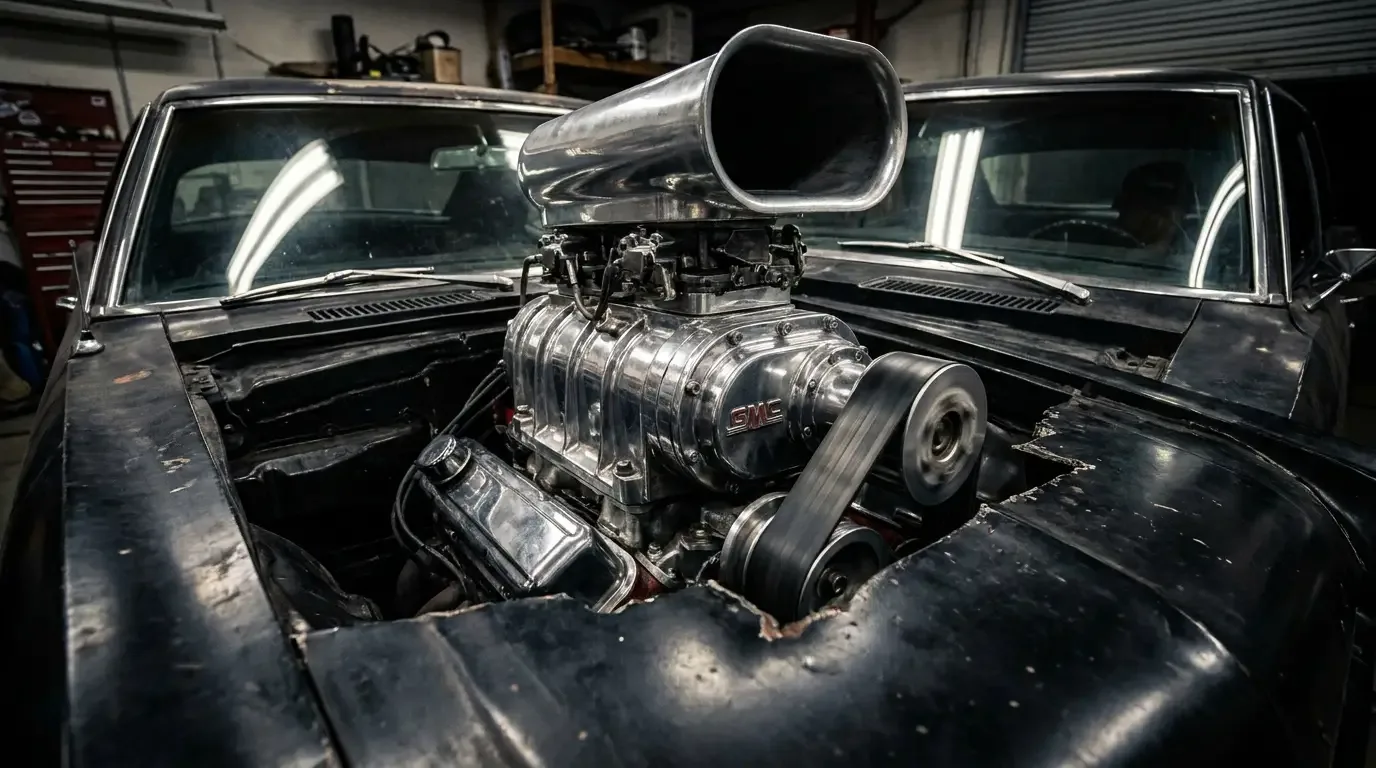
For a street car, the choice is usually a progressive tri-power or a well-matched dual quad, because both can be made to idle and cruise. If you are going for pure show or a strip car, straight linkage and more carburetor make sense. Match the intake to the engine you have. A mild flathead does not want the same induction as a stroked small-block, and hanging too much carburetor on a small engine kills throttle response everywhere but the top. Carburetion is one piece of the induction and exhaust story, and once you have the top end sorted you can push further with forced induction like Superchargers and Blowers on Hot Rods.
None of this is new. Guys have been stacking carburetors on hot rod engines since before the war, and the same manifolds and the same tuning headaches carry straight through the decades of the classic hot rod story. The chrome sells the look. The tuning is what makes it run.
Sources and notes
- Period hot-rod and speed-equipment press covering flathead and overhead-valve induction
- Manufacturer and aftermarket manifold references (Edelbrock, Offenhauser, Weiand, Sharp)
- Factory multi-carburetor option records for period muscle and performance engines
- Builder and engine-shop interviews on multi-carb tuning and synchronization
Related Reading
Have a
Classic Car
for Sale?
Reach thousands of serious classic car collectors across the US.
Sell It Here →
Are You a Classic Car Dealer?
List your full inventory and connect with targeted classic car buyers.
Join as a Dealer →

About the author
Mike Sullivan
Detroit-area muscle car enthusiast and restoration specialist with three decades of hands-on experience working on American iron.
More in Restoration & Tech
Comments
Be the first to comment on this article.