
Make an offer
1969 Chevrolet Camaro · asking $69,995. Your offer goes straight to the seller, who answers you by email.
1969 Chevrolet Camaro
$69,995
Vehicle Details
Chevrolet
Camaro
1969
1,843 miles
124379N579126
Coupe
Manual
Gasoline
1969 CORVETTE 427/425HP
Description
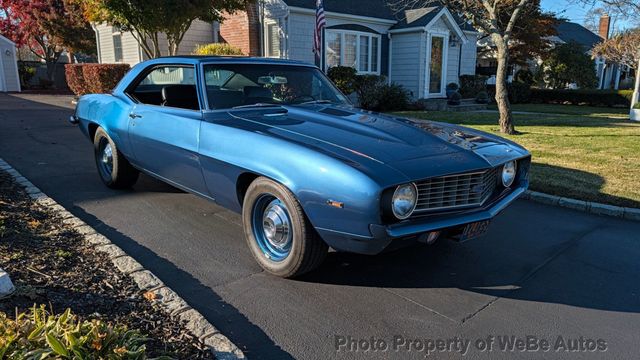
1969 Chevrolet Camaro 427 Big Block For Sale - Factory Dusk Blue - 427/425 HP Big Block - Casting #3963512 - M22 Rock Crusher 4-Speed - 12-Bolt Posi - 3.73 Gears - X11 Style Trim - January 1969 Norwood Build - COPO-Inspired -
Offered for sale is this gorgeous 1969 Chevrolet Camaro, finished in its factory Dusk Blue exterior color with a beautiful black interior and powered by a formidable 427 cubic-inch Chevrolet big-block V8. Combining authentic first-generation Camaro styling with legendary Chevrolet high-performance components, this beautifully presented muscle car captures the unmistakable appearance, sound, and character of Chevrolet's late-1960s performance machines. Owned by its current enthusiast for over 10 years, this Camaro comes with a substantial collection of receipts and supporting documentation accumulated during long-term ownership.
One particularly interesting feature is its original-style Fisher Body identification tag, which identifies this Camaro as a January 1969 Norwood-built Sport Coupe, originally finished in Dusk Blue and equipped with the X11 body trim configuration. Under the steel cowl induction-style hood sits a Chevrolet 427 cubic- inch big-block V8 featuring the desirable 3963512 casting number, commonly referred to as the 512 block. The engine is represented as a four-bolt-main, 425-horsepower Corvette-specification 427.
Backing the engine is a legendary Muncie M22 Rock Crusher four-speed manual transmission, a 12-bolt Positraction rear axle with 3.73 gearing, and vintage Traction Master traction bars. The factory Dusk Blue exterior, body-colored front bumper, steel cowl hood, and steel wheels with dog-dish hubcaps give this Camaro the purposeful, understated appearance associated with Chevrolet's legendary COPO performance cars. With over a decade of current ownership, extensive receipts, factory identification information, and an impressive collection of performance components, this is an exciting opportunity for any first-generation Camaro enthusiast.
Factory Fisher Body Trim Tag - January 1969 Norwood Build An important feature of this Camaro is its Fisher Body trim tag, which provides valuable information about how the vehicle was originally configured. The tag carries the following identification:
ST 69 12437 NOR225133 BDY
TR 715 - 51 PNT
01B - X11 Detailed Factory Trim Tag Decoding ST 69 - 1969 Model Year
The ST designation stands for Style, and the number 69 identifies the vehicle as a 1969 model. The 1969 Camaro represents the final model year of Chevrolet's original first-generation Camaro design.
12437 - Camaro Sport Coupe
The five-digit Fisher Body style number identifies the vehicle as a Chevrolet Camaro two-door Sport Coupe.
The 37 body-style designation confirms the desirable hardtop coupe configuration. NOR - Norwood, Ohio Assembly Plant
The NOR designation identifies the Norwood, Ohio assembly facility. Norwood is particularly significant to first-generation Camaro enthusiasts because it was the assembly plant that used the well-known X-code identification system during the later portion of 1969 Camaro production.
225133 - Fisher Body Identification Number
The six-digit number 225133 represents the Fisher Body order/body identification number.
This number was used during the manufacturing process and is separate from the vehicle's VIN. For the 1969 model year, Fisher Body numbers were generally assigned when vehicle orders were accepted rather than in strict production sequence. TR 715 - Factory Dark Blue Standard Interior
The TR designation identifies the original factory interior trim.
Code 715 indicates that this Camaro was originally configured with a Dark Blue standard bucket-seat interior. The vehicle currently features a black interior, which provides a striking contrast with its Dusk Blue exterior.
51 PNT - Factory Dusk Blue Exterior
The PNT designation identifies the vehicle's original exterior paint. Code 51 confirms Dusk Blue, one of Chevrolet's attractive metallic colors offered during the 1969 model year.
The surviving tag photograph clearly displays the 51 paint code, confirming Dusk Blue as the original lower-body color. This factory identification adds to the appeal of the vehicle's current Dusk Blue presentation.
01B - Second Week of January 1969
The 01B production code identifies the body-build scheduling period: 01 - January B - Second week of the month This indicates that Fisher Body began the body assembly process during the second week of January 1969. X11 - Style Trim Group Identification
Perhaps the most interesting identification code on this Camaro is its factory X11 designation.
During the 1969 model year, Norwood began stamping X-codes on Fisher Body tags to help assembly workers identify exterior trim and body configuration requirements. The X11 designation identifies a body built with the Z21 Style Trim Group or the related Z22 Rally Sport trim configuration. It was used on several different Camaro configurations, including standard V8 cars, certain SS350 models, and some special-order high-performance applications.
However, it is an interesting piece of factory identification, especially on a car equipped today with a powerful 427 big-block and COPO-inspired exterior styling. The combination of the January 1969 body-build date, original Dusk Blue paint designation, Norwood assembly identification, and factory X11 code adds historical interest to this impressive first-generation Camaro. 427 Big-Block V8 - Desirable 3963512 Casting Under the steel cowl induction hood sits a powerful Chevrolet 427 cubic-inch big-block V8 built around the desirable 3963512 engine block casting. Commonly referred to as the 512 block, this casting was used in several Chevrolet big-block applications, including high-performance 1969 427 engines and later 454 applications.
The casting is especially interesting to muscle car enthusiasts because of its association with Chevrolet's legendary 427 performance program. 3963512 Casting Number High-Performance Heritage: Associated with Chevrolet 427 performance applications, including 425 HP configurations The engine installed in this Camaro is represented as a four-bolt-main 427 with a 425- horsepower 1969 Corvette-specification configuration. Its precise displacement, main-cap configuration, and present horsepower output have not been independently verified. The block also carries a Chevrolet CE service-replacement designation, identifying it as a replacement engine rather than the Camaro's verified original factory-installed engine.
Engine & Performance Equipment Chevrolet 427ci big-block V8, as represented 3963512 engine block casting Reported four-bolt-main configuration 425-horsepower Corvette-specification configuration, as represented CE-designated Chevrolet service-replacement block Holley 780 CFM carburetor L63 intake manifold, per equipment notes Correct-style 1969 big-block valve covers Original GM high-performance deep-groove pulleys Hooker performance headers MSD electronic ignition system GM 772 cooling fan Factory-style fan shroud High-performance mechanical fuel pump Three-inch dual exhaust system Flowmaster mufflers The engine compartment has a traditional Chevrolet performance appearance, with period- inspired components and carefully selected upgrades. During the accompanying driving demonstration, the engine starts readily, settles into a strong idle, and produces the unmistakable exhaust note associated with Chevrolet's legendary big-block V8. The owner reports that the Holley carburetor is properly adjusted and that the engine delivers strong, responsive performance.
Legendary M22 Rock Crusher Four-Speed & 3.73 Posi Backing the powerful big-block is a desirable Muncie M22 Rock Crusher four-speed manual transmission, one of the most recognizable performance transmissions of the original muscle car era. Known for its heavy-duty design and distinctive mechanical whine, the M22 is a natural companion to Chevrolet's high-performance big-block engines. Drivetrain equipment includes: Muncie M22 Rock Crusher four-speed manual transmission with a new centerforce clutch Rebuilt factory Hurst shifter with OEM light weight 4 oz Ball Chevrolet 12-bolt rear axle 3.73 rear axle gearing Positraction differential, as represented Vintage Traction Master traction bars The rebuilt Hurst shifter provides a traditional mechanical driving experience, while the 3.73 rear gearing complements the big-block's substantial torque.
The vintage Traction Master traction bars add another period-performance detail to this impressive build. During the driving demonstration, the transmission reportedly operated smoothly and produced the characteristic M22 gear whine that enthusiasts appreciate. Factory Dusk Blue Exterior - Classic COPO-Inspired Styling One of the most striking features of this Camaro is its beautiful Dusk Blue exterior, a color confirmed by the factory 51 paint code on its Fisher Body trim tag.
The rich metallic blue complements the Camaro's timeless body lines and looks especially attractive with its understated performance-oriented exterior. Exterior features include: Factory Dusk Blue exterior color Steel cowl induction-style hood Body-colored Endura-style front bumper Classic steel wheels Dog-dish hubcaps New BFGoodrich tires Original-style exterior fender emblems removed and included Factory-style side marker lights Original-style taillights Traditional chrome and stainless trim Three-inch exhaust with rear turn-down outlets The combination of Dusk Blue paint, steel cowl hood, body-colored front bumper, and dog-dish wheels gives this Camaro an unmistakable COPO-inspired appearance. The body is described as straight and attractive, and numerous exterior components are believed to be original to the vehicle.
Rather than relying on excessive modifications, this Camaro achieves its aggressive muscle car appearance through carefully selected traditional Chevrolet performance styling. Black Interior - Rally Gauges, Center Console & Hurst Shifter The interior features attractive black upholstery and retains the straightforward, driver- focused character of the first-generation Camaro. Although the factory trim tag identifies an original Dark Blue standard interior, the vehicle is currently finished in black.
Interior features include: Black interior upholstery Factory-style center console Original-style dashboard Rally gauge package Rebuilt factory-style Hurst shifter Original-style AM/FM radio with blue indicator light Functional low-fuel warning light Functional warning buzzer Factory-style interior trim The original-style AM/FM radio preserves the vintage dashboard appearance, while the center console, Rally gauges, and Hurst four-speed shifter create an authentic late-1960s Chevrolet performance atmosphere. During the walkaround demonstration, the owner showed several functioning electrical features, including the warning buzzer and low-fuel indicator. Four-Wheel Disc Brakes, Power Steering & Upgraded Suspension While retaining its traditional muscle car appearance, this Camaro has received several mechanical upgrades intended to improve braking, steering, and handling.
Chassis and suspension equipment includes: Four-wheel disc brakes Power-assisted braking system Power steering Tubular front control arms Vintage Traction Master traction bars Chevrolet 12-bolt rear axle 3.73 rear gearing New BFGoodrich tires The upgraded four-wheel disc braking system provides improved stopping capability compared with the original factory drum brake arrangement. Power steering adds convenience, while tubular front control arms provide an upgraded suspension configuration. These improvements help make this classic Camaro more enjoyable to drive without sacrificing its traditional performance character.
Long-Term Ownership - Over 10 Years & Extensive Receipts An especially appealing feature of this Camaro is its established ownership history. The current owner has owned the vehicle for over 10 years, providing a long period of ownership and familiarity with the car. Accompanying the vehicle is a substantial collection of receipts and paperwork accumulated during ownership.
This documentation is an important feature for enthusiasts who appreciate classic muscle cars with supporting records of their maintenance and mechanical improvements. Ownership and documentation highlights include: Over 10 years with the current owner Extensive collection of receipts and paperwork Maintenance and mechanical records Documentation relating to performance components Factory Fisher Body trim tag Factory paint and trim identification Engine casting and identification information Vehicle identification number The accumulated documentation provides valuable background information and contributes to the overall appeal of this classic Camaro. Vehicle Identification & Authenticity The vehicle carries VIN 124379N579126, identifying it as a genuine 1969 Chevrolet Camaro V8 Sport Coupe assembled in Norwood, Ohio.
The VIN and Fisher Body tag provide the following identification information: Model Year: 1969 Manufacturer: Chevrolet Model: Camaro V8 Sport Coupe VIN: 124379N579126 Assembly Plant: Norwood, Ohio Fisher Body Number: 225133 Body-Build Date: Second Week of January 1969 Original Exterior Paint: Dusk Blue, Code 51 Original Interior Trim: Dark Blue Standard, Code 715 Fisher Body Trim Designation: X11 Current Interior Color: Black Installed Engine: 427ci Chevrolet Big Block, as represented Engine Casting: 3963512 Engine Designation: CE Service Replacement Transmission: Muncie M22 Four-Speed, as represented Rear Axle: Chevrolet 12-Bolt with 3.73 Positraction, as represented The installed 427 is not being represented as the vehicle's original factory-installed engine. Likewise, although this Camaro features numerous desirable COPO- inspired components and styling details, it is not being represented as an authenticated factory COPO Camaro. The combination of factory identification, long-term ownership, and extensive paperwork provides
Classic Chevrolet Camaro Buyer's Guide
Chevrolet Camaro Market Overview
Based on 248 Chevrolet Camaro listings currently on ClassicCarsArena.com
Selling a classic? Here's how
Fees, audience and photo limits compared: where to sell your classic car online .
Classic Chevrolet Camaro Buyer's Guide
The Chevrolet Camaro launched in September 1966 as Chevy's direct response to the Ford Mustang, and for over five decades it has defined American performance for an entire generation of enthusiasts. Whether you're hunting a numbers-matching first-generation Z/28, a survivor split-bumper second-gen, or a clean third-gen IROC-Z, the Camaro buyer's market is deep, varied, and full of pitfalls for the unprepared.
What to Check Before Buying
Common Issues
What to Look For
Price Guide
Did You Know?
Also Consider
Similar classic cars shoppers also browse:
How Does It Compare?
Head-to-head matchups for the Chevrolet Camaro:
1969 Chevrolet Camaro
Contact Seller

Car alert
Get an email when a 1964-1974 Chevrolet Camaro is listed
At most one email a day. Stop anytime with one click.
Nationwide consignment dealer
WeBe Autos lists vehicles from sellers across multiple states. The vehicle may not be at the dealer's address shown. Contact the dealer to confirm the vehicle's actual location before traveling.
Buying safely?
Read our scam-avoidance tips before paying →
Listing Actions
Browse by Era
1960s Classics for SaleAll 1969 Classics
Browse all 1969 Cars for SaleModel History
How the Chevrolet Camaro evolved (1967–2002) across 4 generations.
📈 View Full EvolutionGet classic car alerts
Latest arrivals, newest deals, and discount coupons, straight to your inbox.
Selling your classic car?
Reach millions of classic car enthusiasts on the largest US classics marketplace.
Sell Your Car →More from WeBe Autos

 United States
1966 Chevrolet Corvette
 United States
1962 Chevrolet Impala
 United States
1954 Mercury Monterey
 United States
1992 Cadillac Fleetwood
Similar Listings


 United States
1968 Chevrolet Camaro


Contact Seller
Call this seller?
You're about to call WeBe Autos about the 1969 Chevrolet Camaro.
+1 (631) 339-0399
Car alert
Get an email when a 1964-1974 Chevrolet Camaro is listed
At most one email a day. Stop anytime with one click.
Report this Ad
Help us keep the marketplace clean. Our moderation team reviews every report within 24 hours.