
Collectors use the term "blackout car" loosely, but the factory record behind it is fairly specific. In the last weeks before the February 1942 production freeze, several manufacturers ran short of chrome-plated trim as the material was redirected to the war effort. Rather than halt the line entirely while waiting on chrome that was not coming, some plants substituted painted steel trim, matte or gloss finish depending on the piece, and kept building cars until the freeze order arrived.
Car Features
6 min read
The 1942 Blackout Cars Explained
As chrome supplies ran out ahead of the 1942 production freeze, some factories substituted painted trim. Here is what blackout cars actually are and how to authenticate one.
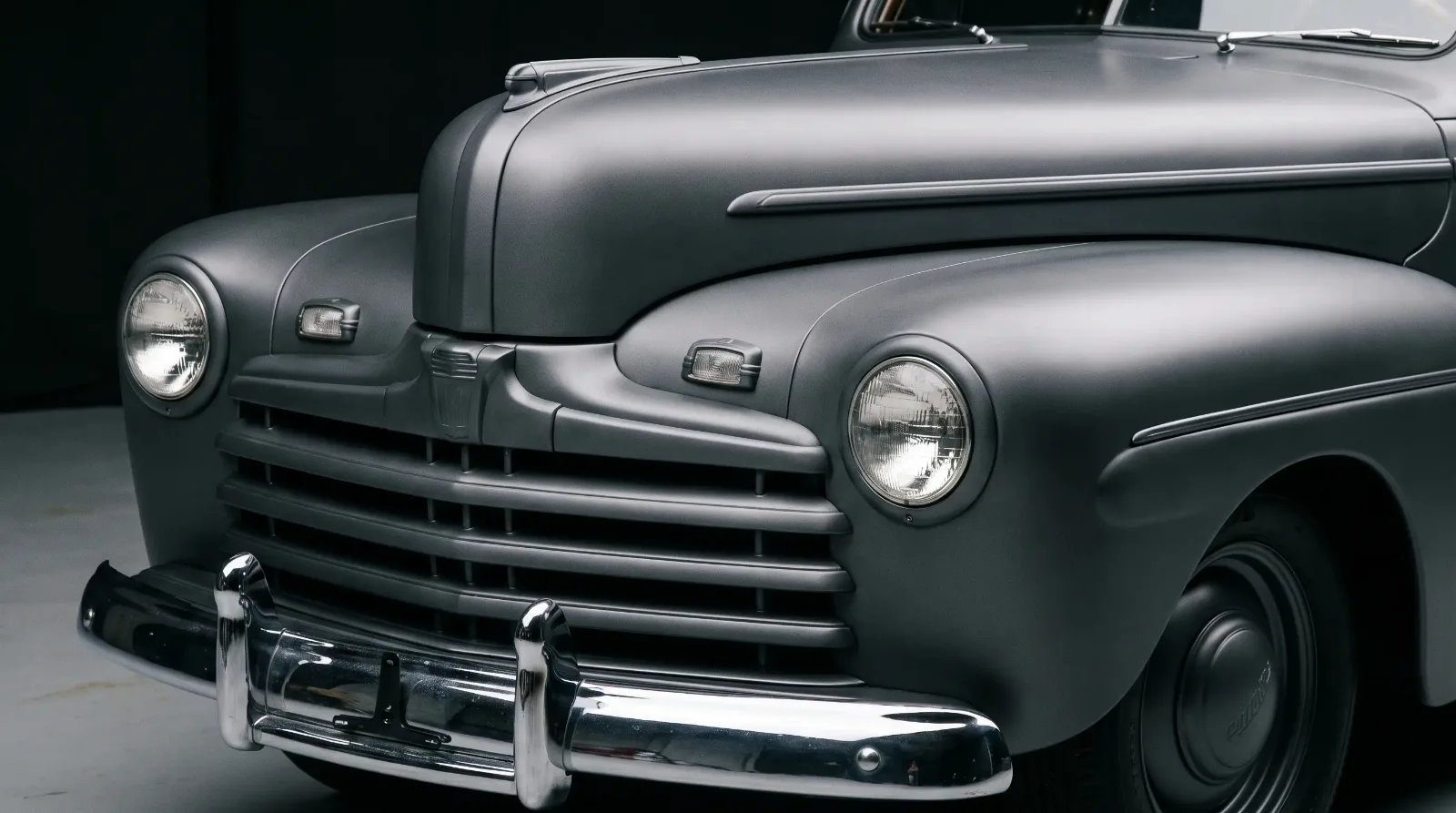
That substitution is the entire technical basis of the blackout designation. It was not a styling decision or a special trim package ordered by a customer. It was a materials workaround, applied car by car as inventories of plated parts ran out, and it produced a small, genuinely distinctive subset of 1942 production.
What actually changed on a blackout car
The most visible substitution was on grille bars, headlight rims, and hubcaps, pieces normally chrome-plated that instead left the factory painted body color or, in some cases, a flat gunmetal gray. Door and trunk handles, window moldings, and other brightwork followed the same pattern. Bumpers were the one notable exception, since chrome plating on bumpers remained permitted even as the rest of a car's trim went to paint. Interior trim pieces sometimes followed the general pattern too, with painted metal replacing bright work on dashboards and window surrounds.
Because the substitution happened as supplies ran out rather than as a planned running change, blackout treatment was not applied uniformly across a model line or even across a single plant's output. Some late-production cars show full blackout trim throughout. Others show a mix, chrome in places where existing stock lasted, paint where it did not. That inconsistency is actually a useful authentication signal; a car with a suspiciously uniform, catalog-perfect blackout treatment is worth a closer look, since the real thing tends to show the improvised, patchwork character of a factory working through its remaining parts bins.
Some manufacturers went further than trim, using stamped steel in place of die-cast pot metal for smaller ornaments, or simplifying badge designs to reduce the amount of plated surface needed altogether. These smaller substitutions rarely show up in period advertising, which continued to depict standard chrome trim well after actual production had moved on, so photographs from the time are a poor guide to what any specific late-production car actually left the factory wearing.
Which makes are documented
Chevrolet, Pontiac, and several other GM divisions are among the makes with the best-documented blackout production, partly because GM's late-1942 output was large enough that a meaningful number of cars survive. Ford and the independents also built cars with painted trim in this window, though documentation varies by manufacturer and, frankly, by how well individual company archives survived the following decades.
Regional differences complicate the picture further. A plant on the East Coast might have exhausted its chrome stock weeks before a sister plant in the Midwest, simply because of how supply shipments happened to be scheduled that winter. Two otherwise identical cars, same model, same week of the calendar, could leave different factories wearing different trim, which is one more reason collectors researching a specific vehicle need to know which plant actually built it, not just the model year on the title.
Because blackout cars represent such a narrow production window, weeks rather than months, they were never a large percentage of any manufacturer's 1942 output. That scarcity is part of what makes them interesting to collectors today, though it also means claims of blackout status deserve the same scrutiny applied to any narrow production claim: a build date within the right window, ideally supported by factory records or period documentation, rather than trim finish alone.
Verifying a genuine blackout car
Trim finish by itself is not sufficient proof, since paint deteriorates and get refinished over eight decades, and a repainted chrome piece can look superficially similar to an original painted one if the work was not done carefully. The stronger approach combines trim evidence with a documented build date late enough in the production run to fall within the materials shortage window, ideally cross-referenced against whatever factory shipping or dealer records survive for that plant.
Collectors researching a specific car should also look at hardware details, screws, clips, and fasteners, since substitution sometimes extended beyond the obviously visible trim pieces. A car that is blackout-correct in the small details as well as the large ones tends to be a more convincing example than one where only the showpiece chrome has been addressed.
Dealer network records, where they survive, can also help. A dealership that took delivery of a shipment in the final weeks before the freeze would sometimes note the unusual trim in its own paperwork, since customers occasionally asked questions about why their new car looked different from the brochure. Those small, incidental mentions in surviving dealer correspondence are sometimes the clearest surviving proof of a specific car's production timing.
| Feature | Standard 1942 trim | Blackout trim |
|---|---|---|
| Bumpers | Chrome-plated | Chrome-plated (exempted) |
| Grille bars | Chrome-plated | Painted, sometimes body color |
| Hubcaps | Chrome-plated | Painted steel |
| Interior bright work | Chrome or bright metal | Painted metal, varies by unit |
For a closer look at what preceded these cars on the line and how the shortage developed, a related read covers the broader final production run leading into the freeze.
Why collectors seek them out
Blackout cars sit at an interesting intersection of ordinary and rare. Mechanically, most are unremarkable 1942 models, the same engines and chassis found across the model year. What sets them apart is entirely a story about timing and materials, which is exactly the kind of narrow, documentable detail that appeals to collectors focused on production history rather than performance or styling.
"A blackout car is a snapshot of a factory running out of one thing while trying to keep building anyway. The painted trim is not a flaw or a downgrade. It is a record of exactly what was happening on that line the week the war caught up with it."
Tom Ramirez
Anyone chasing a documented blackout example should expect the research to take longer than the search for the car itself. The vehicles exist in modest numbers, but the paperwork that proves a car's specific place in that narrow window is scarcer still, which is exactly what makes a well-documented example worth having, a story that connects directly to the blackout models 1942 guide for readers wanting the fuller production picture.
Sources and notes
- Mac's Motor City Garage - Gearing for war: the Motor City's 1942 blackout cars
- The Wayback Times - Blackout cars
- Barn Finds - Rare wartime blackout car: 1942 Studebaker Champion
- MotorCities: The 1942 Studebakers - last models before WWII
- The Truth About Cars - Ike's 1942 Cadillac staff car and blackout civilian Studebaker
Related Reading
Have a
Classic Car
for Sale?
Reach thousands of serious classic car collectors across the US.
Sell It Here →
Are You a Classic Car Dealer?
List your full inventory and connect with targeted classic car buyers.
Join as a Dealer →
#pre-war classics
#blackout models 1942
#wartime trim
#1942 production
#classic car authentication
#wwii era cars

About the author
Tom Ramirez
Corvette researcher and historian based in Bowling Green, Kentucky. Two decades documenting Corvette production history from original factory records.




Comments
Be the first to comment on this article.